WASP planet on BBC2’s Horizon: Secrets of the Solar System

BBC2’s flagship science programme, Horizon, dedicated yesterday’s episode to Secrets of the Solar System. The programme explained how the discovery and understanding of exoplanets had led directly to improvements in our understanding of our own Solar System.

Whereas traditionally our Solar System has been regarded as a static array of planets, which formed early after our star’s birth, about 4 billion years ago, and which since then have merely cycled through their orbits, we now understand that planets can radically change their orbits by interacting with each other and with the proto-planetary disk from which they formed.

BBC Horizon: Secrets of the Solar System

A major part of this picture has been developed through understanding “hot Jupiters”, a class of planets which is now dominated by WASP discoveries. In particular the finding of hot Jupiters in retrograde orbits around their star was based largely on WASP planets, starting with WASP-17b.

Yesterday’s programme, on prime-time BBC television, featured a 20-minute discussion of hot Jupiters which was anchored around an observation of WASP-84b using the Telescopio Nazionale Galileo on La Palma.

Telescopio Nazionale Galileo

Telescopio Nazionale Galileo

WASP-84b is a WASP-South planet that was announced in a 2014 paper led by Keele University postdoc David Anderson. The finding of an aligned orbit for this planet, announced in a 2015 follow-up paper which was also led by Anderson, is evidence that this particular hot Jupiter migrated inwards by interaction with the proto-planetary disk, and not by a close encounter with another large planet.

Thus the BBC’s Horizon showed how WASP discoveries are having a direct impact on our understanding of our Solar System, and thus of the origin of our own Earth. The audience for the programme was 2.03 million in the UK, and Horizon programmes are re-broadcast worldwide.

Planet detection history in 60 seconds

Hugh Osborn, a PhD student on the WASP project at Warwick University, has produced a graphic illustrating the “gold rush” of exoplanet detection in recent times.

The animation shows the planet masses and orbital periods against year of discovery.

Exoplanet gold rush

The symbols are colour-coded according to detection method. The WASP project is responsible for a large fraction of the transiting (green symbol) “hot Jupiters” — massive, short-period planets at upper-left. Kepler has found most of the other transiting exoplanets. For more explanation see Hugh’s blog.

The proposed Twinkle mission to study exoplanet atmospheres

With over a hundred gas-giant exoplanets now known transiting relatively bright stars, thanks to WASP and other projects, scientific attention is being directed to characterising their atmospheres.

The proposed Twinkle spacecraft (Twinkle/Surrey Satellite Technology Ltd)

The proposed Twinkle spacecraft (Twinkle/Surrey Satellite Technology Ltd)

Twinkle is a new proposed satellite, led by a team from University College London, that would be dedicated to studying exoplanet atmospheres. The aim is for a relatively cheap and quick mission, but with a high scientific return.

Twinkle aims to analyse the atmospheres of 100 exoplanets using an infrared spectrograph. By comparing the spectra observed in and out of transit, and spacecraft will detect signatures of molecules in the transiting planet atmospheres.

The project needs £50 million to succeed. WASP planets would be prime targets for Twinkle, and so we hope that Twinkle gets funded and wish it every success.

The Twinkle team invite expressions of support at the Twinkle website.

Giant ring system around a WASP exoplanet?

In April 2007 WASP-South saw a star undergo a complex series of deep dips in its light. One interpretation is that the star was being occulted by a complex ring system surrounding a planet orbiting that star.

A paper to be published in the Astrophysical Journal, by Matthew Kenworthy and Eric Mamajek, argues that the ring system would have to be 200 times bigger than Saturn’s rings, and is divided up into 37 different rings, perhaps sculpted by the presence of exo-moons orbiting the planet. If true, this is the first strong evidence for both ring systems and moons outside our own Solar System, and would be a notable first for the WASP project.

A press release by the team from the Leiden Observatory and the University of Rochester has been picked up by the BBC and several dozen other websites such as Science News. Accompanying the press release are artist’s illustrations of the ring system (above) and an impression of how the ringed planet might look to us if it were in our own Solar System in place of Saturn.

waspobj_rings2

RAS Gold Medal for Professor Michel Mayor

The Royal Astronomical Society has announced the award of a Gold Medal to Professor Michel Mayor of the University of Geneva. Prof. Mayor was, of course, the co-discoverer of the first extrasolar planet around a solar-like star, with the detection of 51 Pegasi b back in 1995. His Observatoire de Genève group developed a succession of planet-finding spectrographs that have led the way to the discovery of many hundreds of extrasolar planets.

Michel Mayor

Prof. Mayor has been an important collaborator for the WASP project, through the CORALIE spectrograph on the 1.2-m Swiss/Euler telescope at La Silla. The CORALIE spectrograph observes all WASP-South planet candidates, and the detection of the radial-velocity signature of a planet — in about 1 in 8 such candidates — is the crucial step that confirms a new planet discovery. Thus Prof. Mayor was a co-author on many of the early WASP planet papers until his retirement.

The WASP project is hugely indebted to Prof. Mayor and is honoured to have collaborated with him on WASP planet discovery. We congratulate him on the well-deserved award of the RAS Gold Medal.

WASP: an end-of-2014 round up

WASP planets, papers and citation by year

2014 saw 18 new WASP planets published, our most productive year yet. As the green histogram shows, our success at planet finding continues to increase as we accumulate more and more data.

While Kepler exceeds us in terms of sheer numbers, and in finding small planets, it is important to realise that our planets are usually around much brighter stars, and so are often much better targets for ongoing studies.

Refereed papers related to WASP (either about WASP planets or using WASP data) are also climbing strongly, with 75 new refereed papers in 2014 (blue histogram; and see the listing here). Of course most of these are now by third parties, rather than by the WASP consortium itself, which shows the strong and increasing interest in WASP science from groups worldwide.

2014 was also the best ever year for citations regarding WASP science. There were over 2000 citations in the refereed literature in 2014 to papers that mention WASP either in the paper title or in the abstract. The cumulative number of such citations, shown as the lighter red line, is now over 7600. The darker-red line is the same, but for citations only to papers mentioning WASP in the title (which many papers about WASP do not).

Thus the WASP program is healthy and productive, and we expect that it will continue to dominate the discovery of transiting exoplanets around relatively bright stars until the launch of NASA’s TESS mission in late 2017.

WASP and Kepler K2

WASP-85 is a binary star, with the hot Jupiter WASP-85Ab orbiting the brighter star of the pair. It was in the Campaign 1 field of the revamped Kepler K2 mission, and thus we have the first extensive Kepler-quality lightcurve of a WASP planetary system.

K2 light curve of WASP-85

The WASP discovery paper by David Brown et al presents an initial look at the long-cadence K2 data. The upper plot shows the entire light curve, with obvious variability of the star (presumably because it is magnetically active) and narrow dips caused by the transits. The lower plot shows the data folded on the transit.

K2 light curve of WASP-85 transit

The higher-time-resolution “short cadence” data will be available soon, and should allow a high-quality analysis of this system. The WASP planets WASP-47b and WASP-75b are being observed in the current K2 Campaign 3, which should lead to more space-quality light curves of WASP systems.

In other news, WASP played a minor role in the discovery of the first K2 planet, a super-Earth-sized planet orbiting the bright K-dwarf star HIP 116454. There is extensive WASP data on this star, and while the transits (only 0.1% deep) are too shallow to see in WASP data, the WASP data contribute by showing a possible 16-day rotation period of the host star. The discovery paper by Andrew Vanderburg et al featured in a NASA press release.

Scattering in the atmosphere of WASP-6b

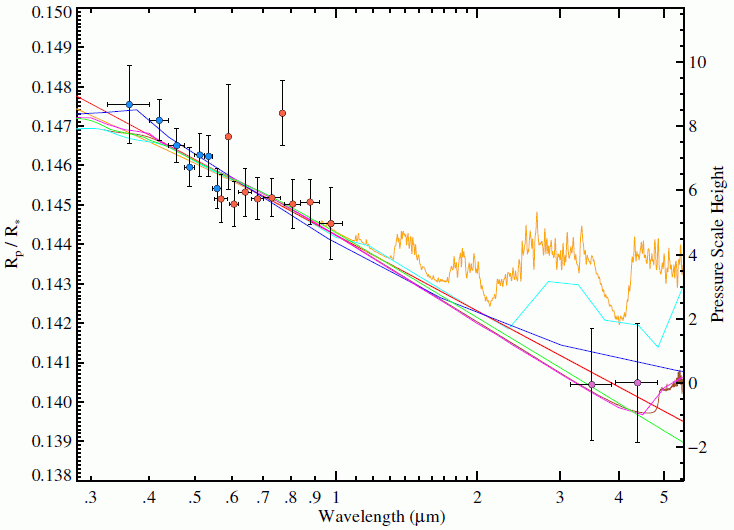
WASP-6b was WASP-South’s third planet, announced in 2009 by Gillon et al. It is a good target for studying exoplanet atmospheres since it is a bloated planet, only half a Jupiter mass but 20% larger than Jupiter.

Nikolov et al (2014) have now pointed the Hubble Space Telescope at WASP-6b in transit, using the STIS spectrograph. They find that the transit depth varies with colour; effectively the planet looks slightly larger in blue light, since small particles in the planet’s atmosphere are scattering blue light more than red light.

wasp6_rayleigh

The strong blue slope in the plot is characteristic of Rayleigh scattering, the same effect that causes Earth’s atmosphere to look blue (in the plot the red line is a Rayleigh-scattering model, though other model fits are possible).

Nikolov etal state that: “With a broad-coverage optical transmission spectrum measured from HST and Spitzer broad-band transit spectrophotometry, WASP-6b joins the small but highly valuable family of hot-Jupiter exoplanets with atmospheric constraints.”

The field of exoplanet atmospheres is growing rapidly in importance, and it is good to see WASP planets being chosen as prime targets for such work.

The atmosphere of hot-Jupiter exoplanet WASP-31b

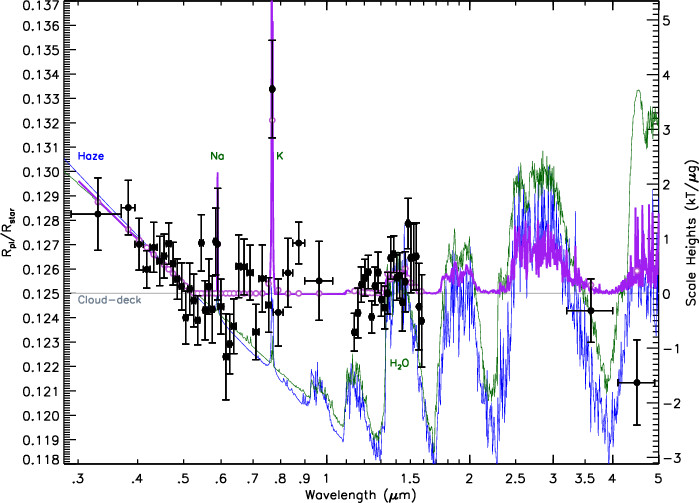
Characterising the atmospheres of exoplanets is a rapidly growing field that is set to increase in importance even more with the forthcoming launch of JWST. WASP planets are prime targets for such work since they transit relatively bright stars. Comparing spectra in and out of transit then gives a transmission spectrum of the planet’s atmosphere.

A new study by David Sing et al presents a state-of-the-art analysis of WASP-31b’s atmosphere using the STIS instrument on the Hubble Space Telescope.

w31_atmos

Notable features include the presence of potassium absorption (the peak labelled K) and the fact that this is stronger than sodium (Na) absorption. The absence of many of the broad features in the plotted models implies a “cloud deck” that results in few spectral features. Also seen is a “Rayleigh scattering” slope implying small atmospheric particles floating above the cloud layer.

WASP-31b is a planet of 0.5 Jupiter masses that is bloated up to 1.5 Jupiter radii. This gives it a large atmospheric scale height that makes it a good target for transmission spectroscopy, since the fluffier atmosphere covers a larger fraction of the star during transit.

WASP-31b was discovered in 2010 by the WASP-South team led by David Anderson.

2014: A bumper year for WASP planets

2014 is proving to be the WASP project’s most successful year yet for the publication of transiting exoplanets. With two months to go before the end of the year, there are already 17 new planets published in 2014 in refereed journals. 12 more planets have been announced on the arXiv preprint server, though many of those will likely appear with a 2015 publication date.

We are currently finding transiting exoplanets at a rate of about 30 a year (WASP-117 is the highest number published, though we have currently got as far as WASP-134). This results from improvements in data quality owing to adding multiple years of observation. Further, the combination of WASP-South with the TRAPPIST photometer and the Euler/CORALIE spectrograph is proving to be a highly effective team. The process involves a lot of telescope time and hard work — only 1 in 10 of candidates followed up proves to be a planet — but the reward is the strong worldwide interest in studying WASP planets.