Category Archives: Hot Jupiters

Long-lasting starspots on exoplanet-host Qatar-2

Planets transiting their star can cross a starspot, and that — since the spot is dimmer than its surrounding — causes an upward blip in the light-curve of the transit. The same starspot can be occulted in consecutive transits, and so is seen later in phase each time because the star has rotated between the transits.
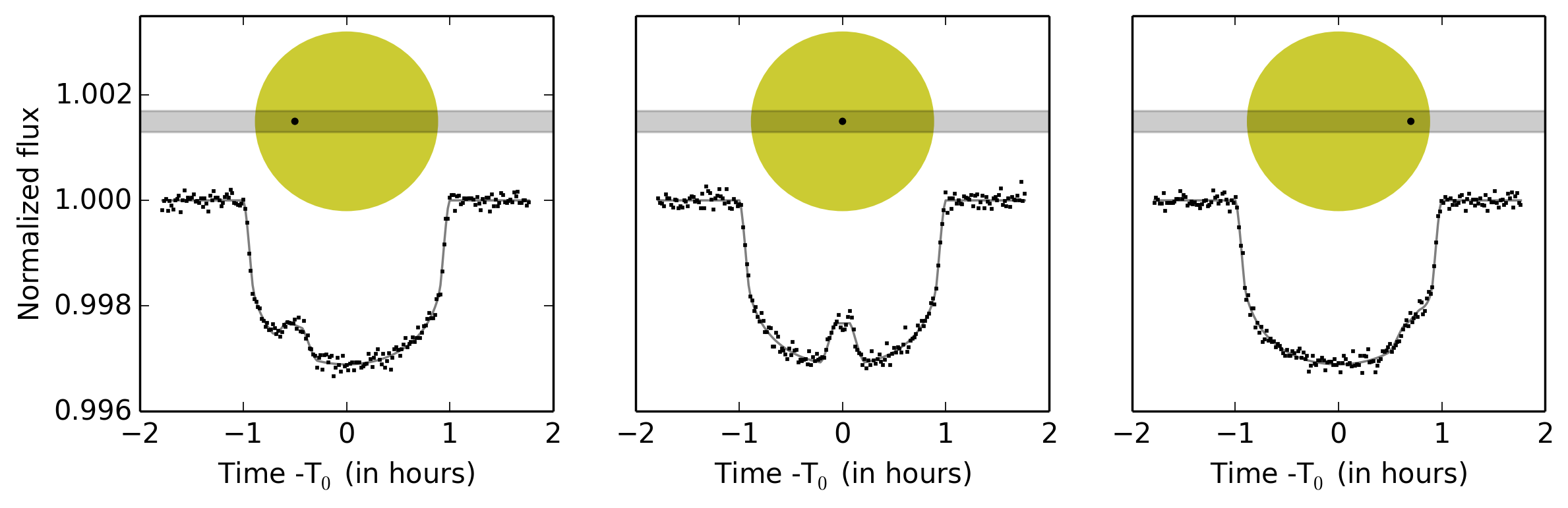
An illustration of a starspot feature in consecutive transits.  Image by Klaus Felix Huber.

A starspot feature in three consecutive transits. Image by Klaus Felix Huber.

Keele University PhD student Teo Močnik has looked at the Kepler K2 lightcurve of Qatar-2, a star known to host a hot Jupiter in a 1.34-day orbit. The lightcurve records 59 consecutive transits over a 79-day period and Močnik finds that most of the observed transits are affected by starspots (link to paper).

In the plot below each numbered lightcurve is from a transit, which occurs between the vertical dashed lines. The transit profile itself, however, has been subtracted in order to better show the starspot features.

Starspots in transits of exoplanet host Qatar-2

The starspots occur in groups, shown by red ellipses, and each group is the same starspot being seen in consecutive transits. Interestingly, though, the groups of spots themselves recur. Thus the starspots are lasting long enough that they pass behind the limb of the star, and then re-appear to be transited again one stellar rotation cycle later!

One particular starspot first causes the features in transits 20 to 22, then comes round again to produce the features in transits 33 to 36, and then comes round once again to produce the features in transits 46 to 50. Thus the starspot must have lasted for at least 40 days.

We thus have one of the best observations yet of a starspot on a star other than our sun. From this information we can calculate the rotation period of the star, place limits on the size, position and longevity of the spots, and also show that the planet’s orbit is closely aligned with the spin axis of the star.

Using the stellar rotation to trace a planet’s orbit

As a transiting exoplanet tracks across its star it progressively blocks out different regions of the face of the star. Since the star will be rotating, one limb of the star will be moving towards us (and so its light will be blueshifted) while the other limb recedes (producing a redshift). The blocking of light by the planet thus changes the spectral lines from the star. This is called the Rossiter–McLaughlin effect, and it can be used to discern the track of the planet’s orbit.

Brett Addison and Jonti Horner have written a nice introduction to such techniques on the widely read The Conversation website. Since large numbers of WASP planets orbit stars bright enough to enable a detection of the Rossiter–McLaughlin effect, around half of the planets with measured orbits are WASP planets.

Addison and Horner illustrate their piece with an artist’s conception of the polar orbit of WASP-79b:

Hot Jupiter exoplanet WASP-79b polar orbit

KELT-16b and sub-1-day hot-Jupiter exoplanets

Until recently the only hot-Jupiter exoplanets known with orbital periods below one day were the four discovered by WASP-South (WASP-18b, WASP-19b, WASP-43b and WASP-103b). But last month HATSouth reported that HATS-18b has a 0.84-day period and now KELT have announced KELT-16b at 0.97 days.

The KELT team, lead by Thomas Oberst, have produced this figure showing planetary masses against orbital separation (semi-major axis):

Short-period hot Jupiter exoplanets

One can see that all the planets just mentioned are Jupiter-mass or heavier. There are relatively few planets in the blue-shaded region, where they would have both Neptune-like masses and very short orbital periods. There are, though, Earth-mass planets known at these orbital periods. The paucity of short-period Neptunes cannot just be a selection effect, since they would have been readily found in the Kepler mission.

Instead, the currently favoured explanation is that planets in the blue-shaded region would rapidly be evaporated and be stripped down to their cores. At such short separations from their stars planets are subject to high irradiation and tidal forces. The combination can inflate the planets to the point that their atmospheres “boil off” and overflow the planet’s Roche lobe.

They avoid this fate only if the planet has enough mass, and thus gravity, to hold on to its atmosphere. Thus, at these very short orbital periods, we see either large, Jupiter-mass planets, or small, dense, rocky planets (possibly remnant cores of evaporated larger planets) — but not any in-between planets the size of Neptune.

Changeable weather on exoplanet WASP-43b?

WASP-43b is the “hot Jupiter” exoplanet with the orbit closest-in to its star, producing an ultra-short orbital period of only 20 hours. The dayside face is thus strongly heated, making it a prime system for studying exoplanet atmospheres.

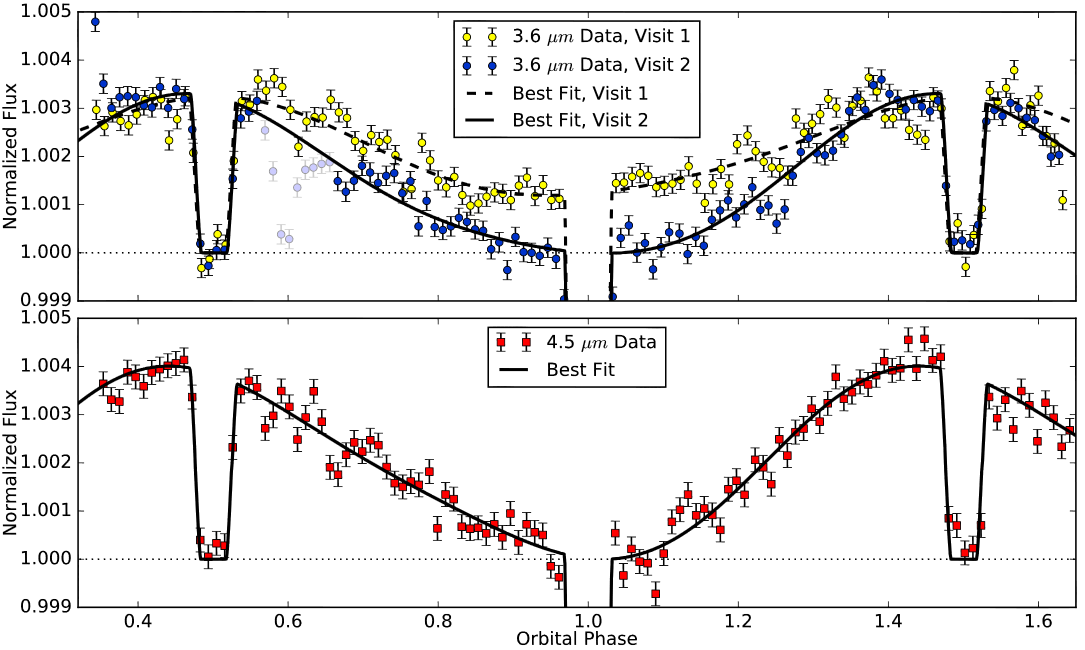
Kevin Stevenson et al have pointed NASA’s Spitzer Space Telescope at WASP-43, covering the full orbit of the planet on three different occasions. Spitzer observed the infrared light from the heated face in two bands around 3.6 microns and 4.5 microns.

The three resulting “phase curves” are shown in the figure:

Spitzer phase curves of exoplanet WASP-43b

The 4.5-micron data from one visit are shown in red in the lower panel; the 3.6-micron data from the two other visits are in the upper panel. The transit (when the planet passes in front of the star) is at phase 1.0, and drops below the plotted figure. The planet occultation (when it passes behind the star) is at phase 0.5. The sinusoidal variation results from the heated face of the planet facing towards us (near phase 0.5) or away (near phase 1.0).

Intriguingly, the depth of the variation in the 3.6-micron data is clearly different between the two visits. Why is this? Well, Stevenson et al are not sure. One possibility is that the data are not well calibrated and that the difference results from systematic errors in the observations. After all, such observations are pushing the instruments to their very limits, beyond what they had been designed to do (back when no exoplanets were known and such observations were not conceived of).

More intriguingly, the planet might genuinely have been different on the different occasions. The authors report that, in order to model the spectra of the planet as it appears to be during the “blue” Visit 2 in the figure, the night-time face needs to be predominantly cloudy. But, if the clouds cleared, more heat would be let out and the infrared emission would be stronger. That might explain the higher flux during the “yellow” Visit 1. Here on Earth the sky regularly turns from cloudy to clear; is the same happening on WASP-43b?

Cloudy Days on Exoplanets May Hide Atmospheric Water

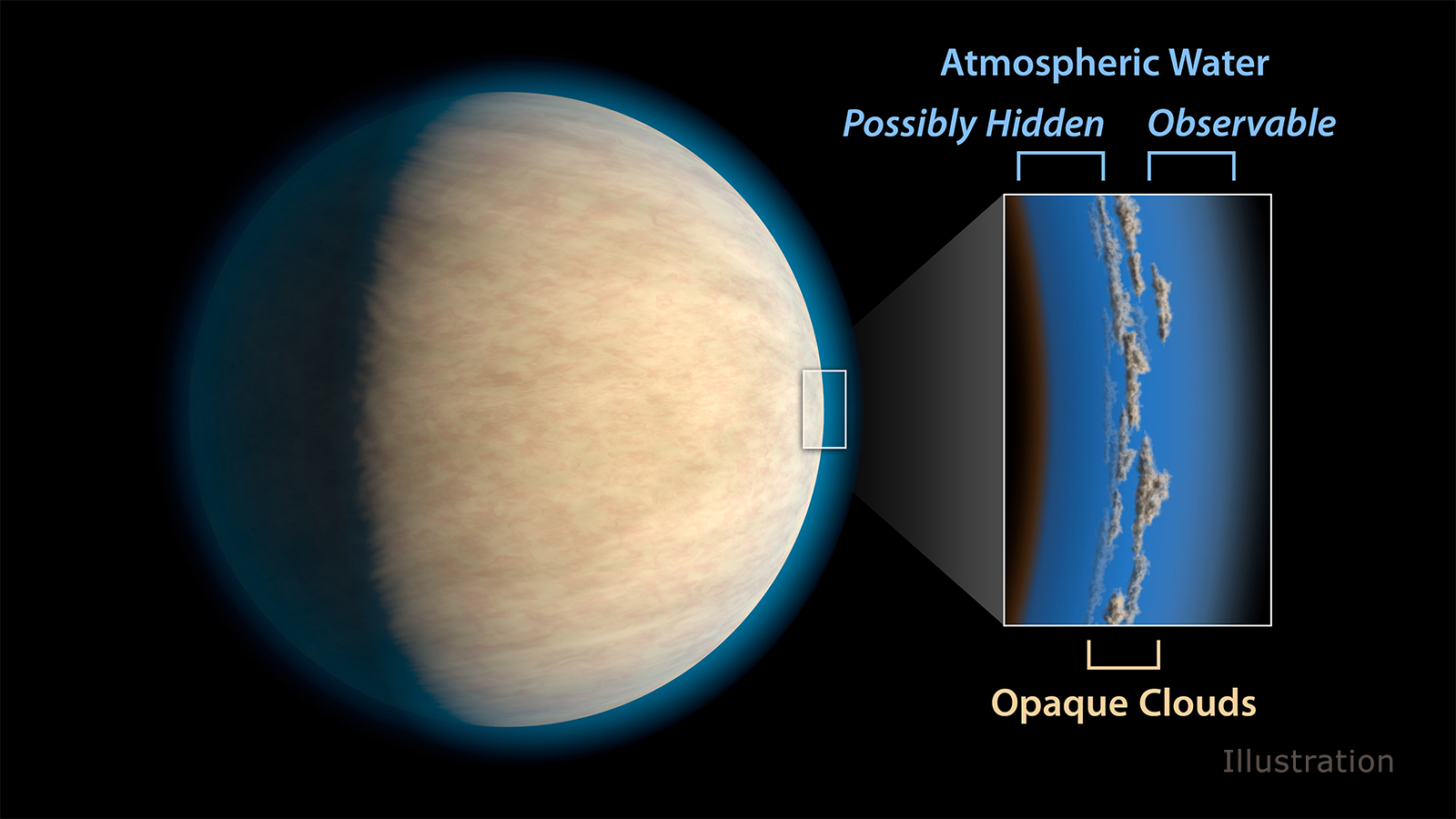
NASA’s Jet Propulsion Laboratory have put out a press release suggesting that clouds in exoplanet atmospheres might be preventing the detection of water that lies beneath the clouds, thus explaining why some hot Jupiters show signs of water while others don’t.

The release is based on work by Aishwarya Iyer et al, published in the Astrophysical Journal in June. Iyer et al made a comprehensive study of Hubble/WFC3 data for 19 transiting hot Jupiters, including many WASP planets.

Cloud or haze layers in the atmospheres of hot Jupiters  may prevent space telescopes from detecting atmospheric water that lies beneath the clouds, according to a study in the Astrophysical Journal.

Clouds in Hot-Jupiter atmospheres might be preventing space telescopes from detecting atmospheric water. Image credit: NASA/JPL-Caltech

The press release has been extensively reported, being carried on over 40 news websites. In the UK the Daily Mail covered the story, and included a note about the recent Keele University-led discovery of five new hot Jupiters, WASP-119b, WASP-124b, WASP-126b, WASP-129b and WASP-133b.

Orbital-period decay in hot-Jupiter WASP-12b?

Closely orbiting hot-Jupiter exoplanets are likely to be spiralling inwards towards their host star as a result of tidal interactions with the star. A new paper by Maciejewski et al reports a possible detection of this orbital-period decay in WASP-12b.

The authors have acquired 31 new transit light-curves over four years, and detect a trend under which the latest transits occur about a minute early compared to an unchanging ephemeris.

WASP-12b orbital period decay

Transits of WASP-12b. O–C is the observed time compared to that calculated from an unchanging orbital period. The time (x-axis) is given in both a count of days (BJD) and a count of transits.

This is the most convincing claim yet of a changing orbital period in a hot Jupiter. Whether it shows the spiral infall, though, is less clear. As the authors explain, other tidal interactions between the star and the planet, such as that causing apsidal precession, could account for the effect. Further, in close binary stars there are known to be similar period changes on decade-long timescales that are not fully understood, but which might be caused by Solar-like magnetic cycles on the star.

One suggestion that this is not spiral infall comes from the deduced value of the tidal quality factor, Q, which the authors calculate as 2.5 x 10⁵. This is lower than other estimates of Q as nearer 107.

The way to settle the issue will be to accumulate more data over a longer timespan until the case for spiral infall becomes overwhelming. It will thus be important to continue monitoring WASP-12b, and the other short-period hot Jupiters, over the coming decades.

Five more WASP transiting hot Jupiters

The WASP-South camera array, in conjunction with the Euler/CORALIE spectrograph and the TRAPPIST photometer, continues to be the world’s most prolific programme for discovering hot Jupiters transiting relatively bright stars of V < 13.

The lastest batch of five (WASP-119b, WASP-124b, WASP-126b, WASP-129b and WASP-133b) was announced by Maxted et al this month.

The discovery has reported by the Daily Mail, The Times of India, and The Hindu, and has been covered by about twenty news websites including Phys.org, wired.co.uk, scienceworldreport.com, techtimes, I4U News, and siliconrepublic.

Hot Jupiter exoplanet

Artist’s impression of a ‘hot Jupiter’. Credit: Ricardo Cardoso Reis (CAUP)

This derived from a piece by Tomasz Nowakowski, of Phys.org, which includes:

“WASP-126b is the most interesting because it orbits the brightest star of the five. This means it can be a target for atmospheric characterization, deducing the composition and nature of the atmosphere from detailed study, for example with the Hubble Space Telescope or the forthcoming James Webb Space Telescope,” Coel Hellier, one of the co-authors of the paper, told Phys.org.”

And:

“NASA’s Transiting Exoplanet Survey Satellite … might find smaller transiting exoplanets in these systems, as the Kepler K2 mission did with our previous discovery WASP-47. TESS, however, will do this for nearly all WASP planets, whereas K2 is restricted to an ecliptic strip, and so can only look at a few WASP planets,” Hellier said.”.

The rigidity of hot-Jupiter exoplanet HAT-P-13b

It is fairly amazing what one can deduce about planets orbiting distant stars. A new paper by Peter Buhler et al reports constraints on the rigidity of the hot-Jupiter exoplanet HAT-P-13b.

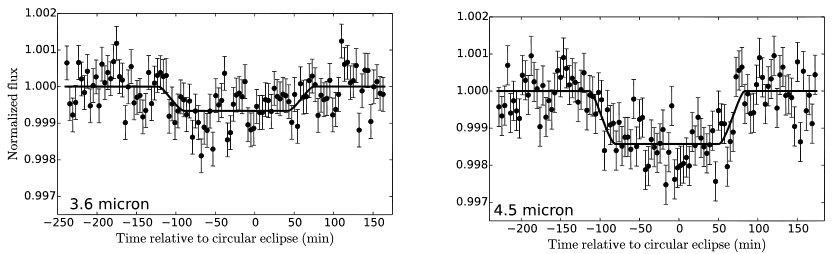
The essential data comes from an observation of the occultation of the planet (when it passes behind the host star), as observed in infra-red light by the Spitzer Space Telescope.

Occultation of HAT-P-13b

If the planet’s orbit were exactly circular the occultation would occur exactly half a cycle after the transit. But this occultation is 20 minutes early. That means that the orbit is slightly elliptical, amounting to an eccentricity of 0.007 +/– 0.001, a small but non-zero value.

Most hot Jupiters are expected to have orbits which have been completely circularised by tidal forces. Thus an eccentric orbit implies either that the planet has only relatively recently moved into that orbit, or that the eccentricity is being maintained by the gravitational effects of a third body.

In this case another planet, HAT-P-13c, a 14-Jupiter-mass planet in a longer 446-day orbit, is thought to be perturbing the close-in hot Jupiter HAT-P-13b.

The extent of the perturbation then tells us about the rigidity of the hot Jupiter. Tidal forces result from the fact that gravity differs across an extended body such as a planet, and how a planet reacts to the tidal stress depends on its rigidity.

The rigidity is parametrised by the “Love number”, and the authors find that the eccentricity of HAT-P-13b’s orbit implies a Love number of 0.3. This in turn implies that the planet likely has a rocky core of about 11 Earth masses, with the rest being an extended gaseous envelope.

Calculations of hot-Jupiter tidal infall

Closely orbiting hot Jupiters raise a tidal bulge on their star, just as our Moon does on Earth. Since the planet is orbiting faster than the star rotates, the tidal bulge will tend to lag behind the planet and so its gravitational attraction will pull back on the planet. The orbit of the planet is thus expected to decay, with the planet gradually spiralling inwards to destruction.

Calculating how long this will take is hard, and depends on the efficiency with which energy is dissipated in the tidal bulge of the star. This is summed up by a number called a quality factor, Q, which is, crudely, the number of orbital cycles required to dissipate energy. The higher this number the slower the decay of the planet’s orbit.

In a new paper, Reed Essick and Nevin Weinberg, of the Massachusetts Institute of Technology, present a detailed calculation of Q for hot Jupiters orbiting solar-like stars. They arrive at values for Q of 105 to 106, assuming a planet above half a Jupiter mass and an orbital period of less than 2 days.

Hot Jupiter orbital decay timescales

The figure shows the resulting infall timescales of all the hot Jupiters predicted to have remaining lifetimes of less than 1 Gyr. By far the smallest lifetime is that for WASP-19b, which is predicted to spiral into its star within 8 million years. This would mean that shifts in WASP-19b’s transit times would be readily detectable, with a shift accumulating to 1 minute in only 5 years.

The calculations presented here are at odds with deductions that Q must be around 107, based on explaining the current distribution of hot-Jupiter periods (e.g. Penev & Sasselov 2011), which would give a much slower orbital decay. We can determine who is right by monitoring transits of WASP-19b and similar systems over the coming decade, and it will be interesting to discover who is right.

Energy recirculation in the hot Jupiter WASP-19b

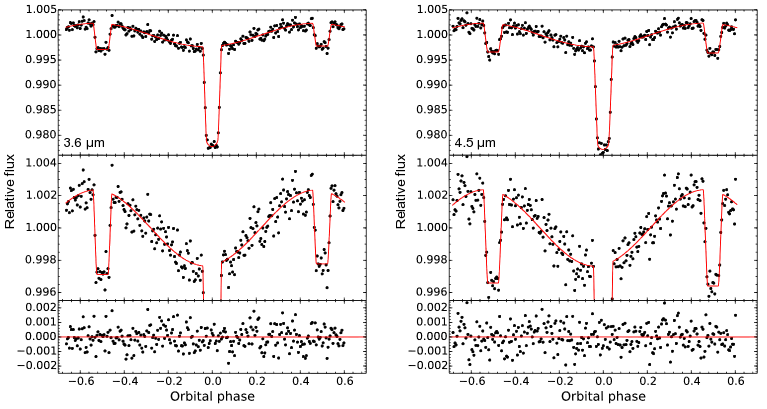
A team led by Ian Wong of Caltech have announced observations of the hot Jupiters WASP-19b and HAT-P-7b, looking at infra-red light using the Spitzer Space Telescope. By observing the planets around their entire orbit they detect the transit, caused by the planet passing in front of the host star, the secondary eclipse, when the planet passes behind the star, and the “phase curve” caused by the changing visibility of the heated face of the planet.

WASP-19b Spitzer lightcurve

The figure shows the infra-red light (“heat”) of the WASP-19 system in two pass bands (3.6 microns and 4.5 microns). The middle panels are expanded to show the phase curve, while the lowest panels show the residuals about a fitted model (the red line).

By fitting all three features, the authors can constrain the temperatures of the “day time” heated face of the planet (which faces towards us near the secondary eclipse) and of the “night time” face of the planet (which faces us near transit). From there they can estimate the “recirculation”, how efficient the planet is at redistributing heat from the day-time face to the night-time face.

Such short-period planets are phase-locked by tidal forces, and so always present the same face to the star. Thus redistribution of heat energy requires powerful winds circling the planet.

An interesting plot by Wong et al shows the recirculation in different hot Jupiters against the albedo (the fraction of energy that is reflected).

Energy recirculation in hot Jupiters.

There appear to be two groups of hot Jupiters: ones with albedos near 0.4, such as WASP-19b, and ones with much lower albedos, such as WASP-14b and WASP-18b. So far there is no simple explanation for this difference.

Further, the recirculation efficiency also appears to be different in different systems. Wong et al suggest that the hot Jupiters experiencing the highest irradiation, such as WASP-19b, are least efficient at redistributing heat, while
longer-period, less-irradiated hot Jupiters such as HD209458b and HD189733b are better at redistribution.