A thread by Vivien Parmentier regarding a new paper by Joost Wardenier et al:













Here’s a plot from a new paper by David Cont et al, of the University of Göttingen. The plot shows spectra of the WASP-33 system, obtained with the CARMENES near-infra-red spectrograph on the 3.5-m telescope at the Calar Alto Observatory.

The image shows features caused by iron absorption lines, as a function of time (y-axis). The spectra have all been adjusted so that zero velocity (RV) is centred on the host star, WASP-33. The star’s rotation then causes features over the spread of velocities marked by the dashed yellow lines.
One can clearly see the rippling effect of pulsations as they run around the star. The pulsations are likely being excited by the tidal pull of the planet.
In addition, though, and marked by yellow arrows, is a faint diagonal line. This is caused by the planet, WASP-33b, and is the effect of iron absorption lines in the planet’s atmosphere. It moves diagonally across the image owing to the orbital motion of the planet around the star.
By comparing their analysis of iron lines to a similar analysis for Titanium Oxide, the authors show that there is a temperature inversion (higher temperature at greater height) in the atmosphere of the planet.
Bloated hot-Jupiter WASP-79b, one of the largest known exoplanets with a radius near twice that of Jupiter, is among the planets scheduled to be observed with the keenly-awaited JWST. In a new paper, Alexander Rathcke et al report on observations made with Hubble. Here’s the spectrum:
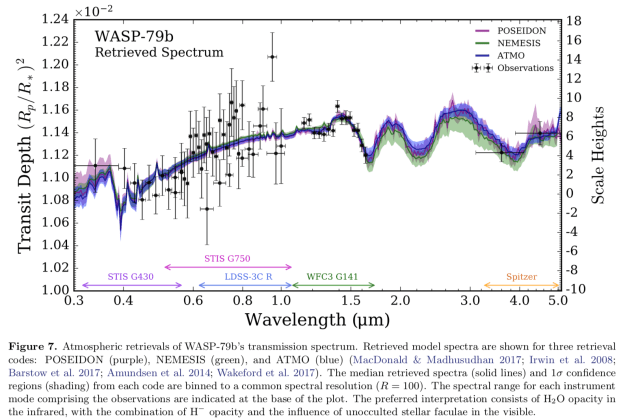
The clearest spectral feature, in the range observed with the WFC3 G141 grating, is attributed to water vapour. The authors also interpret the spectrum as showing opacity due to H− ions and the effects of faculae on the host star, that are 500 K hotter than most of the star’s surface. They say that this “underscores the importance” of observing a wide wavelength range in order to “disentangle the influence of unocculted stellar heterogeneities from planetary transmission spectra”.
As you’ll likely know from flying in an aircraft above the weather, clouds are bright, they reflect a lot of sunlight. This means that if a hot-Jupiter exoplanet has a cloudy atmosphere, then it should also be relatively bright, and so we should be able to detect a discernible drop in light when it it eclipsed behind its host star.
A new paper by Jonathan Fraine et al analyses data obtained with the Hubble Space Telescope WFCS/UVIS instrument to look for the eclipse of WASP-43b. Here is the result (with the data compared to model eclipse profiles):
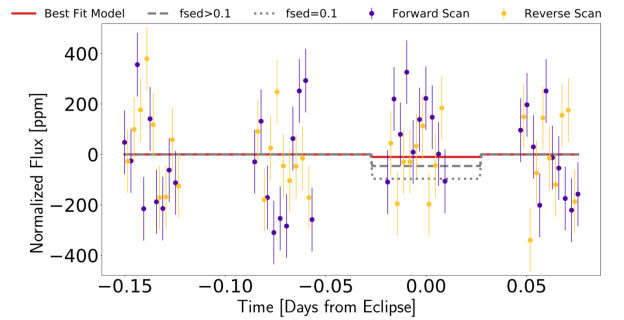
The authors find no significant eclipse, deriving only an upper limit to any drop in light of 67 parts-per-million, which means that the dayside face of the planet is reflecting less than 6% of the illuminating starlight. And that means “that we can rule out a high altitude, bright, uniform cloud layer”.
Fraine et al remark that “Because of its observational and atmospheric viability for spectroscopic detections, WASP-43b has become a benchmark planet for current and future hot Jupiter observations. Upcoming … JWST observations [will] map the thermal structure and chemical composition of this exoplanet with exquisite detail … We expect that no other exoplanet has or will be observed with this much precision and wavelength coverage for many years to come.”
The importance of cloud-free skies is that one can then see atomic and molecular spectral features much more readily, and so learn much more about the atmosphere’s composition.
Here’s a plot of the spectrum of the ultra-hot-Jupiter WASP-121b. It’s from a new paper led by Jamie Wilson of Queen’s University Belfast.
The plot compares results from different instruments at different times. In particular the green points are from the ground-based Gemini/GMOS instrument, and are fitted by the model in red. The light-blue points (and fitted purple model) are from the space-based HST/STIS instrument.
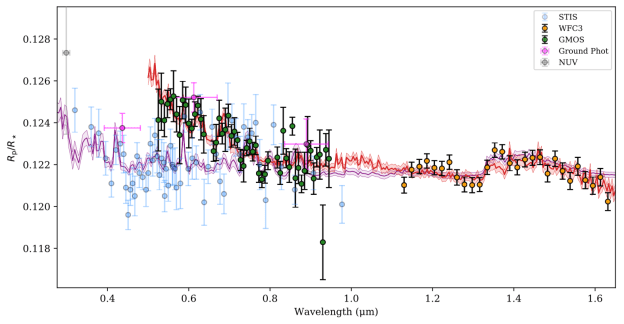
Clearly the two datasets are not consistent. One possible explanation would involve instrumental systematics that are not properly accounted for in the analysis. Such analyses are right at the edge of what can be done, pushing the instruments beyond their designed capabilities, and reducing the datasets to a properly calibrated spectrum is a demanding task.
The other possible explanation is that WASP-121b really was different on the two occasions, and that “weather” on the planet is affecting its atmosphere. Just as Earth’s atmosphere can change from clear to cloudy, we expect that the same could be occurring on exoplanets.
The authors say that: “WASP-121b is expected to have wind speeds of 7 km/s and a pressure–temperature profile which lies near the condensation curves of a number of species”, and thus: “It is therefore perhaps not all that surprising that small temperature fluctuations could result in significant spatial and temporal variations in atmospheric constituents and could lead to measurable variations in transit measurements.”
The hot Jupiter WASP-148b is rather unusual, since it has a sibling planet, WASP-148c in a 35-day orbit (Hébrard et al. 2020). The system was recently observed by TESS leading to a new paper by Gracjan Maciejewski et al. (Nicolaus Copernicus University and the Instituto de Astrofísica de Andalucía).
The gravitational tug of the outer planet WASP-148c perturbs the orbit of the hot Jupiter WASP-148b. Here are deviations in the timings of the hot-Jupiter’s transit (the green points are new timings from TESS, the blue points are from observations from the Sierra Nevada Observatory, the red line is a model based on the masses and orbits of the planets):
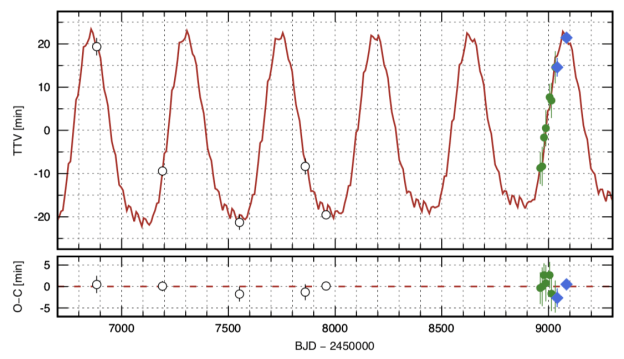
The great boon of transit-timing information is that it leads to measurements of the masses of the planets, which can be combined with radial-velocity measurements to give a better overall characterisation of the system.
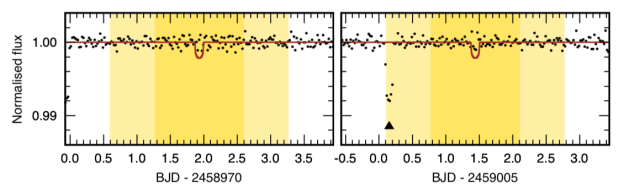
Maciejewski et al. also searched the TESS data for transits of the outer planet. The yellow areas are the predicted time of transit, should the planet’s orbital inclination be sufficiently high (the red line is a model showing the predicted depth of the transit; the black triangle marks a transit of the hot Jupiter WASP-148b). There is no indication that WASP-148c transits.
Here’s a thread by Joshua Lothringer (@JDLothringer) who researches exoplanet atmospheres at Johns Hopkins University. It’s based on his new paper on arXiv:








WASP-107b is a hugely bloated planet, with a mass of only two Neptunes, but a radius near that of Jupiter, making it one of the puffiest planets known. As such it has been heavily studied, and indeed was the exoplanet showing the first detection of helium.
Long-term monitoring of the WASP-107 system with the Keck telescope has now revealed a companion planet, WASP-107c, as announced by Caroline Piaulet et al.

The new planet is in a much wider orbit, with a period of 1088 days and a high eccentricity of e = 0.26. It likely does not transit, and has a mass of perhaps a third that of Jupiter.
The discovery of a second planet is important for understanding the nature of WASP-107b itself. The tight, 5.7-d orbit, and the fact that the orbit is mis-aligned with the star’s rotation, might be explained by gravitational interactions with the second planet. The bloated size could then result from tidal interactions with the host star, as the planet circularised in its orbit, after the interactions with WASP-107c.

The authors conclude that, “Looking ahead, WASP-107b will be a keystone planet to understand the physics of gas envelope accretion”, starting with a planned observation with the soon-to-be-launched JWST.
ESPRESSO is ESO’s state-of-the-art spectrograph for the Very Large Telescope, specifically designed to get the best data possible on planetary systems.
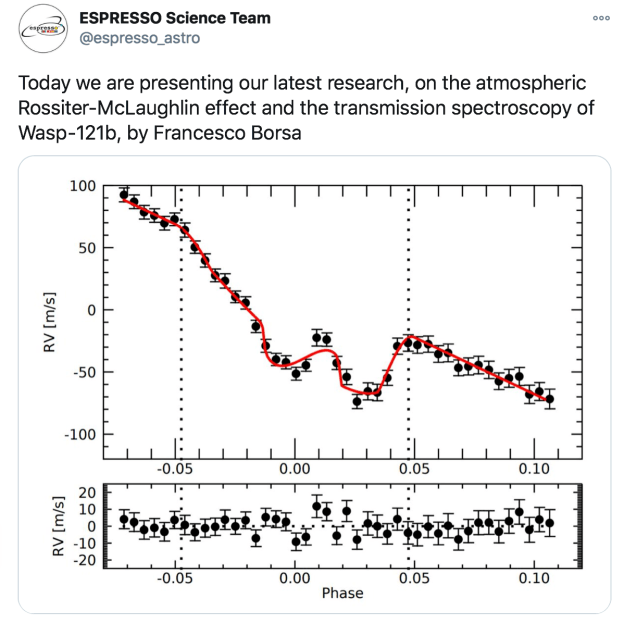
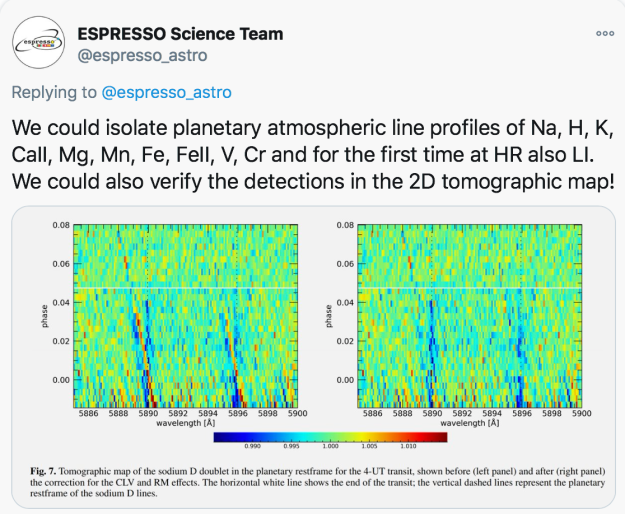
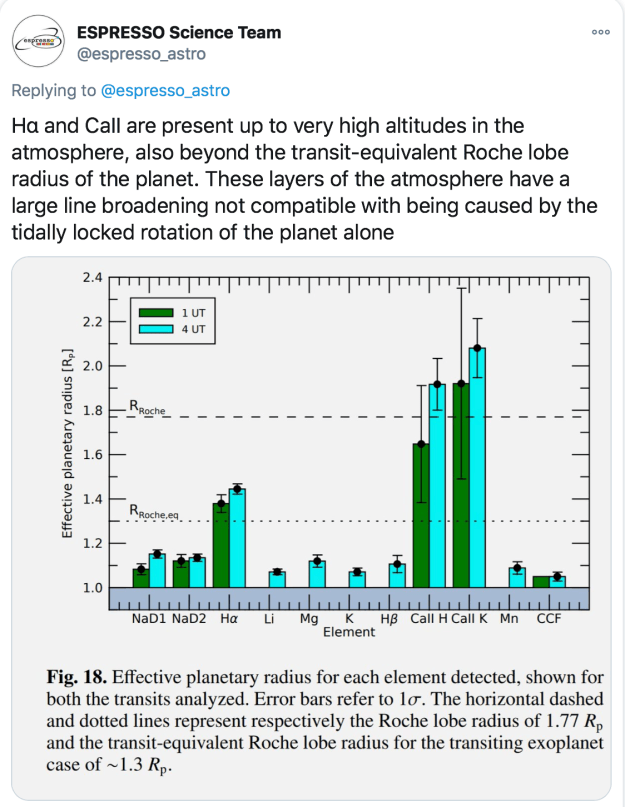
Francesco Borsa et al have pointed ESPRESSO at transits of the ultra-hot-Jupiter WASP-121b, and the ESPRESSO team have put out a series of Tweets explaining the paper:


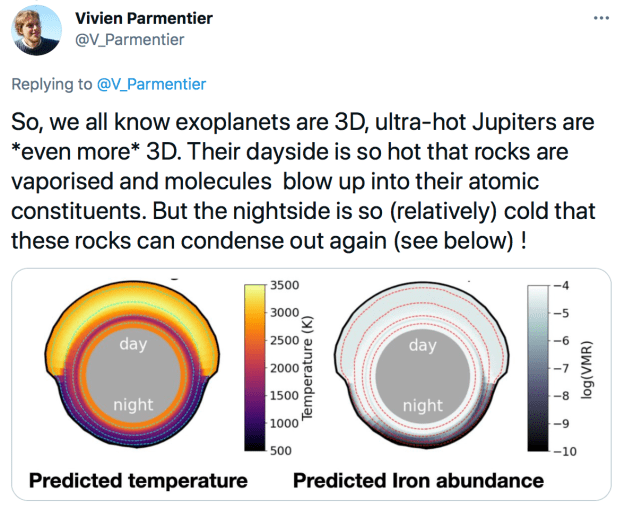
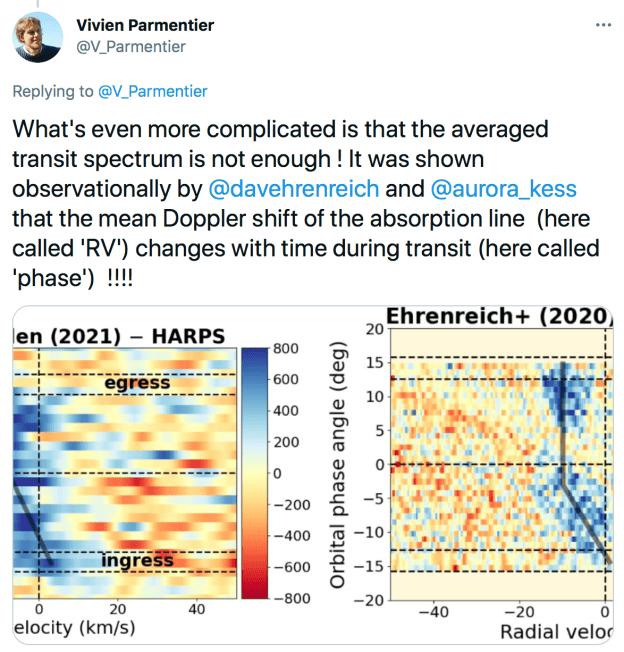
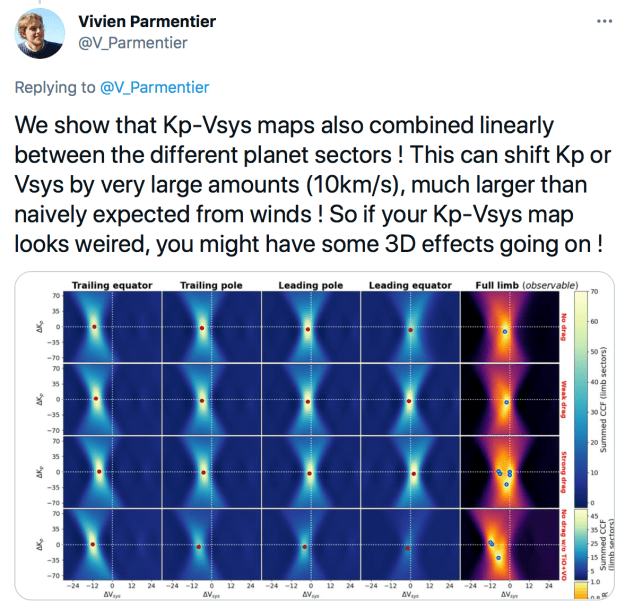
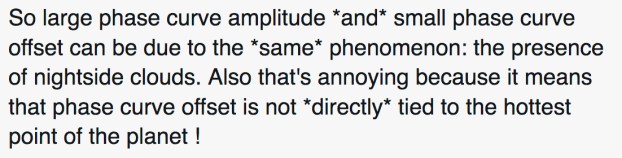
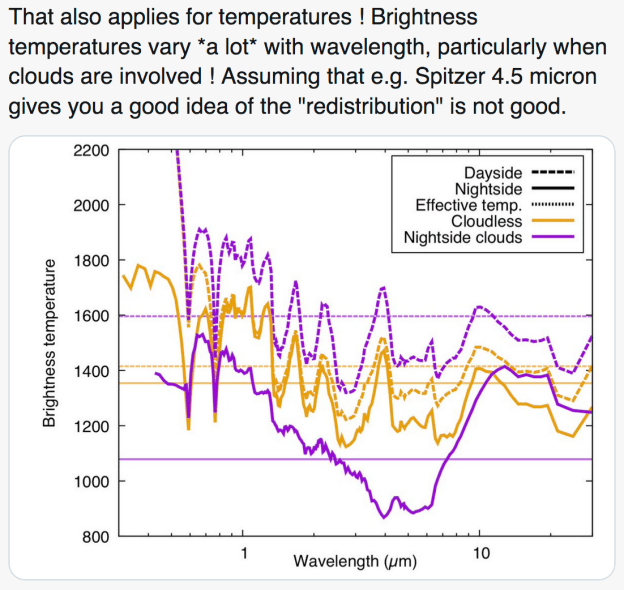
Vivien Parmentier (Oxford University, @V_Parmentier) has produced an explanatory Twitter thread on his latest paper with Jonathan Fortney (@jjfplanet). Since this concerns WASP exoplanets, let’s reproduce it here:

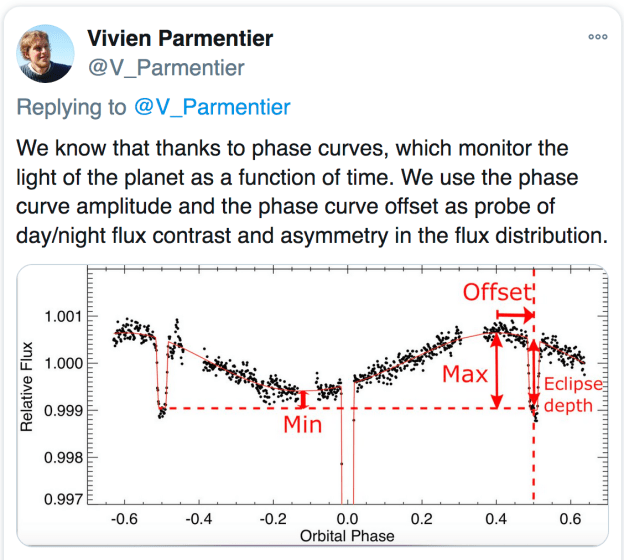

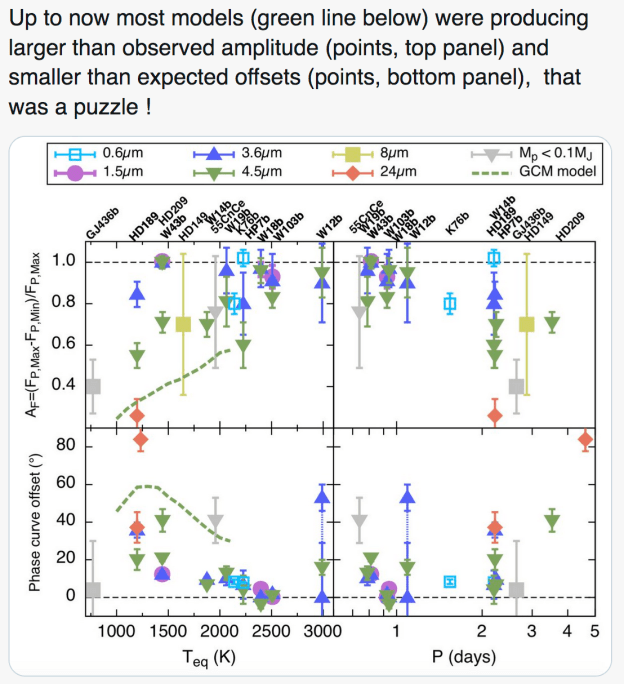
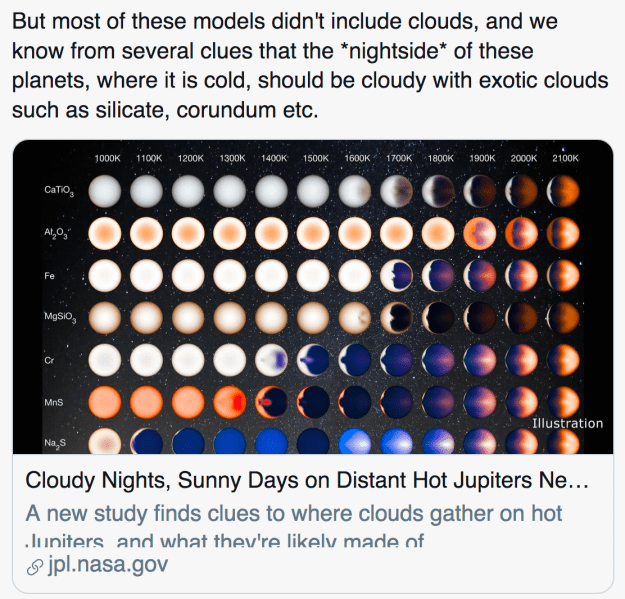
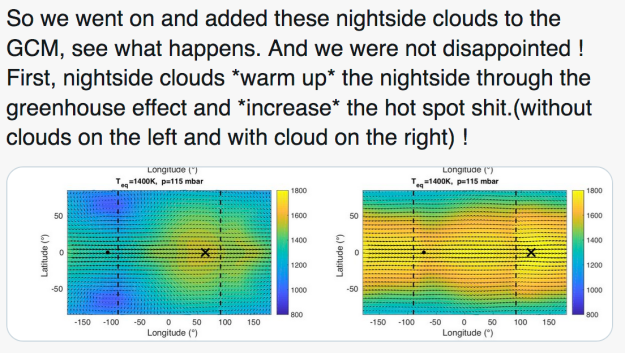

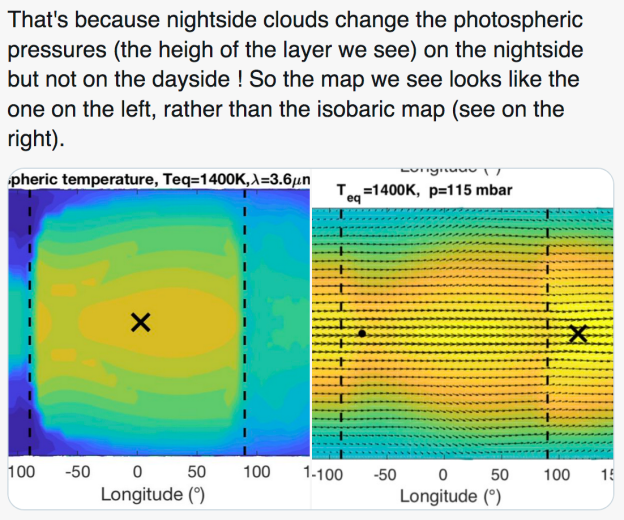


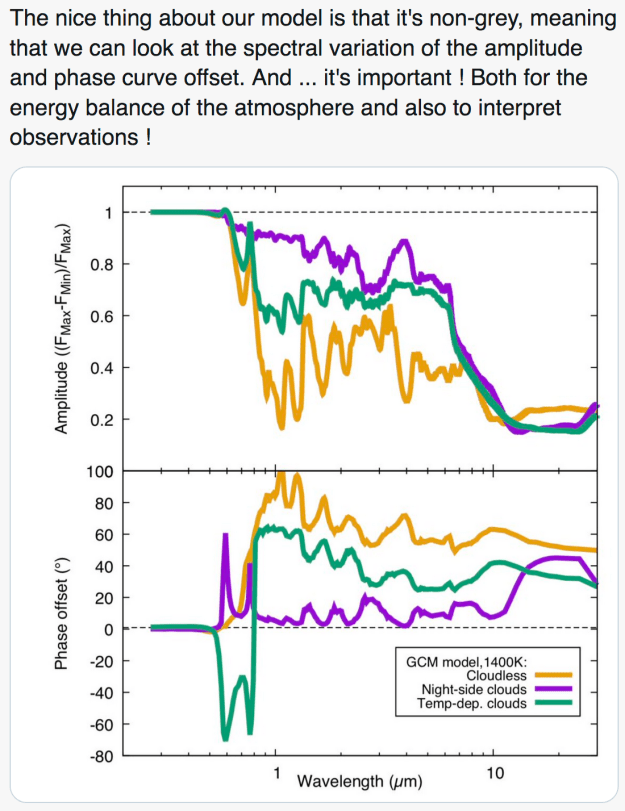

[The symbols include data points for WASP-43b, WASP-14b, WASP-19b, WASP-18b and WASP-103b, along with other hot Jupiters.]


 WASP Planets