Category Archives: exoplanet atmospheres

Hubble study of water in hot-Jupiter atmospheres

NASA have put out a press release regarding the largest-ever study of hot-Jupiter atmospheres by the Hubble Space Telescope and the Spitzer Space Telescope. Of the ten planets studied, six are WASP discoveries.

Clear to cloudy hot Jupiters (annotated)

The results, published in Nature, report that hot Jupiters are a diverse group that have atmospheres ranging from clear to cloudy. Strong water absorption lines are seen when the planets have a clear atmosphere, but less so when the atmospheres are dominated by clouds and hazes.

hubble_water

Planets such as WASP-17b and WASP-19b have clear atmospheres and show the strongest water features, whereas planets such as WASP-12b and WASP-31b are more cloudy.

The NASA press release has so far resulted in articles on over 110 news websites worldwide. The paper was lead-authored by David Sing of the University of Exeter.

Spitzer observations of cool WASP planets

A new paper by Joshua Kammer et al reports observations of 5 transiting hot-Jupiter planets with the Spitzer Space Telescope. The Spitzer infra-red observations looked for the occultation of the planet, when it passes behind its host star. By comparing the observed emission in and out of the occultation one can deduce the temperature of the planet’s atmosphere.

Kammer and colleagues chose to look at 5 relatively cool hot-Jupiter planets (ones around cooler stars, or orbiting further from the star), with expected temperatures in the range 900 to 1200 K. Of the 5, four were WASP planets (WASP-6b, WASP-10b, WASP-39b and WASP-67b).

The point of looking at cooler planets is that the ratio of the light in two Spitzer pass-bands, 3.6 and 4.5 microns, is expected to depend on the metallicity (the abundance of elements heavier than hydrogen and helium) of the planet’s atmosphere.

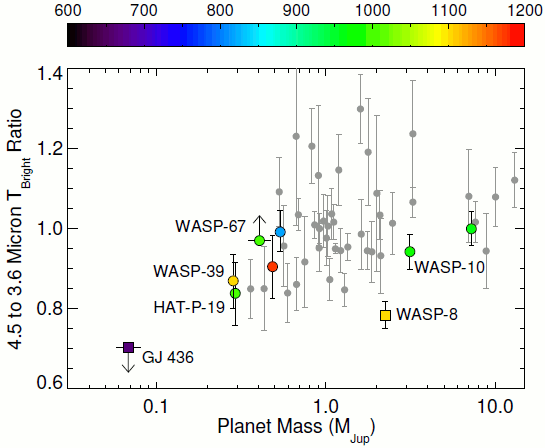
The authors found a tentative but possible relation between that ratio and the mass of the planet.

kammer

The plot shows the brightness ratio in the two pass-bands against planet mass. The named planets are also colour-coded by the planet’s temperature (where the top bar shows the scale in Kelvin). There is a possible trend to a higher ratio at higher masses (WASP-8b is a clear outlier to the trend, and the authors suggest that this might be because it is in a highly eccentric orbit).

Kammer et al say that “If this trend can be confirmed, it would suggest that the shape of these planets’ emission spectra depends primarily on their masses, consistent with the hypothesis that lower-mass planets are more likely to have metal-rich atmospheres.”

NASA’s Hubble Telescope Detects ‘Sunscreen’ Layer on WASP-33b

NASA have put out a press release about Hubble Space Telescope observations of WASP-33b.

WASP-33b is the hottest of the WASP planets, being the only one so far found orbiting a very hot A-type star. A team led by Korey Haynes from NASA’s Goddard Space Flight Center, have used Hubble to show that WASP-33b has a “stratosphere”. The spectrum in the infra-red is best explained by a temperature inversion caused by the presence of Titanium Oxide in the atmosphere.

Titanium Oxide is noted for its ability to absorb light, which is why it is often used in sunscreen lotion. NASA’s graphic shows how an absorbing layer in the atmosphere produces a “temperature inversion” with a hotter layer higher up:

WASP-33b stratosphere

WASP-33b’s stratosphere was detected by measuring the drop in light as the planet passed behind its star (top). Temperatures in the low stratosphere rise because of molecules absorbing radiation from the star (right). Without a stratosphere, temperatures would cool down at higher altitudes (left). [Image: NASA/GSFC]

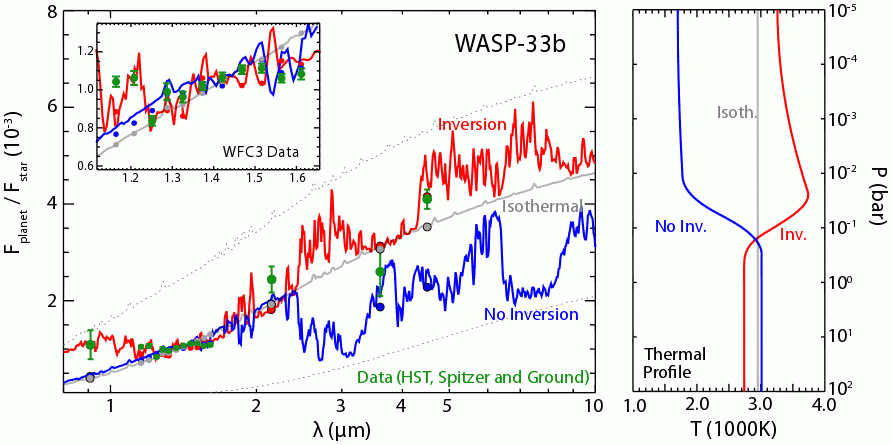
By comparing models with and without a temperature inversion to the spectrum of WASP-33b, as observed with Hubble’s WFC3 instrument, Haynes et al “make a very convincing case that we have detected a stratosphere on an exoplanet”.

Spectrum of stratosphere in WASP-33b

The figure shows the spectrum of WASP-33b (left) and the temperature profile of the atmosphere (right), both for models with a temperature inversion (red) and without an inversion (blue). (From Haynes et al 2015)

The work has been reported widely, in over 100 news and science websites, such as by SciTechDaily, Pioneer News, The Daily Mail, and NY City Today.

The proposed Twinkle mission to study exoplanet atmospheres

With over a hundred gas-giant exoplanets now known transiting relatively bright stars, thanks to WASP and other projects, scientific attention is being directed to characterising their atmospheres.

The proposed Twinkle spacecraft (Twinkle/Surrey Satellite Technology Ltd)

The proposed Twinkle spacecraft (Twinkle/Surrey Satellite Technology Ltd)

Twinkle is a new proposed satellite, led by a team from University College London, that would be dedicated to studying exoplanet atmospheres. The aim is for a relatively cheap and quick mission, but with a high scientific return.

Twinkle aims to analyse the atmospheres of 100 exoplanets using an infrared spectrograph. By comparing the spectra observed in and out of transit, and spacecraft will detect signatures of molecules in the transiting planet atmospheres.

The project needs £50 million to succeed. WASP planets would be prime targets for Twinkle, and so we hope that Twinkle gets funded and wish it every success.

The Twinkle team invite expressions of support at the Twinkle website.

Scattering in the atmosphere of WASP-6b

WASP-6b was WASP-South’s third planet, announced in 2009 by Gillon et al. It is a good target for studying exoplanet atmospheres since it is a bloated planet, only half a Jupiter mass but 20% larger than Jupiter.

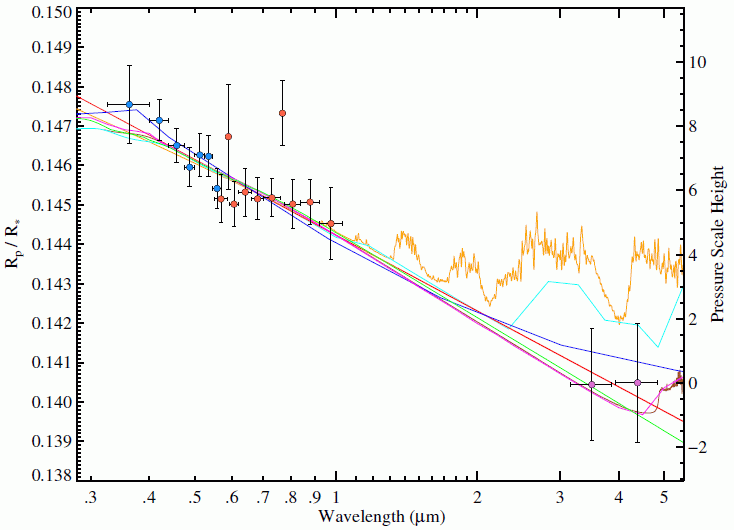
Nikolov et al (2014) have now pointed the Hubble Space Telescope at WASP-6b in transit, using the STIS spectrograph. They find that the transit depth varies with colour; effectively the planet looks slightly larger in blue light, since small particles in the planet’s atmosphere are scattering blue light more than red light.

wasp6_rayleigh

The strong blue slope in the plot is characteristic of Rayleigh scattering, the same effect that causes Earth’s atmosphere to look blue (in the plot the red line is a Rayleigh-scattering model, though other model fits are possible).

Nikolov etal state that: “With a broad-coverage optical transmission spectrum measured from HST and Spitzer broad-band transit spectrophotometry, WASP-6b joins the small but highly valuable family of hot-Jupiter exoplanets with atmospheric constraints.”

The field of exoplanet atmospheres is growing rapidly in importance, and it is good to see WASP planets being chosen as prime targets for such work.

The atmosphere of hot-Jupiter exoplanet WASP-31b

Characterising the atmospheres of exoplanets is a rapidly growing field that is set to increase in importance even more with the forthcoming launch of JWST. WASP planets are prime targets for such work since they transit relatively bright stars. Comparing spectra in and out of transit then gives a transmission spectrum of the planet’s atmosphere.

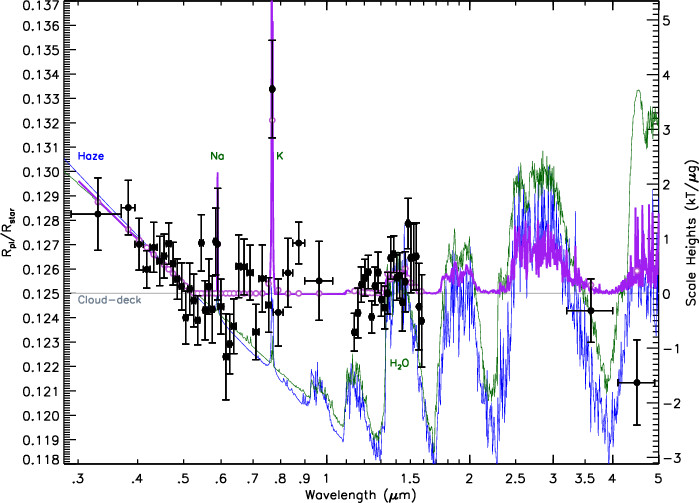
A new study by David Sing et al presents a state-of-the-art analysis of WASP-31b’s atmosphere using the STIS instrument on the Hubble Space Telescope.

w31_atmos

Notable features include the presence of potassium absorption (the peak labelled K) and the fact that this is stronger than sodium (Na) absorption. The absence of many of the broad features in the plotted models implies a “cloud deck” that results in few spectral features. Also seen is a “Rayleigh scattering” slope implying small atmospheric particles floating above the cloud layer.

WASP-31b is a planet of 0.5 Jupiter masses that is bloated up to 1.5 Jupiter radii. This gives it a large atmospheric scale height that makes it a good target for transmission spectroscopy, since the fluffier atmosphere covers a larger fraction of the star during transit.

WASP-31b was discovered in 2010 by the WASP-South team led by David Anderson.

Hubble maps the atmosphere of WASP-43b

WASP-43b is one of the more extreme hot Jupiters found by WASP-South, orbiting its star in only 19 hours, making it the hot-Jupiter planet closest to its star, where its atmosphere gets blasted by the stellar irradiation. Since the host star is relatively dim, a K7V dwarf smaller and fainter than our Sun, the planet’s light is relatively easy to see and thus the system is a prime target for characterising exoplanet atmospheres.

Now, NASA have put out a press release regarding a Hubble Space Telescope observation of WASP-43b which monitored the planet around three of its orbits.

By recording the changes in the observed light around the orbit, as the irradiated face of the planet swings into view and then faces away again, the team have mapped the temperature and the distribution of water vapour of the planet’s atmosphere.

Exoplanet WASP-43b orbits its parent star

The image (Credit: NASA, ESA, and Z. Levay (STScI)) shows the changing view of WASP-43b around its orbit, illustrating the hot, blasted heated face and the darker atmosphere pointing away from the star.

The planet is phase-locked to the orbit by tidal forces, always pointing the same face to its star, and thus we expect dramatic winds as the planet’s atmosphere redistributes heat from the star-facing side to the cooler side.

The Hubble observations are reported in three papers, one accepted for Science, lead by Kevin Stevenson of the University of Chicago (arXiv link). A second paper, led by Laura Kreidberg, also of the University of Chicago, shows that the abundance of water in WASP-43b’s atmosphere is compatible with that in the Sun (arXiv link). A third paper, led by Tiffany Kataria of the University of Arizona, models the planet’s atmospheric circulation (arXiv link).

WASP-43b was announced in 2011 by the WASP-South team in a paper led by Coel Hellier of Keele University.

The atmosphere of WASP-80b

WASP-80b is one of the most important planets found by WASP-South. It is hot Jupiter, in a 3-day orbit, but its host star is unusually small and dim, being an K7/M1 star with a mass of only 0.59 that of the Sun. Only one other such system is known, namely Kepler-45, but that is faint at V = 16.9 and so hard to study. WASP-80 is much brighter, at V = 11.9.

A new paper by Mancini etal reports observing a transit of WASP-80b in four colours simultaneously, using the GROND instrument on the 2.2-m/ESO telescope at La Silla.

Transit of WASP-80b in four colours

The transit depth is distinctly different in the different colours. Why might this be? The planet, of course, does not have a hard edge, it has an atmosphere, and a gaseous atmosphere can be more transparent to some colours of light and less transparent to others. Thus the planet will appear to be a slightly different size in different colours, and hence the transit can have a slightly different depth.

This is not easy to interpret, however, since the host star is also gaseous, with no sharp edge. Owing to limb-darkening it also appears to be a different size in different colours, which can complicate the interpretation. Studies such as this are in their infancy, but should allow us to prove the temperatures and compositions of atmospheres of exoplanets. This is one of the main aims of the forthcoming JWST mission and proposed exoplanet missions such as ESA’s EChO.