Yearly Archives: 2016

Changeable weather on exoplanet WASP-43b?

WASP-43b is the “hot Jupiter” exoplanet with the orbit closest-in to its star, producing an ultra-short orbital period of only 20 hours. The dayside face is thus strongly heated, making it a prime system for studying exoplanet atmospheres.

Kevin Stevenson et al have pointed NASA’s Spitzer Space Telescope at WASP-43, covering the full orbit of the planet on three different occasions. Spitzer observed the infrared light from the heated face in two bands around 3.6 microns and 4.5 microns.

The three resulting “phase curves” are shown in the figure:
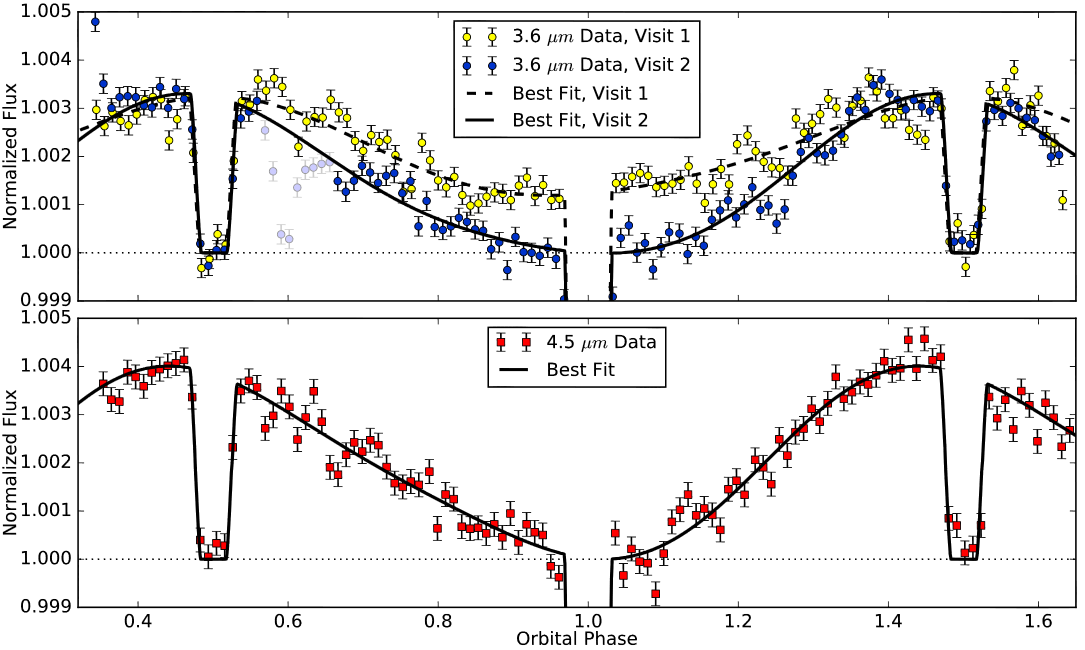
Spitzer phase curves of exoplanet WASP-43b

The 4.5-micron data from one visit are shown in red in the lower panel; the 3.6-micron data from the two other visits are in the upper panel. The transit (when the planet passes in front of the star) is at phase 1.0, and drops below the plotted figure. The planet occultation (when it passes behind the star) is at phase 0.5. The sinusoidal variation results from the heated face of the planet facing towards us (near phase 0.5) or away (near phase 1.0).

Intriguingly, the depth of the variation in the 3.6-micron data is clearly different between the two visits. Why is this? Well, Stevenson et al are not sure. One possibility is that the data are not well calibrated and that the difference results from systematic errors in the observations. After all, such observations are pushing the instruments to their very limits, beyond what they had been designed to do (back when no exoplanets were known and such observations were not conceived of).

More intriguingly, the planet might genuinely have been different on the different occasions. The authors report that, in order to model the spectra of the planet as it appears to be during the “blue” Visit 2 in the figure, the night-time face needs to be predominantly cloudy. But, if the clouds cleared, more heat would be let out and the infrared emission would be stronger. That might explain the higher flux during the “yellow” Visit 1. Here on Earth the sky regularly turns from cloudy to clear; is the same happening on WASP-43b?

HATS-18b and short-period hot Jupiters

Congratulations to the HATSouth project for the discovery of HATS-18b, a hot Jupiter with the very short orbital period of only 0.84 days. The other known hot Jupiters with periods below 1 day are all WASP-South discoveries (WASP-19b at 0.79 d, WASP-43b at 0.81 d, WASP-103b at 0.93 d and WASP-18b at 0.94 d).

Since such short-period systems are the easiest to find in transit surveys (owing to lots of transits!) they must be very rare, presumably because tidal forces are causing the orbits to decay, so that the planets spiral into their stars on relatively short timescales of tens of millions of years.

The HATSouth team note that the rotational periods of the host stars of HATS-18b and WASP-19b are much shorter than expected given the ages of the stars, and suggest that the stars have been spun up by the same tidal interaction that caused the planet’s orbit to decay. By modelling the in-spiral process Penev et al arrive at constraints on the “quality factor” Q* of the star. This is a measure of how efficient the star is at dissipating the tidal energy resulting from the planet’s gravitational tug on the star, and this sets the timescale for the tidal decay. Penev et al argue that the log of Q* is between 6.5 and 7, one of the tightest constraints yet estimated.

Stellar tidal decay quality factor

Estimates of the tidal quality factor, from modelling the HATS-18b and WASP-19b systems. The different models use different assumptions and are explained in the text. Figure by Penev et al.

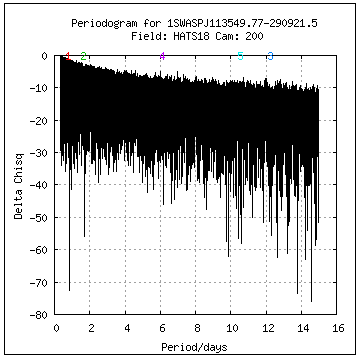
New HATSouth planets gives us at WASP a check on our methods, since we can look for them in our own data (and if we don’t see them we can ask why not). At V = 14.1, HATS-18 is fainter than any of the WASP host stars, and fainter than we would adopt as a candidate (HATSouth is optimised to get better photometry on a slightly fainter magnitude range, whereas WASP-South is optimised for a wider field). Nevertheless, 26 000 data points from WASP-South do detect the transit of HATS-18b, giving a detected signal at the 0.837-day period and its first harmonic (1.67-d) in the period search:

hats18per

There is then a clear detection of the transit when the data are folded on the transit period:

hats18bfld

This is thus the faintest detection of a planet yet by WASP-South and so is reassuring about WASP data quality.

Cloudy Days on Exoplanets May Hide Atmospheric Water

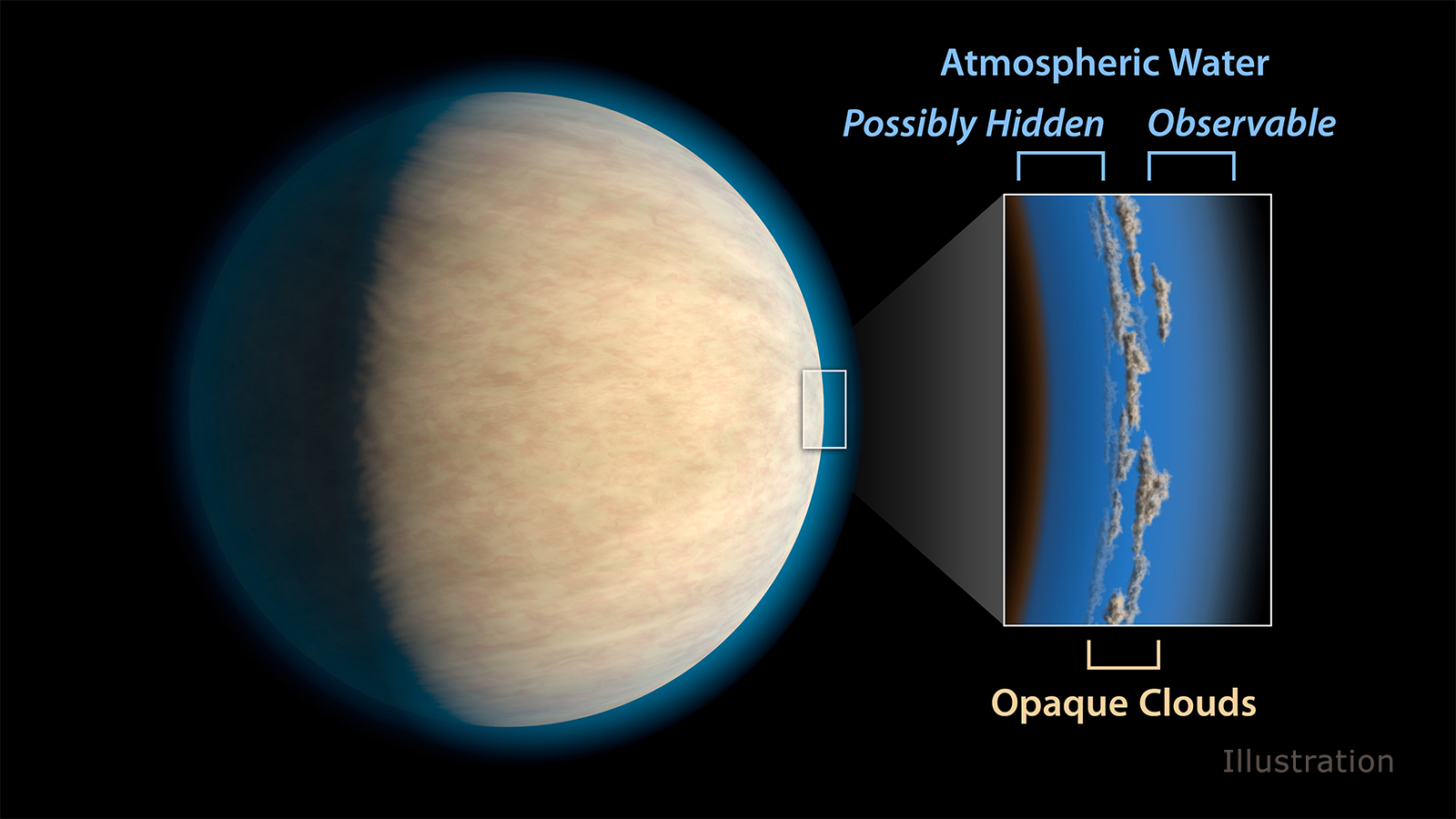
NASA’s Jet Propulsion Laboratory have put out a press release suggesting that clouds in exoplanet atmospheres might be preventing the detection of water that lies beneath the clouds, thus explaining why some hot Jupiters show signs of water while others don’t.

The release is based on work by Aishwarya Iyer et al, published in the Astrophysical Journal in June. Iyer et al made a comprehensive study of Hubble/WFC3 data for 19 transiting hot Jupiters, including many WASP planets.

Cloud or haze layers in the atmospheres of hot Jupiters  may prevent space telescopes from detecting atmospheric water that lies beneath the clouds, according to a study in the Astrophysical Journal.

Clouds in Hot-Jupiter atmospheres might be preventing space telescopes from detecting atmospheric water. Image credit: NASA/JPL-Caltech

The press release has been extensively reported, being carried on over 40 news websites. In the UK the Daily Mail covered the story, and included a note about the recent Keele University-led discovery of five new hot Jupiters, WASP-119b, WASP-124b, WASP-126b, WASP-129b and WASP-133b.

Starspots on WASP-85 from K2 transits

If, during a transit of its star, an exoplanet crosses a star spot, it will be covering a region that is dimmer than the rest of the star. Since less light will be being occulted, we will see a small increase or “bump” in the transit profile. WASP-85 was recently observed by the K2 mission, getting sufficiently high-quality photometry that it could reveal such starspot `bumps”.

Here is the transit proflle, from a paper by Teo Močnik et al, which contains all the K2 data folded in:

WASP-85b transit profile observed with Kepler K2.

Teo Močnik then subtracted the overall transit profile, thus showing the departures from the average behaviour, and produced a plot of each transit:

WASP-85 starspots observed with K2

The vertical dashed lines show the regions in transit. The lightcurve bumps circled in red are starspots being occulted. (Blue arrows are times when K2 fired its thrusters, which can cause a feature in the lightcurve.)

The interesting question is whether a bump recurs in the next transit, but shifted later in phase, as it would if the same starspot is being occulted again. This would happen if the planet’s orbit is aligned with the stellar rotation. In that case, as the star rotates, the spot moves along the line of transit, to be occulted again next transit.

Aligned orbit star spot occultation

An illustration of a planet occulting a star spot when the planet’s orbit and the star’s rotation are aligned. Graphic by Cristina Sanchis Ojeda

To judge whether the starspot bumps repeat, Teo gave all the co-authors a set of lightcurves and asked them to judge which features in the lightcurve were genuine bumps. But, to avoid human bias, he first scrambled the order of the lightcurves, so that the co-authors didn’t know which lightcurve came next.

The result is that we think that starspots do repeat, shown by the red linking lines in the above figure. This shows that the planet’s orbit is aligned, and it also allows us to estimate the rotational period of the star.

Titanium and Vanadium on the exoplanet WASP-121b?

The hot Jupiter WASP-121b, discovered recently by Laetitia Delrez et al, is a very good opportunity for learning what the atmosphere of an exoplanet is made of. Being in a close, 1.27-day orbit around a hot star makes the atmosphere hot, while being a bloated planet of 1.9 Jupiter radii makes the atmosphere puffy. That means one can observe the planet in transit, projected against its star, and readily observe spectral features caused by the atmosphere absorbing star light.

Thomas Evans et al have pointed the Hubble Space Telescope at WASP-121b. To model the resulting spectrum they find they need an atmosphere containing titanium oxide, vanadium oxide, and iron hydride. In the plot below, models with these molecules are plotted red and yellow, and fit the observations, while models without, plotted in green and purple, do not.

WASP-121b atmosphere

The model also shows that WASP-121b has clear skies, rich in water vapour. It looks as though WASP-121b will become one of the most important exoplanets for such atmospheric characterisation work.

The atmosphere of exoplanet WASP-36b

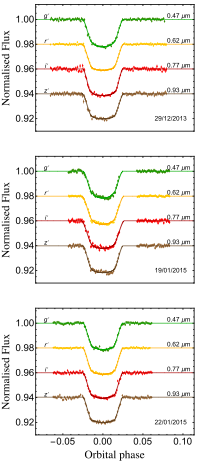
WASP-36b transits

Transits of WASP-36b in multiple colours and from different nights.

A new paper by Luigi Mancini et al reports transits of the hot-Jupiter exoplanet WASP-36b in multiple colours. The point is to record the transit depth as a function of wavelength, and thus deduce how opaque the planet’s atmosphere is at different wavelengths. That, in turn, might tell us what the atmosphere is made of.

To do this Mancini et al have used the GROND instrument on ESO’s 2.2-m telescope, which records light in four different colours simultaneously. They observed four different transits of WASP-36b over 2012 to 2015.

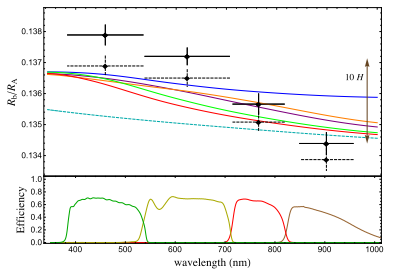
The result is the figure below showing the transit depth in the four different passbands (greater depth implying a larger planet radius, plotted as the ratio of planet to star, Rb/RA).

The black crosses show the transit depth. The dashed versions are corrected for possible star-spots in the transit light curves. The coloured lines represent different atmospheric models.

WASP-36b transits versus passband

The data show a clear and strong trend to greater depth in the blue, steeper than would be explained by any of the models shown. This means that something in the planet’s atmosphere is absorbing strongly at bluer wavelengths. What is causing this is unclear, and will require further investigation.

WASP exoplanet skies in Forbes Magazine

A recent article by Brian Koberlein in Forbes Magazine, on “The Wonder of Exoplanet Skies”, features WASP. The article is based on a recent paper by Jake Turner et al which includes observations of 15 hot Jupiters, of which seven are WASP planets.

The paper is one of the first to compile exoplanet transits in the near-UV “U” band. By comparing transit depths at different wavelengths one can discern facts about the exoplanet’s sky, such as whether is it clear or cloudy.

The most interesting result is apparently anomalous U-band transit depths in WASP-1b and WASP-36b, which appear shallower than in the optical, a finding that is hard to explain. Most likely this will have been caused by some observational bias, especially since there appears to be “red noise” in some of the transit profiles.

The image shows transits in the red (Harris R) and the near-UV (Bessell U), along with the residuals against a fitted model.

WASP-36b U-band transit

This sort of work is hard to do from the ground, but such studies point to a bright future for parameterising exoplanet atmospheres.

Spin-orbit alignments for three more WASP planets

A team led by Brett Addison has been pointing the Anglo-Australian Telescope at WASP planets, trying to discern whether the planet’s orbit is aligned with the star’s spin axis.

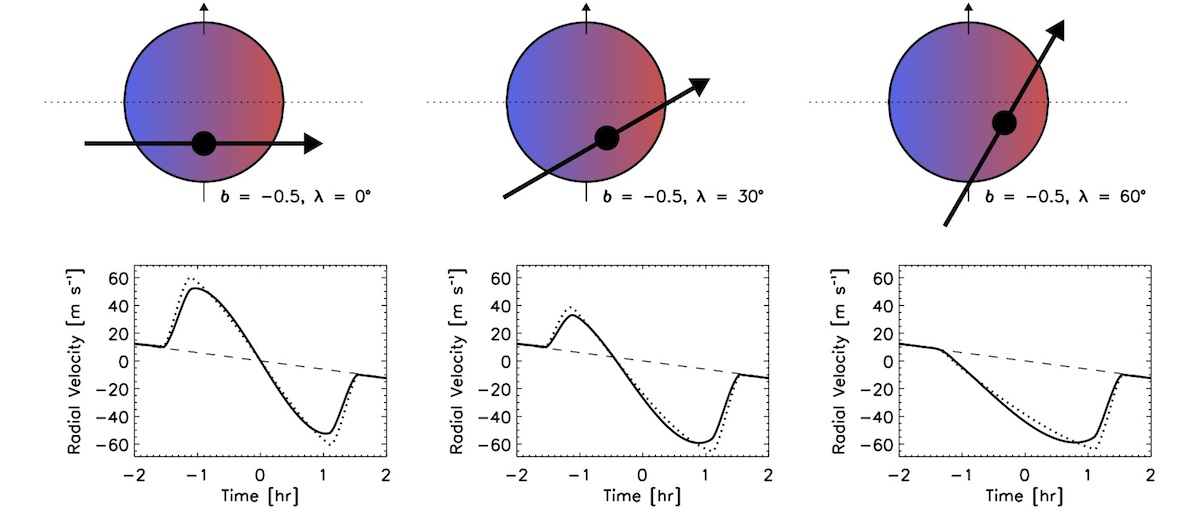
The rotation of the star means that one limb is approaching us, and so is blue-shifted, while the other limb is receding, and so is red-shifted. The planet can occult blue-shifted light (making a spectral line redder) and then red-shifted light. This is called the Rossiter–McLaughlin (or R–M) effect, and allows us to deduce the path of a transiting planet across the face of its star.

Rossiter-McLaughlin effect

Brett Addison and colleagues report the R–M effect for three more WASP planets, WASP-66b, WASP-87b and WASP-103b. Here are their data for WASP-87b:

WASP-87 Rossiter-McLaughlin effect

All three planets appear to have orbital axes aligned with the star’s spin axis. The authors discuss the mechanisms and timescales by which orbits get “damped” by tidal effects and so become aligned with their star.

WASP-157b, a transiting Hot Jupiter observed with K2

Hot on to arXiv is our latest discovery paper. WASP-157b marks a jump upwards in WASP numbering, since we’ve somewhat rushed this one out. WASP-157 was flagged as a WASP candidate in 2014 and added to our program for radial-velocity (RV) and photometric follow-up. Meanwhile, being in the field of K2 Campaign 6, it was observed by Kepler from July to September 2015. Since K2 data are public, this meant that other groups would soon be on its trail.

A TRAPPIST observation of the transit, shortly before the K2 data were due to be released, along with prioritising it for CORALIE and HARPS RVs, rapidly accumulated enough observations to prove it was a planet. Keele student Teo Močnik then did a good job of analysing the K2 data and turning all the observations into a paper. A gap of only four days between the last CORALIE radial-velocity observation and the paper appearing on arXiv is efficient work!

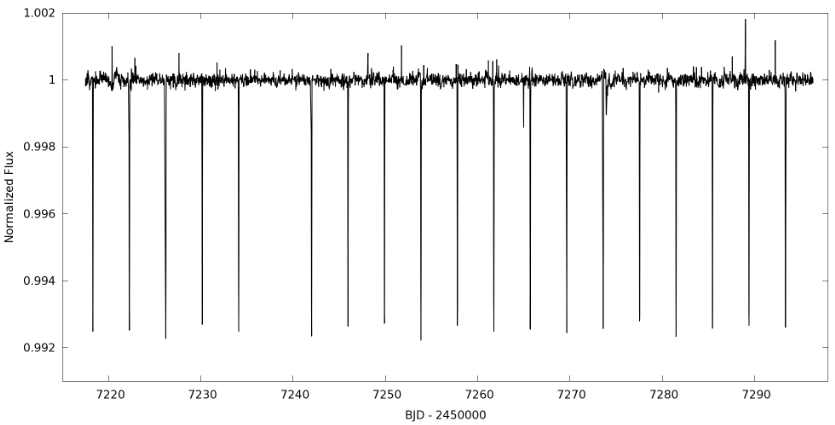
Here is the K2 lightcurve showing the transits of WASP-157b:

Lightcurve of WASP-157b observed with Kepler K2

Orbital-period decay in hot-Jupiter WASP-12b?

Closely orbiting hot-Jupiter exoplanets are likely to be spiralling inwards towards their host star as a result of tidal interactions with the star. A new paper by Maciejewski et al reports a possible detection of this orbital-period decay in WASP-12b.

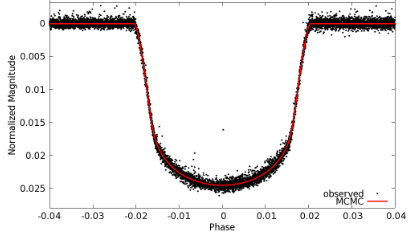
The authors have acquired 31 new transit light-curves over four years, and detect a trend under which the latest transits occur about a minute early compared to an unchanging ephemeris.

WASP-12b orbital period decay

Transits of WASP-12b. O–C is the observed time compared to that calculated from an unchanging orbital period. The time (x-axis) is given in both a count of days (BJD) and a count of transits.

This is the most convincing claim yet of a changing orbital period in a hot Jupiter. Whether it shows the spiral infall, though, is less clear. As the authors explain, other tidal interactions between the star and the planet, such as that causing apsidal precession, could account for the effect. Further, in close binary stars there are known to be similar period changes on decade-long timescales that are not fully understood, but which might be caused by Solar-like magnetic cycles on the star.

One suggestion that this is not spiral infall comes from the deduced value of the tidal quality factor, Q, which the authors calculate as 2.5 x 10⁵. This is lower than other estimates of Q as nearer 107.

The way to settle the issue will be to accumulate more data over a longer timespan until the case for spiral infall becomes overwhelming. It will thus be important to continue monitoring WASP-12b, and the other short-period hot Jupiters, over the coming decades.