Monthly Archives: February 2016

Looking forward to WASP planets with JWST

The $6-billion James Webb Space Telescope “will likely revolutionize transiting exoplanet atmospheric science due to a combination of its capability for continuous, long duration observations and its larger collecting area, spectral coverage, and spectral resolution compared to existing space-based facilities”, write Kevin Stevenson et al in a new paper looking forward to Cycle 1 observations of exoplanets with JWST.

Of interest to us is at WASP that, of the “community targets” identified by Stevenson et al as the best targets for characterizing exoplanet atmospheres in Cycle 1, seven of the twelve are WASP planets, and in particular “the most favorable target is WASP-62b because of its large predicted signal size, relatively bright host star, and location in JWST’s continuous viewing zone”.

This independent assessment validates WASP’s program of finding exoplanets transiting relatively bright stars, where they make the best targets for ongoing detailed studies.

JWST is now not that far off, as Stevenson et al remind us with this timeline:

Timeline Of James Webb Space Telescope

Five more WASP transiting hot Jupiters

The WASP-South camera array, in conjunction with the Euler/CORALIE spectrograph and the TRAPPIST photometer, continues to be the world’s most prolific programme for discovering hot Jupiters transiting relatively bright stars of V < 13.

The lastest batch of five (WASP-119b, WASP-124b, WASP-126b, WASP-129b and WASP-133b) was announced by Maxted et al this month.

The discovery has reported by the Daily Mail, The Times of India, and The Hindu, and has been covered by about twenty news websites including Phys.org, wired.co.uk, scienceworldreport.com, techtimes, I4U News, and siliconrepublic.

Hot Jupiter exoplanet

Artist’s impression of a ‘hot Jupiter’. Credit: Ricardo Cardoso Reis (CAUP)

This derived from a piece by Tomasz Nowakowski, of Phys.org, which includes:

“WASP-126b is the most interesting because it orbits the brightest star of the five. This means it can be a target for atmospheric characterization, deducing the composition and nature of the atmosphere from detailed study, for example with the Hubble Space Telescope or the forthcoming James Webb Space Telescope,” Coel Hellier, one of the co-authors of the paper, told Phys.org.”

And:

“NASA’s Transiting Exoplanet Survey Satellite … might find smaller transiting exoplanets in these systems, as the Kepler K2 mission did with our previous discovery WASP-47. TESS, however, will do this for nearly all WASP planets, whereas K2 is restricted to an ecliptic strip, and so can only look at a few WASP planets,” Hellier said.”.

The rigidity of hot-Jupiter exoplanet HAT-P-13b

It is fairly amazing what one can deduce about planets orbiting distant stars. A new paper by Peter Buhler et al reports constraints on the rigidity of the hot-Jupiter exoplanet HAT-P-13b.

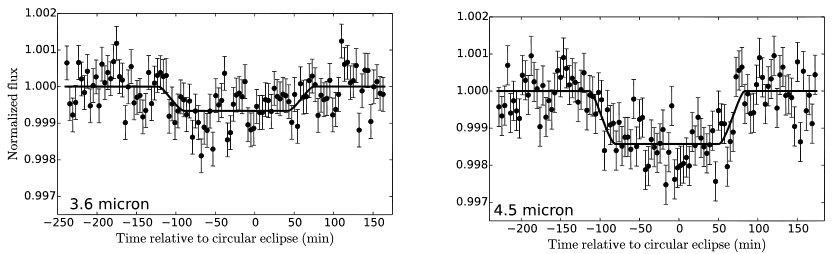
The essential data comes from an observation of the occultation of the planet (when it passes behind the host star), as observed in infra-red light by the Spitzer Space Telescope.

Occultation of HAT-P-13b

If the planet’s orbit were exactly circular the occultation would occur exactly half a cycle after the transit. But this occultation is 20 minutes early. That means that the orbit is slightly elliptical, amounting to an eccentricity of 0.007 +/– 0.001, a small but non-zero value.

Most hot Jupiters are expected to have orbits which have been completely circularised by tidal forces. Thus an eccentric orbit implies either that the planet has only relatively recently moved into that orbit, or that the eccentricity is being maintained by the gravitational effects of a third body.

In this case another planet, HAT-P-13c, a 14-Jupiter-mass planet in a longer 446-day orbit, is thought to be perturbing the close-in hot Jupiter HAT-P-13b.

The extent of the perturbation then tells us about the rigidity of the hot Jupiter. Tidal forces result from the fact that gravity differs across an extended body such as a planet, and how a planet reacts to the tidal stress depends on its rigidity.

The rigidity is parametrised by the “Love number”, and the authors find that the eccentricity of HAT-P-13b’s orbit implies a Love number of 0.3. This in turn implies that the planet likely has a rocky core of about 11 Earth masses, with the rest being an extended gaseous envelope.

Exoplanet cloudiness from transit lightcurves?

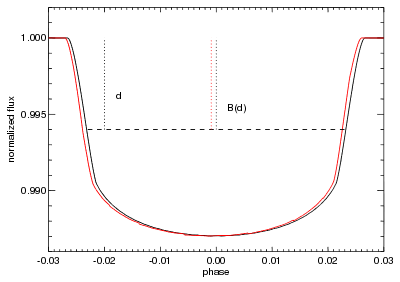
An interesting new paper by von Paris et al has explored the effect of the cloudiness of a planet on transit lightcurves. If a planet were cloudy on one limb, but clear on the other limb, then that could make the transit slightly asymmetric. The authors show that, in principle, this effect could be detectable with good-enough quality lightcurves.

An apparent shift in the transit:

Shifted transit

Would then lead to residuals, relative to a “perfect” transit, looking like:

traresids

The authors then claim a possible detection of such an effect in the hot Jupiter HAT-P-7b.

This might open up a new way of exploring the atmospheres of exoplanets. Whether this can ever be done reliably, however, is debatable. A big assumption in the authors’ simulations is that the star being transited is uniform. However, we know that stars are usually magnetically active and so are patchy. Star spots and bright patches on the star are likely to have a greater effect on the transit profile than the cloudiness of the planet’s atmosphere. Still, the effect is worth exploring, particularly for planets transiting magnetically quiet stars.