Here’s a thread by Joshua Lothringer (@JDLothringer) who researches exoplanet atmospheres at Johns Hopkins University. It’s based on his new paper on arXiv:







Here’s a thread by Joshua Lothringer (@JDLothringer) who researches exoplanet atmospheres at Johns Hopkins University. It’s based on his new paper on arXiv:
WASP-107b is a hugely bloated planet, with a mass of only two Neptunes, but a radius near that of Jupiter, making it one of the puffiest planets known. As such it has been heavily studied, and indeed was the exoplanet showing the first detection of helium.
Long-term monitoring of the WASP-107 system with the Keck telescope has now revealed a companion planet, WASP-107c, as announced by Caroline Piaulet et al.

The new planet is in a much wider orbit, with a period of 1088 days and a high eccentricity of e = 0.26. It likely does not transit, and has a mass of perhaps a third that of Jupiter.
The discovery of a second planet is important for understanding the nature of WASP-107b itself. The tight, 5.7-d orbit, and the fact that the orbit is mis-aligned with the star’s rotation, might be explained by gravitational interactions with the second planet. The bloated size could then result from tidal interactions with the host star, as the planet circularised in its orbit, after the interactions with WASP-107c.

The authors conclude that, “Looking ahead, WASP-107b will be a keystone planet to understand the physics of gas envelope accretion”, starting with a planned observation with the soon-to-be-launched JWST.
James Webb’s “Continuous Viewing Zone” is the patch of sky where the satellite can point continuously at a target and so observe it most efficiently. Exoplanets within the CVZ that are suitable for atmospheric characterisation are thus of high importance, and so far WASP-62b is the only gas giant known within the CVZ.
Munazza Alam et al have now pointed the Hubble and Spitzer space telescopes at WASP-62b to see what its atmosphere looks like. Importantly, they find that WASP-62b has clear skies. This matters since cloudy or haze-filled atmospheres tend to produce flat spectra lacking any spectral features, and so don’t tell us much.
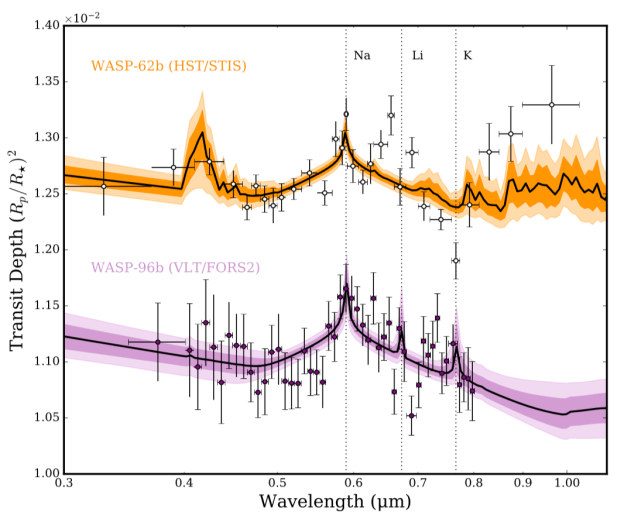
Here, Alam et al plot the spectrum near the sodium (Na) line, showing that it has a broad base, akin to that in the clear-skied planet WASP-96b. The broad base of the line means that it is being widened by “pressure broadening”, and that can only happen deep in the planet’s atmosphere where the pressure is high. And we can only see deep into the atmosphere if it is clear rather than cloudy.
Clear skies mean that spectral features produced by the molecules in the atmosphere should be readily detectable with JWST. Here Alam et al simulate what we expect to see with JWST, showing that Na, H2O, NH3, FeH, SiH, CO, CO2, and CH4 can all be detected.

They conclude by saying that: “As the only transiting giant planet currently known in the JWST Continuous Viewing Zone, WASP-62b could prove a benchmark giant exoplanet for detailed atmospheric characterization in the James Webb era.
ESPRESSO is ESO’s state-of-the-art spectrograph for the Very Large Telescope, specifically designed to get the best data possible on planetary systems.
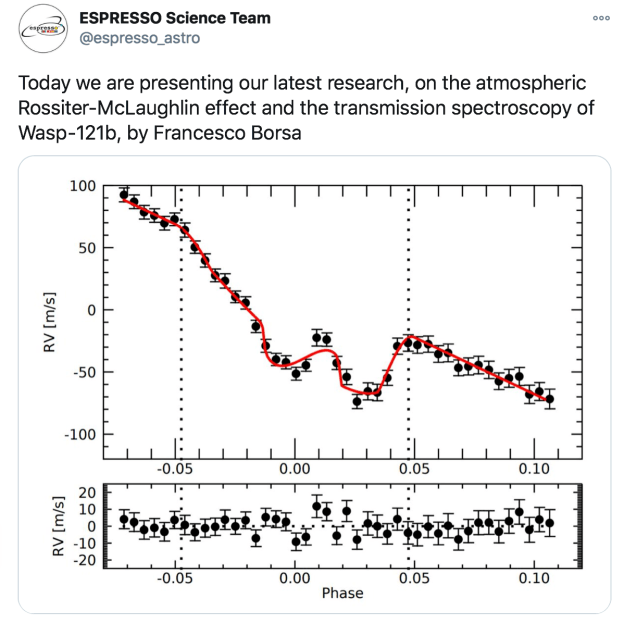
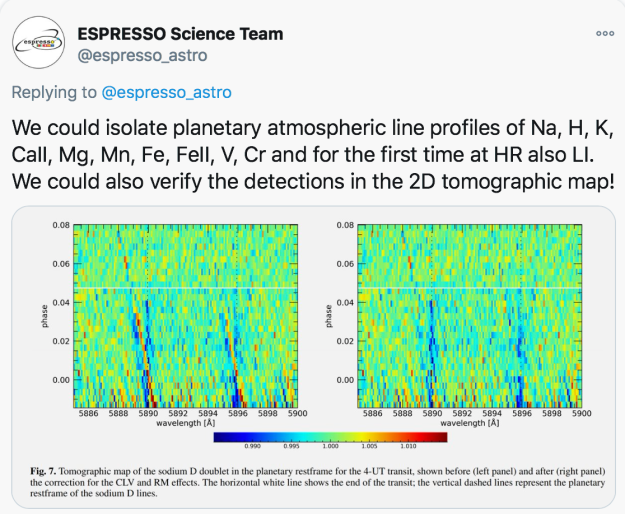
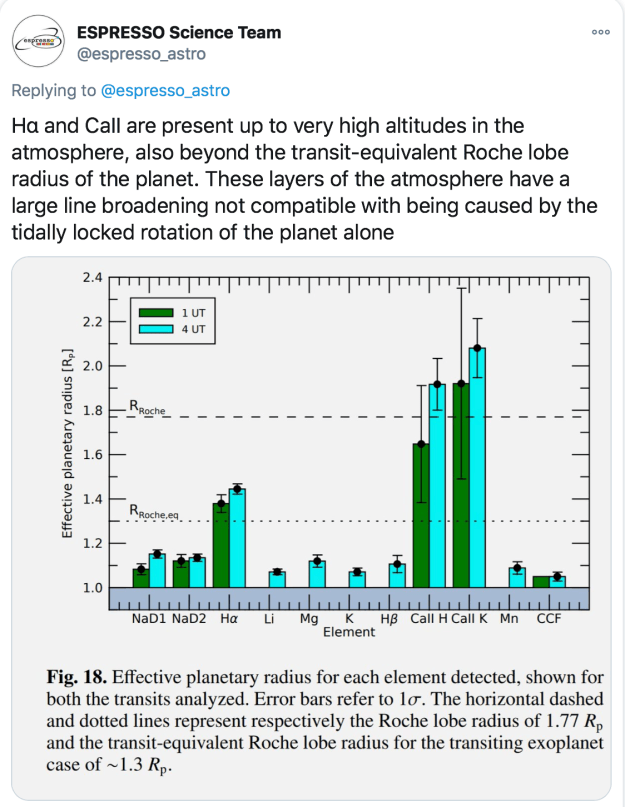
Francesco Borsa et al have pointed ESPRESSO at transits of the ultra-hot-Jupiter WASP-121b, and the ESPRESSO team have put out a series of Tweets explaining the paper:


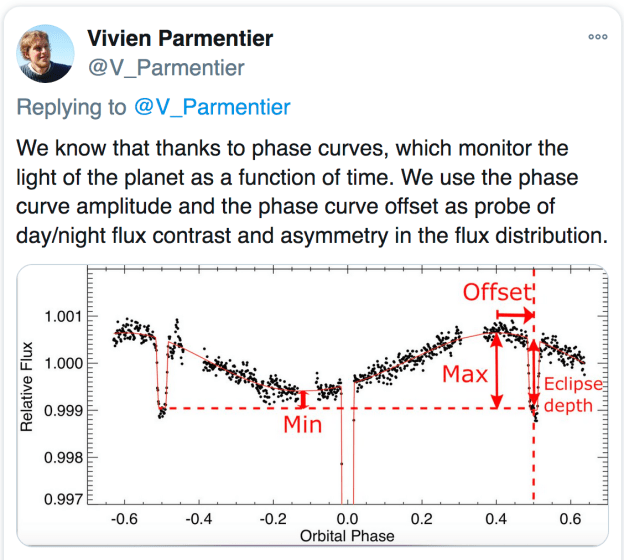
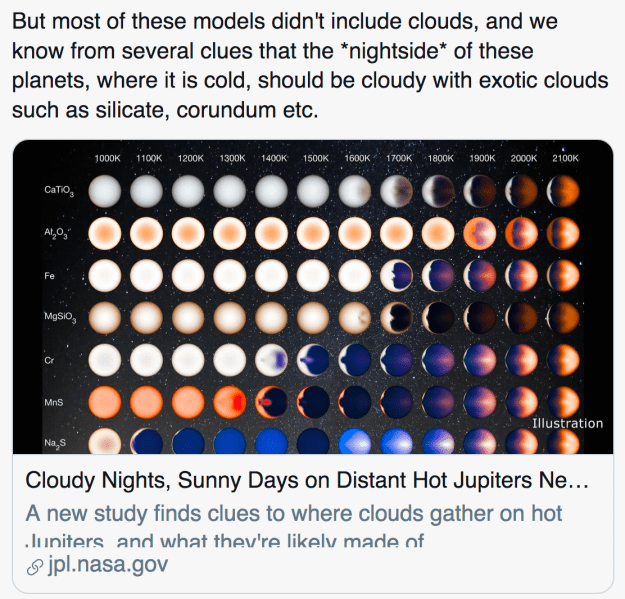
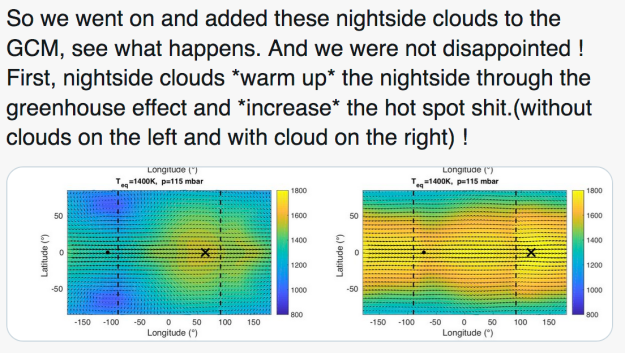
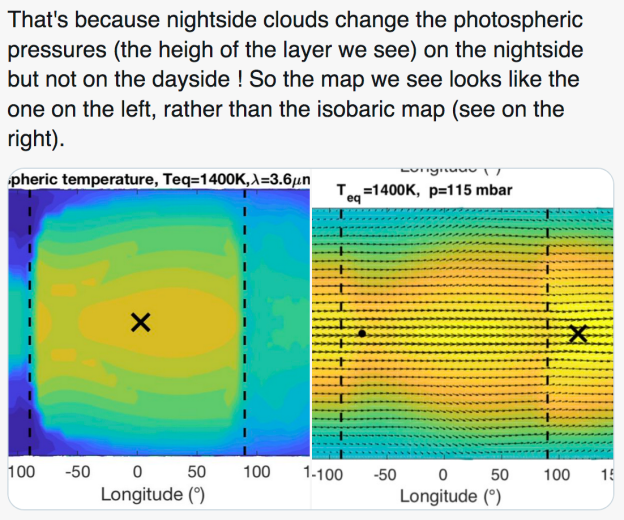
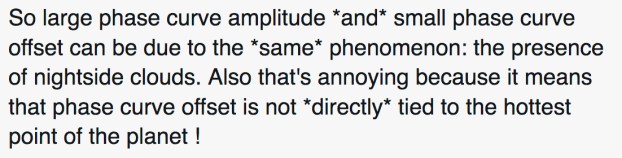
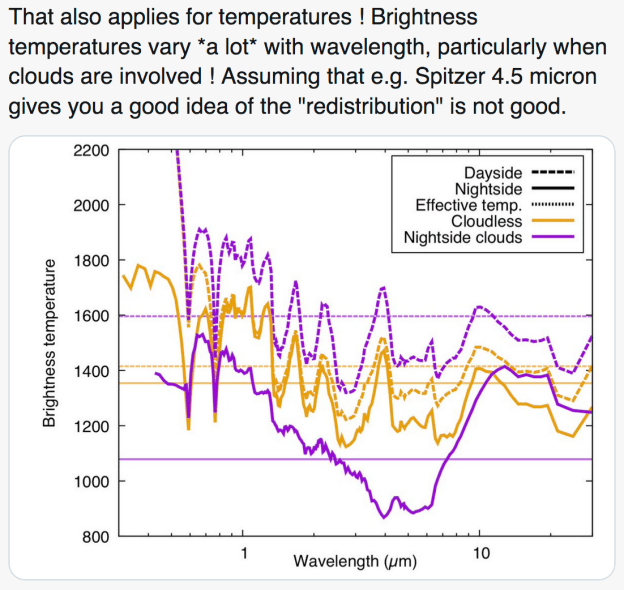
Vivien Parmentier (Oxford University, @V_Parmentier) has produced an explanatory Twitter thread on his latest paper with Jonathan Fortney (@jjfplanet). Since this concerns WASP exoplanets, let’s reproduce it here:


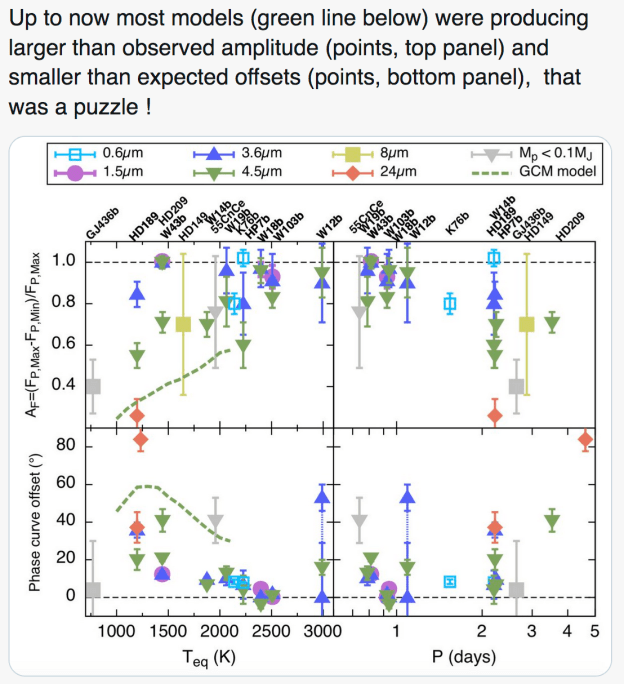



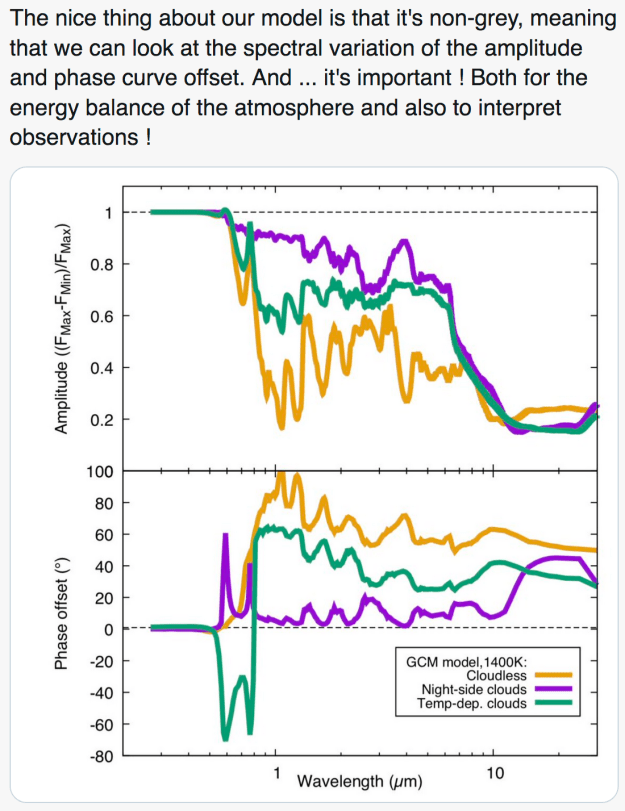

[The symbols include data points for WASP-43b, WASP-14b, WASP-19b, WASP-18b and WASP-103b, along with other hot Jupiters.]


Here’s an interesting plot created by Zafar Rustamkulov (@exoZafar), a PhD student at Johns Hopkins University. He has added up all the exoplanets for which we have either transmission spectra (blue), emission spectra (red) or both (pink), and plotted the planet’s size and orbital period.
Most atmospheric characterisation has been done on the hot Jupiters (top left of the plot), since these are the easiest to study. Their large size and often bloated, fluffy outer layers produce the largest spectral signals. Smaller planets are harder to study, unless their host stars are very bright or very small (such that the fraction blocked by the planet during transit is relatively large).

For the planets for which we have over 50 spectra Zafar has added the planet’s name (though the lettering is rather small!). This shows that roughly half of the most-studied exoplanets come from the WASP survey. WASP-12b, WASP-33b and WASP-39b are in the Northern Hemisphere and came from the SuperWASP-North survey. WASP-17b, WASP-19b, WASP-31b, WASP-43b, WASP-80b, WASP-107b, WASP-121b and WASP-127b are in the South and so are from the WASP-South survey.
ESA’s Cheops satellite (the Characterising Exoplanet Satellite) started observing this year, and ESA has just put out a press release announcing its first science results. Cheops looked at transits and occultations of WASP-189b, an ultra-hot Jupiter in a polar orbit transiting a bright star.

“Only a handful of planets are known to exist around stars this hot, and this system is by far the brightest,” says Monika Lendl of the University of Geneva, Switzerland, lead author of the new study. “WASP-189b is also the brightest hot Jupiter that we can observe as it passes in front of or behind its star, making the whole system really intriguing.”
At a visual magnitude of V = 6.6, WASP-189 is the brightest host star of all the WASP planets. The discovery of the transiting hot Jupiter was announced in 2018 in a paper led by David Anderson. The exceptional nature of WASP-189 thus made it a prime target for Cheops.
The Cheops study shows that: “the star itself is interesting – it’s not perfectly round, but larger and cooler at its equator than at the poles, making the poles of the star appear brighter,” says Dr Lendl. “It’s spinning around so fast that it’s being pulled outwards at its equator!”
“This first result from Cheops is hugely exciting: it is early definitive evidence that the mission is living up to its promise in terms of precision and performance,” says Kate Isaak, Cheops project scientist at ESA.
Press coverage has included articles in CNN, CTV, the International Business Times, The Sun, The Mirror, The Daily Mail, The Express and over 30 other news sites.
A new paper by Sarah Millholland et al reconsiders highly bloated, low-mass planets such as WASP-166b. One explanation for the low mass of such planets is that they have small cores and are mostly gaseous envelope. However, having a relatively small core is at odds with core-accretion theory for the formation of such planets, which says that they can only gravitationally attract and then accrete large envelopes if the core is sufficiently massive.
Instead, Millholland et al suggest that the envelope is a smaller fraction of the planet’s mass than it seems, and that instead it has expanded to its current bloated state by tidal heating. A small eccentricity of the orbit is sufficient to produce tidal dissipation that heats the envelope and thus causes it to expand.

In the figure, the authors plot the fraction of the planet that is envelope, assuming no tidal heating, and also the smaller fraction when accounting for the effects of tidal heating. The reduction makes the proportions compatible with core-accretion theory. Millholland et al suggest that: “many sub-Saturns may be understood as sub-Neptunes that have undergone significant radius inflation, rather than a separate class of objects”.
Thomas Mikal-Evans et al have released a new paper analysing the heated, dayside face of WASP-121b. Teams studying the atmospheres of exoplanets either look at the transit, when the planet’s atmosphere is projected against the host star, such that molecules produce absorption features in the spectrum, or they study the eclipse, when the heated face of the planet disappear and then reappears. In the latter, atmospheric molecules produce emission features in the spectrum.

Here is the spectrum of the heated face of WASP-121b, based on recording five eclipses using the WFC3 spectrograph on the Hubble Space Telescope. The orange line and yellow banding show the spectrum expected for a pure black body of the same temperature as the planet. The red lines then show model fits, which reveal emission features caused by H− ions and water (H2O) molecules.




 WASP Planets