The rigidity of hot-Jupiter exoplanet HAT-P-13b

It is fairly amazing what one can deduce about planets orbiting distant stars. A new paper by Peter Buhler et al reports constraints on the rigidity of the hot-Jupiter exoplanet HAT-P-13b.

The essential data comes from an observation of the occultation of the planet (when it passes behind the host star), as observed in infra-red light by the Spitzer Space Telescope.
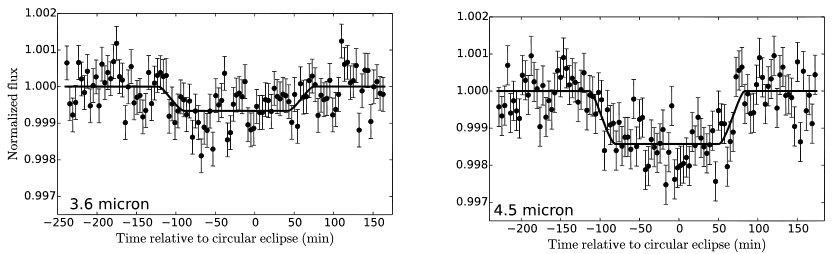
Occultation of HAT-P-13b

If the planet’s orbit were exactly circular the occultation would occur exactly half a cycle after the transit. But this occultation is 20 minutes early. That means that the orbit is slightly elliptical, amounting to an eccentricity of 0.007 +/– 0.001, a small but non-zero value.

Most hot Jupiters are expected to have orbits which have been completely circularised by tidal forces. Thus an eccentric orbit implies either that the planet has only relatively recently moved into that orbit, or that the eccentricity is being maintained by the gravitational effects of a third body.

In this case another planet, HAT-P-13c, a 14-Jupiter-mass planet in a longer 446-day orbit, is thought to be perturbing the close-in hot Jupiter HAT-P-13b.

The extent of the perturbation then tells us about the rigidity of the hot Jupiter. Tidal forces result from the fact that gravity differs across an extended body such as a planet, and how a planet reacts to the tidal stress depends on its rigidity.

The rigidity is parametrised by the “Love number”, and the authors find that the eccentricity of HAT-P-13b’s orbit implies a Love number of 0.3. This in turn implies that the planet likely has a rocky core of about 11 Earth masses, with the rest being an extended gaseous envelope.
Exoplanet cloudiness from transit lightcurves?

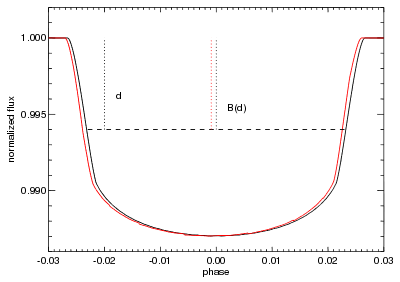
An interesting new paper by von Paris et al has explored the effect of the cloudiness of a planet on transit lightcurves. If a planet were cloudy on one limb, but clear on the other limb, then that could make the transit slightly asymmetric. The authors show that, in principle, this effect could be detectable with good-enough quality lightcurves.

An apparent shift in the transit:

Shifted transit

Would then lead to residuals, relative to a “perfect” transit, looking like:

traresids

The authors then claim a possible detection of such an effect in the hot Jupiter HAT-P-7b.

This might open up a new way of exploring the atmospheres of exoplanets. Whether this can ever be done reliably, however, is debatable. A big assumption in the authors’ simulations is that the star being transited is uniform. However, we know that stars are usually magnetically active and so are patchy. Star spots and bright patches on the star are likely to have a greater effect on the transit profile than the cloudiness of the planet’s atmosphere. Still, the effect is worth exploring, particularly for planets transiting magnetically quiet stars.

Radial velocities of the Sun as an exoplanet host star

The main way of measuring the mass of an extra-solar planet is to record the motion of the host star, caused by the gravitational tug of the planet as it orbits. One can do that by measuring the Doppler shift (radial velocity or RV) of the spectrum of the host star.

However, as a planet gets smaller or further from its star, the tug gets smaller, and so the radial-velocity signal decreases. At some point it gets smaller than the intrinsic variations in spectral lines caused by the magnetic activity of the star. Whether one can account for this will limit our ability to prove the existence of small planets in wide orbits.

Radial velocity of the Sun, bounced off the asteroid Vesta

A team lead by Raphaëlle Haywood, of the University of St. Andrews, and now at Harvard, had the idea of treating our own Sun as a star, by looking at the RV signal in sunlight bounced off the asteroid Vesta. They could then compare the RV signal to images of the magnetic activity on our Sun.

Magnetic activity on the Sun.

Magnetic activity across the Sun’s disc

The spectral lines from each region of the Sun’s disc will depend on the local magnetic activity, but the RV measurement bounced off Vesta would be from light averaged over the whole disc of the Sun, just as we’d record from a star.

The results are shown in the plot below. The top panel shows the variations in the measured RV signal, in metres per second. The second panel shows the magnetic flux aggregated across the Sun’s disc, in Gauss. The third panel shows the fraction of the Sun’s disc filled by magnetic activity (Sun spots).

Radial velocity variations of our Sun

Thus a Sun-like star can show intrinsic RV variability at a level of metres per second, and this will cause a problem for detecting the small RV signals of low-mass planets in wide orbits. For example our Earth produces motion in our Sun of only 0.1 metre per second. Unless there are stars much less magnetically active than our Sun, it is going to be hard to obtain an accuracy sufficient to detect the RV signal of an Earth-like planet in an Earth-like orbit.

The authors note, though, a strong correlation between the RV signal and the total magnetic activity. Thus it might be possible to decorrelate against magnetic activity to provide a way of correcting RV signals for this effect, and so dig out smaller signals caused by planets.

Clear skies for cool Saturn WASP-39b

Transmission spectroscopy of exoplanet atmospheres — looking at the atmosphere of a planet in transit, backlit by the light of its star — is one of the major growth areas in studying WASP planets.

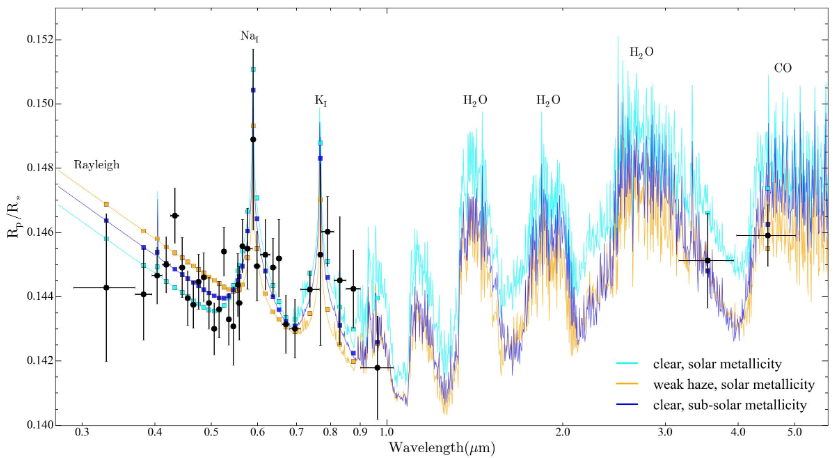
The latest such study is by Patrick Fischer and colleagues, who pointed the Hubble Space Telescope with its STIS spectrograph at WASP-39b in transit.

The plot shows the resulting data compared with three models of WASP-39b’s atmosphere (depending on how clear or hazy it is, and on the metal abundance compared to the Sun).

WASP-39b exoplanet atmosphere spectrum

Unlike some hot Jupiters, which have very hazy atmospheres with few spectral features, WASP-39b shows a clear detection of potassium and sodium, as expected in largely clear skies.

Comparing to the hazier planets HD 189733b and WASP-6b, Fischer et al remark: “These observations further emphasize the surprising diversity of cloudy and cloud-free gas giant planets in short-period orbits and the corresponding challenges associated with developing predictive cloud models for these atmospheres”.

Calculations of hot-Jupiter tidal infall

Closely orbiting hot Jupiters raise a tidal bulge on their star, just as our Moon does on Earth. Since the planet is orbiting faster than the star rotates, the tidal bulge will tend to lag behind the planet and so its gravitational attraction will pull back on the planet. The orbit of the planet is thus expected to decay, with the planet gradually spiralling inwards to destruction.

Calculating how long this will take is hard, and depends on the efficiency with which energy is dissipated in the tidal bulge of the star. This is summed up by a number called a quality factor, Q, which is, crudely, the number of orbital cycles required to dissipate energy. The higher this number the slower the decay of the planet’s orbit.

In a new paper, Reed Essick and Nevin Weinberg, of the Massachusetts Institute of Technology, present a detailed calculation of Q for hot Jupiters orbiting solar-like stars. They arrive at values for Q of 105 to 106, assuming a planet above half a Jupiter mass and an orbital period of less than 2 days.

Hot Jupiter orbital decay timescales

The figure shows the resulting infall timescales of all the hot Jupiters predicted to have remaining lifetimes of less than 1 Gyr. By far the smallest lifetime is that for WASP-19b, which is predicted to spiral into its star within 8 million years. This would mean that shifts in WASP-19b’s transit times would be readily detectable, with a shift accumulating to 1 minute in only 5 years.

The calculations presented here are at odds with deductions that Q must be around 107, based on explaining the current distribution of hot-Jupiter periods (e.g. Penev & Sasselov 2011), which would give a much slower orbital decay. We can determine who is right by monitoring transits of WASP-19b and similar systems over the coming decade, and it will be interesting to discover who is right.

Energy recirculation in the hot Jupiter WASP-19b

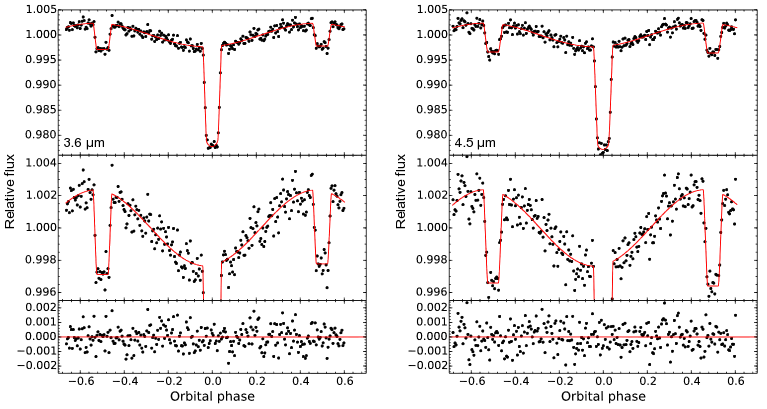
A team led by Ian Wong of Caltech have announced observations of the hot Jupiters WASP-19b and HAT-P-7b, looking at infra-red light using the Spitzer Space Telescope. By observing the planets around their entire orbit they detect the transit, caused by the planet passing in front of the host star, the secondary eclipse, when the planet passes behind the star, and the “phase curve” caused by the changing visibility of the heated face of the planet.

WASP-19b Spitzer lightcurve

The figure shows the infra-red light (“heat”) of the WASP-19 system in two pass bands (3.6 microns and 4.5 microns). The middle panels are expanded to show the phase curve, while the lowest panels show the residuals about a fitted model (the red line).

By fitting all three features, the authors can constrain the temperatures of the “day time” heated face of the planet (which faces towards us near the secondary eclipse) and of the “night time” face of the planet (which faces us near transit). From there they can estimate the “recirculation”, how efficient the planet is at redistributing heat from the day-time face to the night-time face.

Such short-period planets are phase-locked by tidal forces, and so always present the same face to the star. Thus redistribution of heat energy requires powerful winds circling the planet.

An interesting plot by Wong et al shows the recirculation in different hot Jupiters against the albedo (the fraction of energy that is reflected).

Energy recirculation in hot Jupiters.

There appear to be two groups of hot Jupiters: ones with albedos near 0.4, such as WASP-19b, and ones with much lower albedos, such as WASP-14b and WASP-18b. So far there is no simple explanation for this difference.

Further, the recirculation efficiency also appears to be different in different systems. Wong et al suggest that the hot Jupiters experiencing the highest irradiation, such as WASP-19b, are least efficient at redistributing heat, while
longer-period, less-irradiated hot Jupiters such as HD209458b and HD189733b are better at redistribution.

Hubble study of water in hot-Jupiter atmospheres

NASA have put out a press release regarding the largest-ever study of hot-Jupiter atmospheres by the Hubble Space Telescope and the Spitzer Space Telescope. Of the ten planets studied, six are WASP discoveries.

Clear to cloudy hot Jupiters (annotated)

The results, published in Nature, report that hot Jupiters are a diverse group that have atmospheres ranging from clear to cloudy. Strong water absorption lines are seen when the planets have a clear atmosphere, but less so when the atmospheres are dominated by clouds and hazes.

hubble_water

Planets such as WASP-17b and WASP-19b have clear atmospheres and show the strongest water features, whereas planets such as WASP-12b and WASP-31b are more cloudy.

The NASA press release has so far resulted in articles on over 110 news websites worldwide. The paper was lead-authored by David Sing of the University of Exeter.

Magnetospheres of hot Jupiters

If a hot Jupiter has a magnetic field of a few Gauss it would be surrounded by a magnetosphere that would carve out a hole in the stellar wind of the host star. Since the planet orbits rapidly, this would lead to a “bow shock” where the magnetosphere ploughs through the stellar wind.

In a new paper, Richard Alexander, of the University of Leicester, and co-authors, report computer simulations of this effect for several hot Jupiters, including WASP-12b and WASP-18b.

Hot Jupiter magnetospheres

In the colour-coded figure (see scale on the right) the blue and red show the density of the stellar wind. A low-density (black) magnetosphere surrounds each planet (white dots).

Since these planets orbit edge on to us, the bow shock would absorb ultra-violet light from the star, and so produce a characteristic light-curve with a broad dip preceding the transit.

Hot Jupiter magnetospheric light curves

This magnetospheric bow-shock is a possible alternative explanation for the UV absorption observed in WASP-12, which has previously been attributed to material being lost from the planet owing to Roche-lobe overflow. Alexander et al suggest that WASP-18 is a critical test of these models, since the much higher gravity of the massive planet WASP-18b means that there should not be any Roche-lobe overflow.

Possible orbital period decay in WASP-43b?

Since hot-Jupiter planets have close-in orbits they will raise a tidal bulge on their host star. Since the planet’s orbit is faster than the star’s rotation, that bulge will tend to lag behind the planet. Its gravity will thus pull back the planet slightly, draining angular momentum from the planet’s orbit.

Hot Jupiters, especially the shortest-period ones, are thus expected to be gradually spiralling inwards, and many will eventually spiral into their star. An important issue is how fast this happens. We can obtain theoretical estimates, but it would be good to have a direct measurement of the decay. Thus the transits of the shortest-period hot Jupiters are being monitored to see whether their orbital period is decreasing.

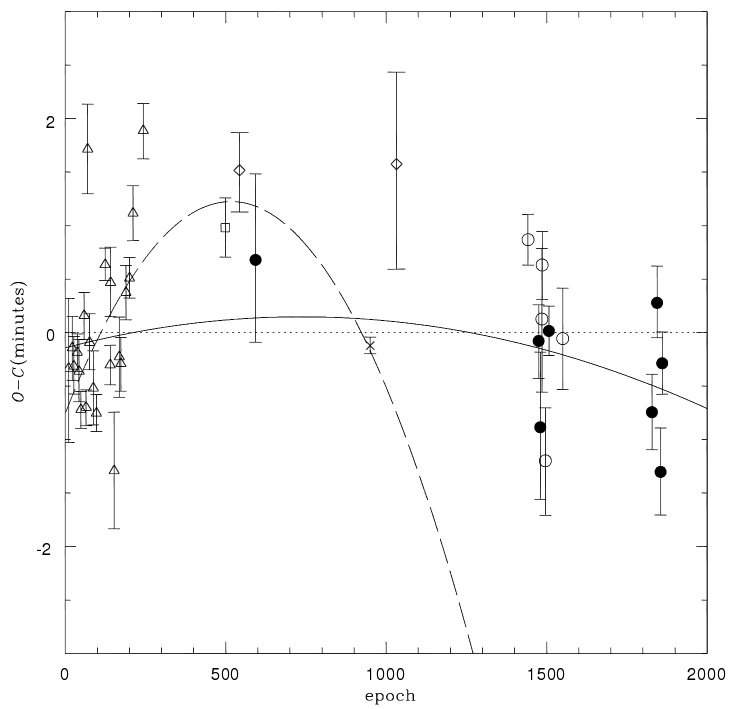
Ing-Guey Jiang et al have just produced a paper based on new transit observations of WASP-43b, an ultra-short-period hot Jupiter which orbits in 0.81 days. They arrive at this plot:

Transit timings and period decay in WASP-43b

The x-axis is time, in a count of transits, while the y-axis is the “observed minus calculated” time of transits, being the observed deviation of a transit timing from the expected time. The data points are the transit timings by Jiang et al and from previous papers.

A constant orbital period would correspond to the dotted line. A very fast period change (as has been previously suggested) would correspond to the dashed curve, and Jiang et al now rule that out. Their best fit is the solid curved line, which has a slower rate of change, but still seems to suggest a changing orbital period.

This is interesting work, and if it really does reveal a period change in WASP-43b then it is highly important. My feeling is to be cautious for now. It is clear from the plot that there is scatter in the transit timings that is larger than the error bars, and we don’t really know what short-term or medium-term “noise” there might be in exoplanet transit timings, since we’re only beginning to study them.

The period change suggested by Jiang et al corresponds to a tidal decay rate specified by the number Q = 105 (where “Q” is the tidal “quality factor” that depends on how much energy is dissipated in the tidal bulge on the star during each orbit). However, it is generally considered that the Q values are more likely to be 107 for hot Jupiters (see here), which would produce a much slower orbital decay.

Thus, the period change in the above figure could be a short-timescale fluctuation (for ill-understood reasons) rather than the true long-term orbital-period decay. The fact that, by adding more timings, Jiang et al have reduced the previous estimate for the period change by an order of magnitude suggests that the same might happen given future timings. Still, this is important work, and it will be interesting to see how it progresses.

Inhabitants of WASP-47 could see an Earth transit!

The planetary system WASP-47 is highly popular at the moment, following the K2 discovery of two more transiting exoplanets, and the radial-velocity detection of a longer-period outer planet, in addition to the orginal hot Jupiter, WASP-47b.

But here’s an additional curiosity: WASP-47 is so close to the plane of our own solar system, aligned to better than 0.26 degrees, that Earth would be seen to transit from WASP-47!

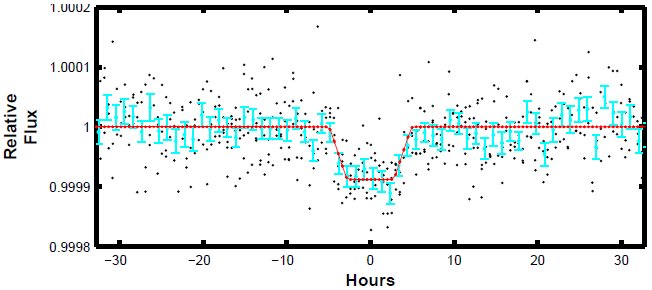
Christopher Burke, of the SETI Institute, has produced this graphic of an Earth transit as seen from the location of WASP-47.:

Earth transit seen from WASP-47

And, supposing that the inhabitants of the WASP-47 system had a spacecraft like Kepler, this is what the transit they might record would look like:

Earth transit seen from WASP-47

Of course it is only speculation that there are inhabitants of WASP-47, though, with four planets known so far in the system, there might be some planet or moon that is inhabitable. If they had detected Earth, they might then point their biggest telescope at the next transit, and perhaps find free oxygen in Earth’s atmosphere, and so deduce that Earth has life.

Chris Burke suggests that WASP-47 is a very good SETI target; they might already know about us!