Category Archives: WASP planets

WASP-104b is Darker than Charcoal

Hot Jupiter WASP-104b was observed in Campaign 14 of the Kepler K2 mission, leading to superb-quality photometry covering 45 orbital cycles of the planet.

Keele graduate student Teo Močnik has analysed the data and concluded that WASP-104b is one of the darkest exoplanets known, reflecting less than 3% of the light from its star.

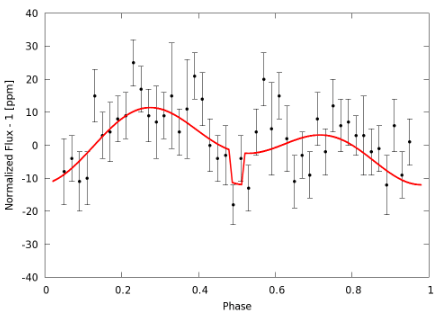
The conclusion comes from interpreting the “phase curve” produced when the photometry is folded on the planet’s orbital period. Variations in the light are expected to come from the transit and occultation (when the planet passes in front of and behind the star, respectively), from the gravitational distortion of the host star caused by the close-in planet, and from the reflection of starlight.

The phase curve of WASP-104b, as observed by K2, fitted with a red-line model.

The low albedo of the planet is a surprise, but might indicate the absence of clouds (which can be highly reflective) or the presence of ions such as sodium and potassium that absorb light.

The story of WASP-104b was reported by New Scientist, and that then led to articles in Science Alert, Metro, the Daily Mail, Newsweek, the International Business Times, Tech Times and other locations.

Comparing WASP-173 to KELT-22

WASP-173 and KELT-22 are the same object. The WASP and KELT teams are both trying to find transiting exoplanets around relatively bright stars, and this means that sometimes our discoveries overlap. We announced that WASP-173 hosts a hot Jupiter in a paper on arXiv on the 7th March, and then on the 21st March KELT reported an entirely independent discovery of the same planet.

Since the two teams use different facilities, techniques and software, comparing the two sets of system parameters provides an interesting check on the methods. So let’s see how similar the reports are.

WASP-173Ab discovery photometry

The biggest difference is a somewhat different transit depth. We (WASP) report a depth of 0.0123 ± 0.0002 whereas KELT report 0.0145 ± 0.0008, where the difference is greater than the error bars quoted. Now this system is a double star, with a companion star 6 arcsecs away and 0.8 magnitudes fainter. That makes it hard to measure the depth. One either uses a much smaller photometric aperture than normal, excluding the nearby star, or one uses a much wider aperture, containing both stars, and makes a correction for the dilution of the companion. Either approach could introduce systematic errors more than normal. Then, of course, there could be red noise in the light-curves owing to observing conditions or stellar activity.

KELT-22Ab transit photometry

The greater depth in the KELT paper means they arrive at a slightly larger planet radius (1.29 ± 0.10 Jupiter radii) than we do (1.20 ± 0.06) but here the error ranges overlap. The planet mass (derived mostly from the radial velocity data) is comparable, 3.47 ± 0.15 Jupiter masses in the KELT paper, and 3.69 ± 0.18 in ours.

WASP-173Ab radial velocities (from CORALIE)

The differences in the parameters of the host star are all within the error ranges. KELT report a G2 star with an effective temperature of 5770 ± 50 K, a surface gravity (log g) of 4.39 ± 0.05, and a mass and radius of 1.09 ± 0.05 and 1.10 ± 0.08 in solar units, whereas WASP report a G3 star with effective temperature of 5700 ± 150 K, a surface gravity of 4.5 ± 0.2, and a mass and radius of 1.05 ± 0.08 and 1.11 ± 0.05.

KELT-22Ab radial velocities (from TrES)

Another comparison is the “impact factor” (how near the center-line the transit chord is), which we have as 0.40 ± 0.08 while KELT report 0.31 ± 0.18. Our higher value results from our having a higher transit width, 0.0957 ± 0.0007 days, compared to KELT’s 0.0981 ± 0.0025. Again, the differences point to red noise in the transit lightcurves, which is likely to produce uncertainties greater than the formal error bars.

Overall, the values are sufficiently similar that we can have broad confidence in the values, but the presence of systematic noise does need to be borne in mind.

Comprehensive Spectrum of WASP-39b

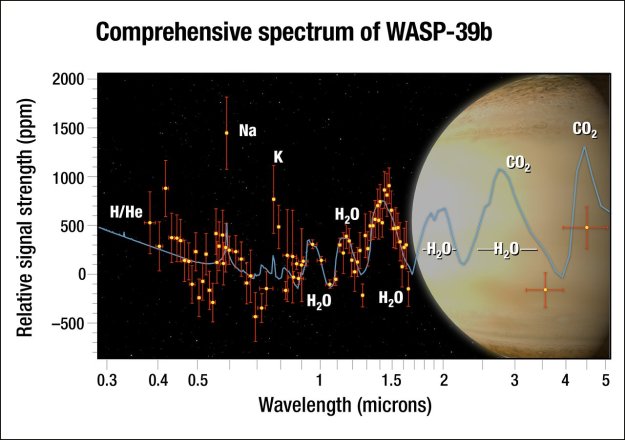
NASA, ESA and JPL have put out press releases on the atmospheric spectrum of WASP-39b. The paper by Hannah Wakeford et al combined Hubble and Spitzer data to produce a comprehensive spectrum with broad spectral coverage.

“Using Hubble and Spitzer, the team has captured the most complete spectrum of an exoplanet’s atmosphere possible with present-day technology. “This spectrum is thus far the most beautiful example we have of what a clear exoplanet atmosphere looks like,” said Wakeford.”

“WASP-39b shows exoplanets can have much different compositions than those of our solar system,” said co-author David Sing of the University of Exeter. “Hopefully, this diversity we see in exoplanets will give us clues in figuring out all the different ways a planet can form and evolve.”

The strongest features in the spectrum are caused by water:

“Although the researchers predicted they’d see water, they were surprised by how much water they found in this “hot Saturn.” Because WASP-39b has so much more water than our famously ringed neighbor, it must have formed differently. The amount of water suggests that the planet actually developed far away from the star, where it was bombarded by a lot of icy material. WASP-39b likely had an interesting evolutionary history as it migrated in, taking an epic journey across its planetary system and perhaps obliterating planetary objects in its path.”

Coverage of the press release includes that by Newsweek, the International Business Times, the Daily Mail and about 30 other websites.

WASP-18b has a smothering stratosphere without water

NASA Goddard Space Flight Center and NASA Jet Propulsion Laboratory have put out press releases about observations of WASP-18b with the Hubble Space Telescope and the Spitzer Space Telescope.

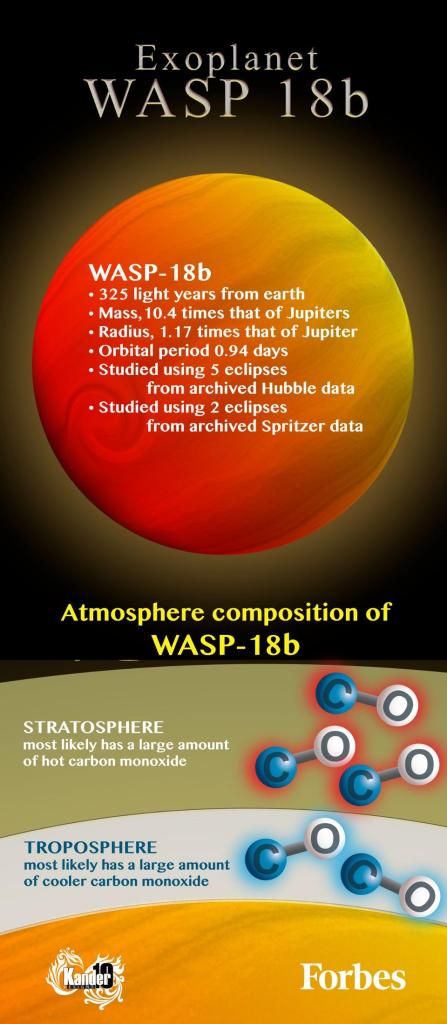
The main finding is that WASP-18b, a highly irradiated hot Jupiter in a tight orbit around a hot F-type star, is “wrapped in a smothering stratosphere loaded with carbon monoxide and devoid of water”.

The team determined this by detecting two types of carbon monoxide signatures, an absorption signature at a wavelength of about 1.6 micrometers and an emission signature at about 4.5 micrometers.”

The findings have been reported in many media outlets including: Newsweek, The Independent, The Sun, the Daily Mail, the International Business Times, phys.org, and more than 20 other websites including Forbes magazine, who have produced the following infographic:

WASP planets selected for James Webb Space Telescope ERS and GTO

Studying the atmospheres of exoplanets is one of the main goals of the James Webb Space Telescope, now scheduled for launch in mid 2019. The mission recently asked for proposals for “Early Release Science”, observations to test out the instruments, show what JWST can so, and supply the community with data to start analysing.

Of 13 ERS proposals accepted, the “The Transiting Exoplanet Community ERS Program”, led by Kepler lead-scientist Natalie Batalha, got all the time it asked for.

WASP planets feature heavily in the ERS program, since many transit relatively bright stars. Large, puffy gaseous planets will also give the strongest and clearest signals of atmospheric features, and so are optimum early targets. While JWST will want to look also at atmospheres of smaller, rocky planets, “Astronomers initially will train their gaze onto gaseous Jupiter-sized worlds like WASP-39b and WASP-43b because they are easier targets on which to [look for the chemical fingerprints of the atmosphere’s gases]”.

The target list for the ERS proposal is currently being finalised in the light of the recent delay in JWST launch from 2018 to 2019, though an earlier draft of the proposal featured 7 WASP planets out of 12 targets.

Further, the four GTO teams have also selected WASP planets for early JWST observations. GTO time (“Guaranteed Time Observations”) is time allocated to the teams who built the JWST instruments as a reward and incentive. All four instrument teams have picked WASP planets, including WASP-17b, WASP-52b, WASP-43b, WASP-69b, WASP-77Ab, WASP-80b, WASP-107b and WASP-121b.

Meanwhile, Kevin Heng, of the University of Bern, has written a popular-level account for American Scientist of how JWST is expected to revolutionise the study of exoplanet atmospheres.

Outer-orbiting companions of hot-Jupiter planets appear to be co-planar

On-going radial-velocity monitoring of WASP hot Jupiters has shown that some of them have companions, additional Jupiter-mass planets in much wider orbits.

This might be part of the answer as to why there are hot Jupiters at all. Standard planet-formation theory suggests that they must form much further out, where it is colder and where ice can form, enabling bits of pre-planetary debris to clump together. Thus one solution is that gravitational perturbations by third bodies (wide-orbit massive planets or companion stars) push the inner planets into highly eccentric orbits, where tidal capture then circularises them into hot-Jupiter orbits.

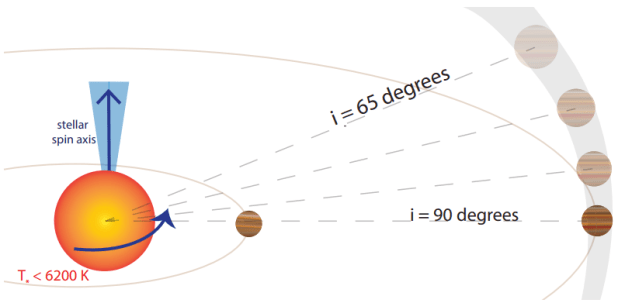
But, if this “Kozai effect” is to work, the outer planets need to be in orbits tilted with respect to the orbits of the hot Jupiters. This requires i < 65 degrees, rather than the co-planar i = 90 degrees.

A new paper by Juliette Becker et al reports an analysis of six hot-Jupiter systems orbiting cool stars that have an outer planetary companion. These are WASP-22, WASP-41, WASP-47, WASP-53, HAT-P-4 and HAT-P-13. Though a statistical analysis they show that the outer planets are most likely co-planar, with orbits tilted by no more than 20 degrees. They thus argue that Kozai-driven high-eccentricity migration is not the dominant way of forming hot Jupiters.

Precise masses for the WASP-47 exoplanetary system

In the discovery paper the exoplanet WASP-47b was introduced to the world with the description: “With an orbital period of 4.16 d, a mass of 1.14 MJup and a radius of 1.15 RJup, WASP-47b is an entirely typical hot Jupiter”.

And it did appear to be entirely typical until Juliette Becker et al looked at K2 lightcurves and found two more planets, a super-Earth orbiting inside the hot Jupiter (WASP-47e in a 0.79-d orbit) and a Neptune orbiting just outside it (WASP-47d in a 9-d orbit). Around the same time Neveu-VanMalle et al announced long-term monitoring showing another Jupiter-mass planet (WASP-47c), this one in a much wider orbit of 580 days. Thus WASP-47 was shown to host a whole exoplanetary system, one that is so-far unique.

Since then WASP-47 has been observed intensively in order to measure the planet masses and investigate the dynamics of the exoplanetary system. The state of play is now reported by Andrew Vanderburg et al. The planets’ host star is tugged around by the gravitational pull of the orbiting planets, leading to the following cyclical variations in the observed radial velocities:

Combining all the information, Vanderburg et al deduce that the innermost “super-Earth”, WASP-47e, is not dense enough to be made only of rock. Instead it likely has a liquid or gaseous envelope (possibly water or steam) surrounding an Earth-like core. That is unlike other ultra-short-period super-Earths which appear to be fully rocky.

From modelling the dynamical history of the system Vanderburg et al also deduce that the outermost planet, WASP-47c, is likely in an orbit that is in the same plane as those of the inner planets. If this were not the case then the system would not be stable. Thus they conclude that the likelihood that WASP-47c also transits its star, as seen from Earth, is relatively high, which should motivate a campaign to look for those transits.

First results on the atmosphere of WASP-107b

Being a Neptune-mass planet (0.12 MJ) bloated to a near-Jupiter radius (0.94 RJ) makes WASP-107b’s atmosphere very fluffy, and that, coupled with it transiting a moderately bright K star (V = 11.6) makes it a superb target for atmospheric characterisation.

Laura Kreidberg et al have pointed the Hubble Space Telescope at WASP-107b to make the first atmospheric study. Here’s the WFC3 spectrum:

Hubble Space Telescope spectrum of WASP-107b

The broad features at 1.15 and 1.4 microns are due to water absorption in WASP-107b’s atmosphere. Kreidberg et al model the features, finding that they are compatible with expectations given solar abundances. They are not deep enough, though, to be produced by fully clear skies, and a layer of high-altitude cloud is also required.

WASP-107b is one of the prime exoplanets already chosen for early observations with the imminent James Webb Space Telescope, so it is exciting to know that its atmosphere does show prominent molecular features.

Outer orbits of binary stars hosting WASP planets

Many of the WASP transiting exoplanets have a companion star visible close to the planet-host star, and these are usually genuine binary companions rather than chance alignments. This raises questions as to whether the gravitational perturbation of the companion affects the planet formation, and whether the cumulative affect of perturbations alters the planetary orbits.

The very existence of close-in hot-Jupiter planets might owe to the Kozai effect, in which companion stars perturb planets into highly eccentric orbits that have very close approaches to their host star, leading to tidal capture into close, circular hot-Jupiter orbits.

A new paper led by Daniel Evans, from Keele University, uses lucky-imaging techniques to look for close companions of known exoplanet hosts. For the first time, they also report observations of the companions over several epochs, which then gives constraints on their orbits.

The above figure for WASP-77 (left) and WASP-85 (right) shows the observed locations of the companion stars (black symbols; the scale is in Astronomical Units from the planet-host star). The blue lines are possible orbits, computed to be consistent with the data. In both cases the companion stars are shown to be in moderately eccentric orbits with separations of hundreds of AU.

Titanium oxide in the atmosphere of WASP-19b

The European Southern Observatory have put out press release about observations of WASP-19b with the Very Large Telescope. A team led by ESO Fellow Elyar Sedaghati have found titanium oxide in the atmosphere of an exoplanet for the first time.

ESO’s graphic (credit: ESO/M. Kornmesser) illustrates how observations during transit allow us to analyse an exoplanet’s atmosphere. The star light shines through the atmosphere, where light at particular wavelengths is absorbed by molecules, causing the light that we see to carry a distinctive signature of the atmosphere’s composition.

The team observed three different transits of WASP-19b, each in a different colour, to produce one of the best transmission spectra of an exoplanet so far. The titanium oxide (TiO) features are marked, along with those from water (H2O), sodium (Na) and scattering due to haze.

ESO’s press release has led to coverage on several dozen news- and science-related websites. ESO have also produced an artist’s impression of WASP-19b: