Category Archives: WASP planets

15-yr-old work-experience schoolboy discovers a new planet

Press release:

A 15-yr-old schoolboy has discovered a new planet orbiting a star 1000 light years away in our galaxy. Tom Wagg was doing work-experience at Keele University when he spotted the planet by finding a tiny dip in the light of a star as a planet passed in front of it.

“I’m hugely excited to have found a new planet, and I’m very impressed that we can find them so far away”, says Tom, now aged 17. It has taken two years of further observations to prove that Tom’s discovery really is a planet.

Tom found the planet by looking at data collected by the WASP project, which surveys the night skies monitoring millions of stars to look for the tell-tale tiny dips (transits) caused by planets passing in front of their host star.

Tom’s planet has been given the catalogue number WASP-142b, being the 142nd discovery by the WASP collaboration. It is in the Southern constellation of Hydra. While astronomers worldwide have now found over 1000 extra-solar planets, Tom is possibly the youngest ever to have done so.

“The WASP software was impressive, enabling me to search through hundreds of different stars, looking for ones that have a planet”, says Tom. The planet is the same size as Jupiter, but orbits its star in only 2 days. With such a short orbital period the transits occur frequently, making such planets much easier to find.

While the planet is much too far away to see directly, an artist’s impression shows how it might look. The hemisphere facing the star is hot, blasted by the irradiation from the star, while the other hemisphere is much cooler.

Tom Wagg at Keele Observatory 3.

Tom Wagg at Keele Observatory    (Click for high-res version; 3MB)

Tom, a pupil at Newcastle-under-Lyme School who has always been keen on science, asked for the work-experience week after learning that Keele University had a research group studying extra-solar planets.

“Tom is keen to learn about science, so it was easy to train him to look for planets”, says Professor Coel Hellier, who leads the WASP project at Keele. Tom has since achieved 12 GCSEs, all at A*, and wants to study physics at university.

The planet is one of a class of “hot Jupiter” planets, which — unlike the planets in our own Solar System — have very tight orbits close to their stars. They are thought to have migrated inwards through interactions with another planet. Thus it is likely that Tom’s planet is not the only planet orbiting that star.

Artist's impression of Tom's planet, WASP-142b, orbiting its star, WASP-142. The  planet is depicted as seen from a hypothetical moon. A second, dimmer star is seen in the background. Being 1000 light years away, the planet is too distant to  obtain a direct image.

An artist’s impression of the planet WASP-142b, depicted as seen from a hypothetical moon.
(Credit: David A. Hardy. http://www.astroart.org/)    Click for high-res version (1.5MB)

For more information email waspplanets@gmail.com

Updates: Coverage on about 300 news websites worldwide, including: BBC News, ITV News, CNN, TIME, Salon, Yahoo News, The Huffington Post, The Washington Post, Toronto Star, The Telegraph, The Guardian, The Independent, Der Spiegel, News Deutschland, India Today, IOL South Africa, France, Chile, Australia, Mexico, China, and Russia.

[Err, Wow!, successful press release! Now on about 650 news websites worldwide, about 205 in English, 59 in German, 48 in Spanish, 106 in Russian, 30 in Chinese, 23 in French, 20 in Italian, 40 in Turkish, 26 in Portuguese, 23 in Indonesian, 14 in Greek, 12 in Bulgarian, 11 in Hungarian, 8 in Polish, 4 in Slovakian, and others including Tamil, Vietnamese, Thai and Malayalam!]

WASP-121b: another planet close to tidal destruction

WASP is particularly good at finding hot-Jupiter planets in ultra-short orbits of order 1 day, since such planets produce lots and lots of transits. WASP-121b is the latest WASP-South discovery, with an orbital period of only 1.2 days and a bloated radius of 1.9 Jupiter-radii.

Being so large and so near to its host star, the planet is close to being destroyed by tidal forces. Indeed, tides will be causing the planet’s orbit to decay, and the planet will be spiralling inwards to destruction on a time-scale of maybe only a few million years, short by astrophysical standards.

The planet is also orbiting a hot F-type star, with a surface temperature of 6500 K. This means that the side of the planet facing the star will be among the most irradiated known. This raises the possibility to detecting the heat of the planet, by watching for the occultation when it passes behind its star, half an orbit away from the transit.

Delr01

Laetitia Delrez, of the University of Liège, who leads the WASP-121b discovery paper, has used the TRAPPIST robotic telescope to look for the occultation. On seven occasions the TRAPPIST team observed the star over the expected phases, using a far-red z’-band filter to increase sensitivity to thermal radiation. They then added the lightcurves together:

WASP-121b occultation

And there it is, a dip of only 6 parts in 10,000, an impressive detection for a small 0.60-m telescope, but revealing the heat of the planet and showing that it is heated to 2400 K by the stellar irradiation.

The ready detectibility of the planet’s occultation, coupled with the fact that the host star is relatively bright star at V = 10.4, mean that WASP-121b will be a prime target for studying the make-up of its atmosphere.

WASP planet on BBC2’s Horizon: Secrets of the Solar System

BBC2’s flagship science programme, Horizon, dedicated yesterday’s episode to Secrets of the Solar System. The programme explained how the discovery and understanding of exoplanets had led directly to improvements in our understanding of our own Solar System.

Whereas traditionally our Solar System has been regarded as a static array of planets, which formed early after our star’s birth, about 4 billion years ago, and which since then have merely cycled through their orbits, we now understand that planets can radically change their orbits by interacting with each other and with the proto-planetary disk from which they formed.

BBC Horizon: Secrets of the Solar System

A major part of this picture has been developed through understanding “hot Jupiters”, a class of planets which is now dominated by WASP discoveries. In particular the finding of hot Jupiters in retrograde orbits around their star was based largely on WASP planets, starting with WASP-17b.

Yesterday’s programme, on prime-time BBC television, featured a 20-minute discussion of hot Jupiters which was anchored around an observation of WASP-84b using the Telescopio Nazionale Galileo on La Palma.

Telescopio Nazionale Galileo

Telescopio Nazionale Galileo

WASP-84b is a WASP-South planet that was announced in a 2014 paper led by Keele University postdoc David Anderson. The finding of an aligned orbit for this planet, announced in a 2015 follow-up paper which was also led by Anderson, is evidence that this particular hot Jupiter migrated inwards by interaction with the proto-planetary disk, and not by a close encounter with another large planet.

Thus the BBC’s Horizon showed how WASP discoveries are having a direct impact on our understanding of our Solar System, and thus of the origin of our own Earth. The audience for the programme was 2.03 million in the UK, and Horizon programmes are re-broadcast worldwide.

Planet detection history in 60 seconds

Hugh Osborn, a PhD student on the WASP project at Warwick University, has produced a graphic illustrating the “gold rush” of exoplanet detection in recent times.

The animation shows the planet masses and orbital periods against year of discovery.

Exoplanet gold rush

The symbols are colour-coded according to detection method. The WASP project is responsible for a large fraction of the transiting (green symbol) “hot Jupiters” — massive, short-period planets at upper-left. Kepler has found most of the other transiting exoplanets. For more explanation see Hugh’s blog.

Giant ring system around a WASP exoplanet?

In April 2007 WASP-South saw a star undergo a complex series of deep dips in its light. One interpretation is that the star was being occulted by a complex ring system surrounding a planet orbiting that star.

A paper to be published in the Astrophysical Journal, by Matthew Kenworthy and Eric Mamajek, argues that the ring system would have to be 200 times bigger than Saturn’s rings, and is divided up into 37 different rings, perhaps sculpted by the presence of exo-moons orbiting the planet. If true, this is the first strong evidence for both ring systems and moons outside our own Solar System, and would be a notable first for the WASP project.

A press release by the team from the Leiden Observatory and the University of Rochester has been picked up by the BBC and several dozen other websites such as Science News. Accompanying the press release are artist’s illustrations of the ring system (above) and an impression of how the ringed planet might look to us if it were in our own Solar System in place of Saturn.

waspobj_rings2

WASP: an end-of-2014 round up

WASP planets, papers and citation by year

2014 saw 18 new WASP planets published, our most productive year yet. As the green histogram shows, our success at planet finding continues to increase as we accumulate more and more data.

While Kepler exceeds us in terms of sheer numbers, and in finding small planets, it is important to realise that our planets are usually around much brighter stars, and so are often much better targets for ongoing studies.

Refereed papers related to WASP (either about WASP planets or using WASP data) are also climbing strongly, with 75 new refereed papers in 2014 (blue histogram; and see the listing here). Of course most of these are now by third parties, rather than by the WASP consortium itself, which shows the strong and increasing interest in WASP science from groups worldwide.

2014 was also the best ever year for citations regarding WASP science. There were over 2000 citations in the refereed literature in 2014 to papers that mention WASP either in the paper title or in the abstract. The cumulative number of such citations, shown as the lighter red line, is now over 7600. The darker-red line is the same, but for citations only to papers mentioning WASP in the title (which many papers about WASP do not).

Thus the WASP program is healthy and productive, and we expect that it will continue to dominate the discovery of transiting exoplanets around relatively bright stars until the launch of NASA’s TESS mission in late 2017.

WASP and Kepler K2

WASP-85 is a binary star, with the hot Jupiter WASP-85Ab orbiting the brighter star of the pair. It was in the Campaign 1 field of the revamped Kepler K2 mission, and thus we have the first extensive Kepler-quality lightcurve of a WASP planetary system.

K2 light curve of WASP-85

The WASP discovery paper by David Brown et al presents an initial look at the long-cadence K2 data. The upper plot shows the entire light curve, with obvious variability of the star (presumably because it is magnetically active) and narrow dips caused by the transits. The lower plot shows the data folded on the transit.

K2 light curve of WASP-85 transit

The higher-time-resolution “short cadence” data will be available soon, and should allow a high-quality analysis of this system. The WASP planets WASP-47b and WASP-75b are being observed in the current K2 Campaign 3, which should lead to more space-quality light curves of WASP systems.

In other news, WASP played a minor role in the discovery of the first K2 planet, a super-Earth-sized planet orbiting the bright K-dwarf star HIP 116454. There is extensive WASP data on this star, and while the transits (only 0.1% deep) are too shallow to see in WASP data, the WASP data contribute by showing a possible 16-day rotation period of the host star. The discovery paper by Andrew Vanderburg et al featured in a NASA press release.

Scattering in the atmosphere of WASP-6b

WASP-6b was WASP-South’s third planet, announced in 2009 by Gillon et al. It is a good target for studying exoplanet atmospheres since it is a bloated planet, only half a Jupiter mass but 20% larger than Jupiter.

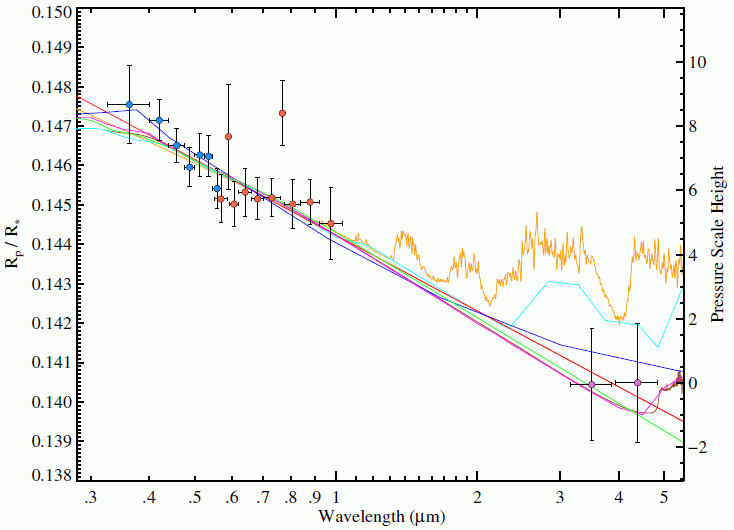
Nikolov et al (2014) have now pointed the Hubble Space Telescope at WASP-6b in transit, using the STIS spectrograph. They find that the transit depth varies with colour; effectively the planet looks slightly larger in blue light, since small particles in the planet’s atmosphere are scattering blue light more than red light.

wasp6_rayleigh

The strong blue slope in the plot is characteristic of Rayleigh scattering, the same effect that causes Earth’s atmosphere to look blue (in the plot the red line is a Rayleigh-scattering model, though other model fits are possible).

Nikolov etal state that: “With a broad-coverage optical transmission spectrum measured from HST and Spitzer broad-band transit spectrophotometry, WASP-6b joins the small but highly valuable family of hot-Jupiter exoplanets with atmospheric constraints.”

The field of exoplanet atmospheres is growing rapidly in importance, and it is good to see WASP planets being chosen as prime targets for such work.

The atmosphere of hot-Jupiter exoplanet WASP-31b

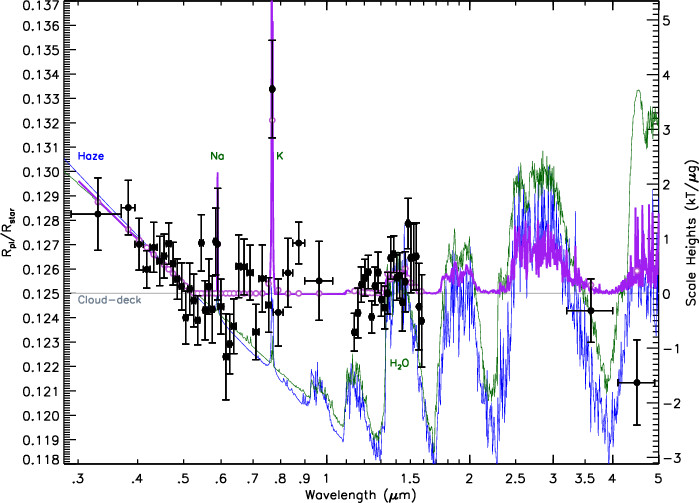
Characterising the atmospheres of exoplanets is a rapidly growing field that is set to increase in importance even more with the forthcoming launch of JWST. WASP planets are prime targets for such work since they transit relatively bright stars. Comparing spectra in and out of transit then gives a transmission spectrum of the planet’s atmosphere.

A new study by David Sing et al presents a state-of-the-art analysis of WASP-31b’s atmosphere using the STIS instrument on the Hubble Space Telescope.

w31_atmos

Notable features include the presence of potassium absorption (the peak labelled K) and the fact that this is stronger than sodium (Na) absorption. The absence of many of the broad features in the plotted models implies a “cloud deck” that results in few spectral features. Also seen is a “Rayleigh scattering” slope implying small atmospheric particles floating above the cloud layer.

WASP-31b is a planet of 0.5 Jupiter masses that is bloated up to 1.5 Jupiter radii. This gives it a large atmospheric scale height that makes it a good target for transmission spectroscopy, since the fluffier atmosphere covers a larger fraction of the star during transit.

WASP-31b was discovered in 2010 by the WASP-South team led by David Anderson.

2014: A bumper year for WASP planets

2014 is proving to be the WASP project’s most successful year yet for the publication of transiting exoplanets. With two months to go before the end of the year, there are already 17 new planets published in 2014 in refereed journals. 12 more planets have been announced on the arXiv preprint server, though many of those will likely appear with a 2015 publication date.

We are currently finding transiting exoplanets at a rate of about 30 a year (WASP-117 is the highest number published, though we have currently got as far as WASP-134). This results from improvements in data quality owing to adding multiple years of observation. Further, the combination of WASP-South with the TRAPPIST photometer and the Euler/CORALIE spectrograph is proving to be a highly effective team. The process involves a lot of telescope time and hard work — only 1 in 10 of candidates followed up proves to be a planet — but the reward is the strong worldwide interest in studying WASP planets.