Category Archives: WASP planets

Long-period brown dwarfs for WASP-53 and WASP-81

The WASP project has just released the discovery paper for the systems WASP-53 and WASP-81, led by Amaury Triaud. We’ve known about close-in hot-Jupiter planets around these two stars for several years, but the paper had been delayed owing to an interesting development: the radial-velocity monitoring showed that the planets both had longer-period brown-dwarf companions. Several years of data have been needed to prove the reality of these brown dwarfs, now dubbed WASP-53c and WASP-81c.

Radial velocity monitoring of WASP-53 and WASP-81

The plot shows the “radial velocities” — how much the star is tugged about by the gravity of orbiting bodies — as a function of time (in BJD, a count of days). WASP-53 is on the left and WASP-81 on the right. The red line is a fit to the data. The close-in hot Jupiters (WASP-53b and WASP-81b, with orbits of 3.3 and 2.7 days respectively) cause short-period variations, so fast that they appear as a solid red swathe.

In addition, though, WASP-53 shows a variation owing to a more-massive brown dwarf with an orbital period of about ten years and a mass of at least 16 Jupiters. Similarly, WASP-81 shows a variation caused by a 57-MJup brown dwarf in a 3.5-yr orbit. Both outer orbits are highly eccentric.

The presence of the brown dwarfs has interesting consequences for ideas about how planets form. It is generally accepted that hot Jupiters form further out, where it is colder, where ices can stick together and form a planetesimal. But the presence of eccentric brown dwarfs, disrupting the proto-planetary disc in that region, would have made that hard. So maybe the planets formed further in? Or maybe the brown dwarfs were originally elsewhere, and moved to their current orbits later on?
Magnetic activity on planet-host stars

One interesting question is whether close-in hot-Jupiter planets have an effect on the magnetic activity of the host star. There have been suggestions that star–planet interactions might increase magnetic activity on the star, or that tidal interactions might decrease it. Further, if mass lost from planets forms an absorbing cloud around the star, then it might reduce observable signs of magnetic activity, even if it doesn’t affect the magnetic activity itself.

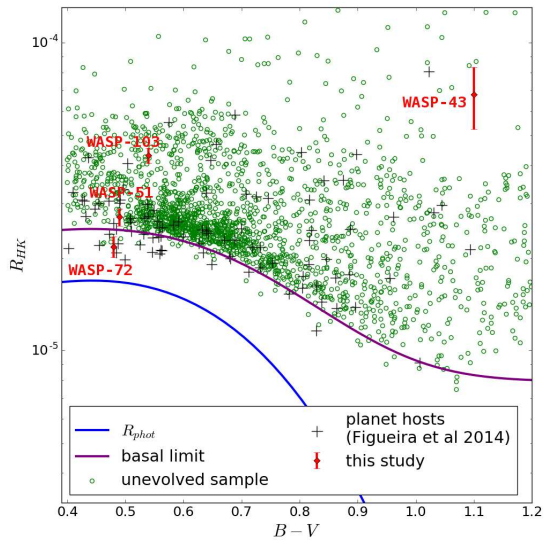
A new paper by Daniel Staab et al, led by the Open University, investigates the issue by looking for markers of magnetic activity in spectra of host stars WASP-43, WASP-51, WASP-72 and WASP-103. In the following plot, RHK is a marker of magnetic activity, plotted against the temperature (B–V) of the star. The green dots are a large sample of field stars, while the four WASP host stars are labelled in red.

Chromospheric activity on planet-host stars.

The result is that at least one planet-host, WASP-43, has an abnormally high degree of magnetic activity, while another one, WASP-72, has abnormally low magnetic activity. Staab et al conclude that there is no single factor explaining the differences, and that more than one effect might be in play. As often, a much larger sample of data is needed to investigate the issue.

The atmospheres of WASP planets with JWST

The James Webb Space Telescope is expected to revolutionise the study of exoplanet atmospheres following its launch in 2018, and WASP planets will be among the prime targets. Paul Mollière et al have been simulating the data expected, and have produced this illustration of the atmospheric emission spectrum of WASP-18b.

Spectrum of exoplanet WASP-18b as observed with JWST

The different coloured curves result from different assumptions about WASP-18b’s atmosphere. The lines along the bottom illustrate the spectral coverage of the different JWST instruments. In contrast to existing data (Spitzer results are shown as black squares), the JWST data will have both the spectral resolution and signal-to-noise to differentiate clearly between different models.

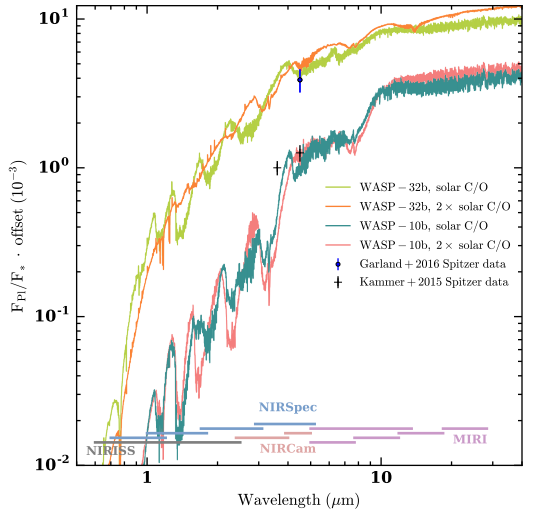
Mollière et al have also simulated spectra for cooler planets, such as WASP-10b and WASP-32b.

WASP-10b and WASP-32b simulated atmospheres observed with James Webb Space Telescope.

The different models are for different abundances of carbon relative to oxygen (C/O), showing that JWST should be able to settle the issue of which exoplanets have enhanced abundances of carbon relative to the Solar System.

Such simulations show that the results from JWST should be spectacular, opening up whole new areas of enquiry.

The clear atmosphere of WASP-39b, seen from the ground

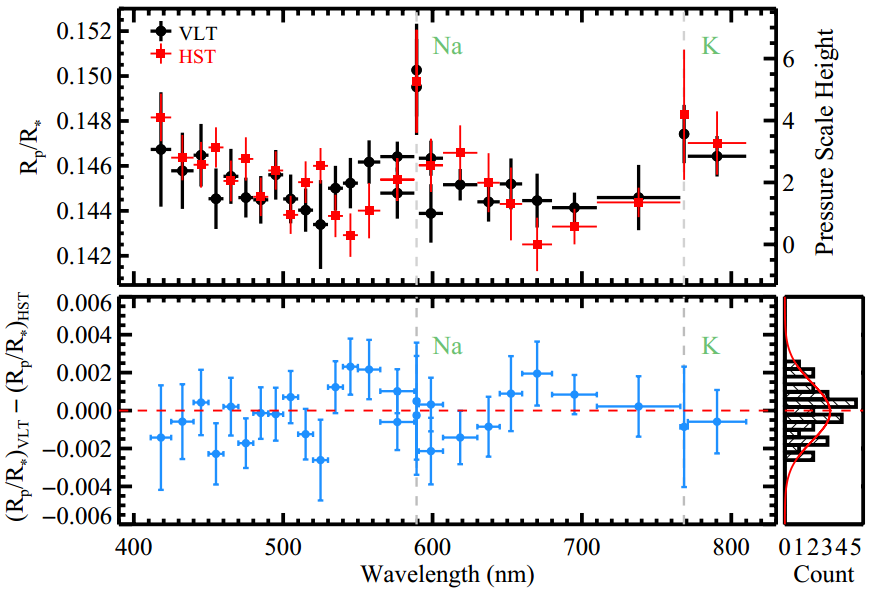
Most of the best detections of features in the atmospheres of transiting exoplanets have come from the Hubble Space Telescope, but time on hugely expensive satellites is in high demand and limited. Thus a recent paper led by Nikolay Nikolov from Exeter University is a welcome development. Nikolov and his team observed WASP-39b and detected a strong Sodium line from the planet, which indicates a clear atmosphere. The result came from the newly upgraded FORS2 spectrograph on ESO’s Very Large Telescope.

Sodium in the atmosphere of exoplanet WASP-39b

The important feature of the plot is that the VLT data (black) are every bit as good as those from a previous detection of the same line using the Hubble. While Hubble has the advantage of being in space, the VLT has a much larger mirror and can observe whole transits without the gaps seen in Hubble data owing to its low-Earth orbit.

The similar result from a very different facility also gives confidence in the correctness of such detections of features in exoplanet atmospheres, which are, after all, pushing current technology to its limits.

Using the stellar rotation to trace a planet’s orbit

As a transiting exoplanet tracks across its star it progressively blocks out different regions of the face of the star. Since the star will be rotating, one limb of the star will be moving towards us (and so its light will be blueshifted) while the other limb recedes (producing a redshift). The blocking of light by the planet thus changes the spectral lines from the star. This is called the Rossiter–McLaughlin effect, and it can be used to discern the track of the planet’s orbit.

Brett Addison and Jonti Horner have written a nice introduction to such techniques on the widely read The Conversation website. Since large numbers of WASP planets orbit stars bright enough to enable a detection of the Rossiter–McLaughlin effect, around half of the planets with measured orbits are WASP planets.

Addison and Horner illustrate their piece with an artist’s conception of the polar orbit of WASP-79b:

Hot Jupiter exoplanet WASP-79b polar orbit

KELT-16b and sub-1-day hot-Jupiter exoplanets

Until recently the only hot-Jupiter exoplanets known with orbital periods below one day were the four discovered by WASP-South (WASP-18b, WASP-19b, WASP-43b and WASP-103b). But last month HATSouth reported that HATS-18b has a 0.84-day period and now KELT have announced KELT-16b at 0.97 days.

The KELT team, lead by Thomas Oberst, have produced this figure showing planetary masses against orbital separation (semi-major axis):

Short-period hot Jupiter exoplanets

One can see that all the planets just mentioned are Jupiter-mass or heavier. There are relatively few planets in the blue-shaded region, where they would have both Neptune-like masses and very short orbital periods. There are, though, Earth-mass planets known at these orbital periods. The paucity of short-period Neptunes cannot just be a selection effect, since they would have been readily found in the Kepler mission.

Instead, the currently favoured explanation is that planets in the blue-shaded region would rapidly be evaporated and be stripped down to their cores. At such short separations from their stars planets are subject to high irradiation and tidal forces. The combination can inflate the planets to the point that their atmospheres “boil off” and overflow the planet’s Roche lobe.

They avoid this fate only if the planet has enough mass, and thus gravity, to hold on to its atmosphere. Thus, at these very short orbital periods, we see either large, Jupiter-mass planets, or small, dense, rocky planets (possibly remnant cores of evaporated larger planets) — but not any in-between planets the size of Neptune.

Changeable weather on exoplanet WASP-43b?

WASP-43b is the “hot Jupiter” exoplanet with the orbit closest-in to its star, producing an ultra-short orbital period of only 20 hours. The dayside face is thus strongly heated, making it a prime system for studying exoplanet atmospheres.

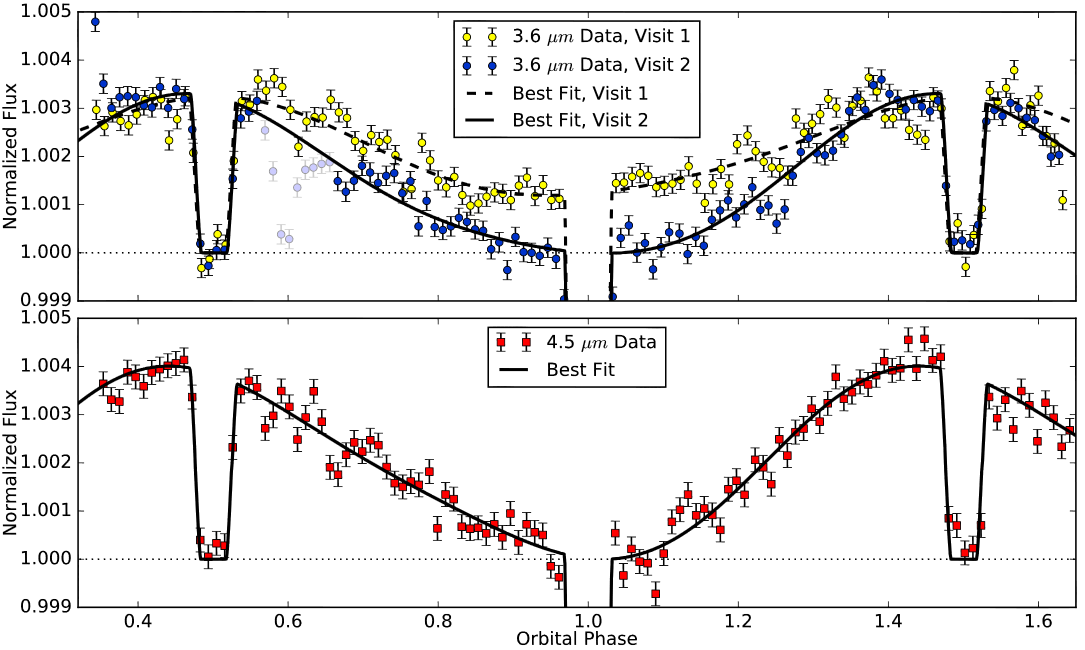
Kevin Stevenson et al have pointed NASA’s Spitzer Space Telescope at WASP-43, covering the full orbit of the planet on three different occasions. Spitzer observed the infrared light from the heated face in two bands around 3.6 microns and 4.5 microns.

The three resulting “phase curves” are shown in the figure:

Spitzer phase curves of exoplanet WASP-43b

The 4.5-micron data from one visit are shown in red in the lower panel; the 3.6-micron data from the two other visits are in the upper panel. The transit (when the planet passes in front of the star) is at phase 1.0, and drops below the plotted figure. The planet occultation (when it passes behind the star) is at phase 0.5. The sinusoidal variation results from the heated face of the planet facing towards us (near phase 0.5) or away (near phase 1.0).

Intriguingly, the depth of the variation in the 3.6-micron data is clearly different between the two visits. Why is this? Well, Stevenson et al are not sure. One possibility is that the data are not well calibrated and that the difference results from systematic errors in the observations. After all, such observations are pushing the instruments to their very limits, beyond what they had been designed to do (back when no exoplanets were known and such observations were not conceived of).

More intriguingly, the planet might genuinely have been different on the different occasions. The authors report that, in order to model the spectra of the planet as it appears to be during the “blue” Visit 2 in the figure, the night-time face needs to be predominantly cloudy. But, if the clouds cleared, more heat would be let out and the infrared emission would be stronger. That might explain the higher flux during the “yellow” Visit 1. Here on Earth the sky regularly turns from cloudy to clear; is the same happening on WASP-43b?

Cloudy Days on Exoplanets May Hide Atmospheric Water

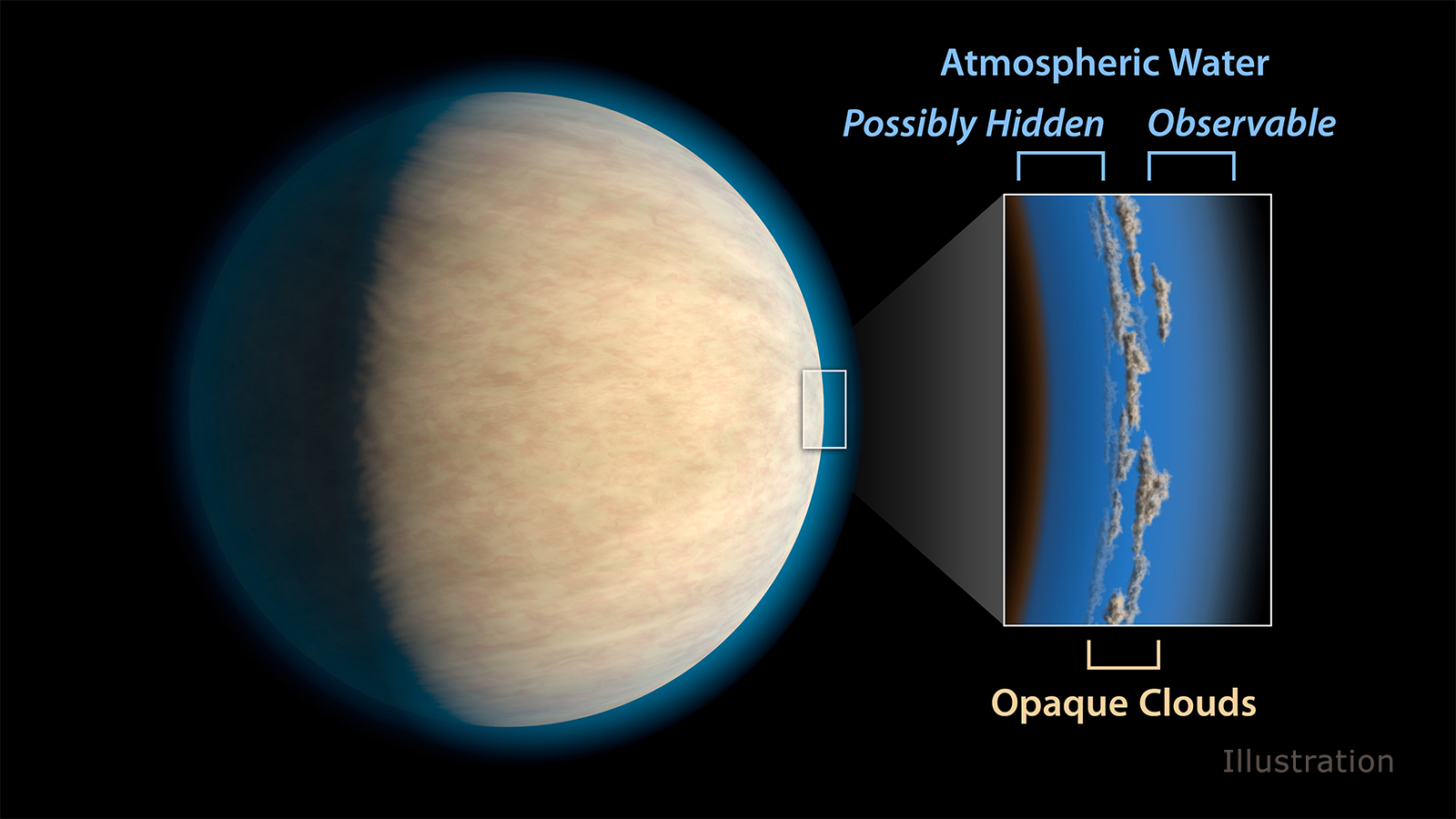
NASA’s Jet Propulsion Laboratory have put out a press release suggesting that clouds in exoplanet atmospheres might be preventing the detection of water that lies beneath the clouds, thus explaining why some hot Jupiters show signs of water while others don’t.

The release is based on work by Aishwarya Iyer et al, published in the Astrophysical Journal in June. Iyer et al made a comprehensive study of Hubble/WFC3 data for 19 transiting hot Jupiters, including many WASP planets.

Cloud or haze layers in the atmospheres of hot Jupiters  may prevent space telescopes from detecting atmospheric water that lies beneath the clouds, according to a study in the Astrophysical Journal.

Clouds in Hot-Jupiter atmospheres might be preventing space telescopes from detecting atmospheric water. Image credit: NASA/JPL-Caltech

The press release has been extensively reported, being carried on over 40 news websites. In the UK the Daily Mail covered the story, and included a note about the recent Keele University-led discovery of five new hot Jupiters, WASP-119b, WASP-124b, WASP-126b, WASP-129b and WASP-133b.

Starspots on WASP-85 from K2 transits

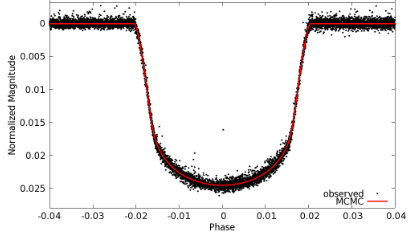
If, during a transit of its star, an exoplanet crosses a star spot, it will be covering a region that is dimmer than the rest of the star. Since less light will be being occulted, we will see a small increase or “bump” in the transit profile. WASP-85 was recently observed by the K2 mission, getting sufficiently high-quality photometry that it could reveal such starspot `bumps”.

Here is the transit proflle, from a paper by Teo Močnik et al, which contains all the K2 data folded in:

WASP-85b transit profile observed with Kepler K2.

Teo Močnik then subtracted the overall transit profile, thus showing the departures from the average behaviour, and produced a plot of each transit:

WASP-85 starspots observed with K2

The vertical dashed lines show the regions in transit. The lightcurve bumps circled in red are starspots being occulted. (Blue arrows are times when K2 fired its thrusters, which can cause a feature in the lightcurve.)

The interesting question is whether a bump recurs in the next transit, but shifted later in phase, as it would if the same starspot is being occulted again. This would happen if the planet’s orbit is aligned with the stellar rotation. In that case, as the star rotates, the spot moves along the line of transit, to be occulted again next transit.

Aligned orbit star spot occultation

An illustration of a planet occulting a star spot when the planet’s orbit and the star’s rotation are aligned. Graphic by Cristina Sanchis Ojeda

To judge whether the starspot bumps repeat, Teo gave all the co-authors a set of lightcurves and asked them to judge which features in the lightcurve were genuine bumps. But, to avoid human bias, he first scrambled the order of the lightcurves, so that the co-authors didn’t know which lightcurve came next.

The result is that we think that starspots do repeat, shown by the red linking lines in the above figure. This shows that the planet’s orbit is aligned, and it also allows us to estimate the rotational period of the star.

Titanium and Vanadium on the exoplanet WASP-121b?

The hot Jupiter WASP-121b, discovered recently by Laetitia Delrez et al, is a very good opportunity for learning what the atmosphere of an exoplanet is made of. Being in a close, 1.27-day orbit around a hot star makes the atmosphere hot, while being a bloated planet of 1.9 Jupiter radii makes the atmosphere puffy. That means one can observe the planet in transit, projected against its star, and readily observe spectral features caused by the atmosphere absorbing star light.

Thomas Evans et al have pointed the Hubble Space Telescope at WASP-121b. To model the resulting spectrum they find they need an atmosphere containing titanium oxide, vanadium oxide, and iron hydride. In the plot below, models with these molecules are plotted red and yellow, and fit the observations, while models without, plotted in green and purple, do not.

WASP-121b atmosphere

The model also shows that WASP-121b has clear skies, rich in water vapour. It looks as though WASP-121b will become one of the most important exoplanets for such atmospheric characterisation work.