Category Archives: WASP planets

WASP-12b a “Blistering Pitch-Black Planet”.

NASA has put out a press release about Hubble Space Telescope observations of WASP-12b. Taylor Bell et al find that WASP-12b “traps at least 94 percent of the visible starlight falling into its atmosphere”, making it “as black as fresh asphalt”.
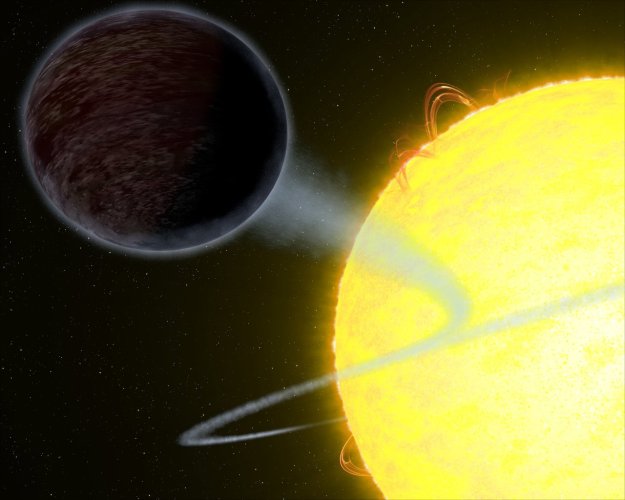
WASP-12b “as black as asphalt” (Credit: NASA, ESA, and G. Bacon, STScI)

The article explains that WASP-12b, in a very close, 1.2-day orbit, is so irradiated by its host star that “clouds probably cannot form to reflect light back into space. Instead, incoming light penetrates deep into the planet’s atmosphere where it is absorbed by hydrogen atoms and converted to heat energy”. NASA’s press release has led to coverage on several dozen websites.

WASP-12b is one of the more important of the WASP discoveries, with over 30 refereed papers so far focused on understanding it. Most notably, the fierce stellar irradiation means that material is boiling off the planet and forming a cloud surrounding it.

Strong Sodium and Potassium absorption in the atmosphere of WASP-103b

Characterising the atmospheres of extrasolar planets is a booming activity, both from ground-based observatories and using the Hubble Space Telescope. The latest study is of the highly-irradiated and hot planet WASP-103b, which was found by WASP-South transiting a star with an ultra-short orbit of only 0.93 days (Michaël Gillon et al 2014).

Monika Lendl et al have now used the Gemini/GMOS instrument to probe its atmosphere. The main finding is prominent features caused by absorption of light by sodium (Na) and potassium (K) ions:

Such features imply that WASP-103b has relatively clear skies, since cloudy or hazy atmospheres tend to produce flat, featureless spectra. The authors explain that: “This finding is in line with previous studies on cloud occurrence on exoplanets which find that clouds dominate the transmission spectra of cool, low surface gravity planets while hot, high surface gravity planets are either cloud-free, or possess clouds located below the altitudes probed by transmission spectra”.

Discovery of the hot Jupiter WASP-167b (KELT-13b)

The websites sci-news.com and phys.org have published articles on our recent discovery of WASP-167b (KELT-13b) — the highest WASP number so far announced — along with an image comparing it to Jupiter:

WASP-167b is notable for two reasons. First, it orbits a hot star with a surface temperature of 7000 Kelvin. Planets transiting hot stars are harder to validate since the star’s spectra shows only broad and weak spectral lines, which makes it harder to get accurate radial-velocity measurements and thus prove that the transiting object has the right mass to be a planet.

The WASP project had tended to put such candidates on the back-burner and go after easier targets, but having succeeded in finding over 100 planets transiting cooler stars we are now focussing on the hot ones.

Secondly, WASP-167b is a joint discovery with the KELT project (hence the additional name of KELT-13b), the first time two of the transit-search teams have combined an announcement. Both projects had put much effort and telescope time into following up this candidate, and a joint paper recognises both of these campaigns.

Hubble’s tale of two exoplanets: WASP-67b and HAT-P-38b

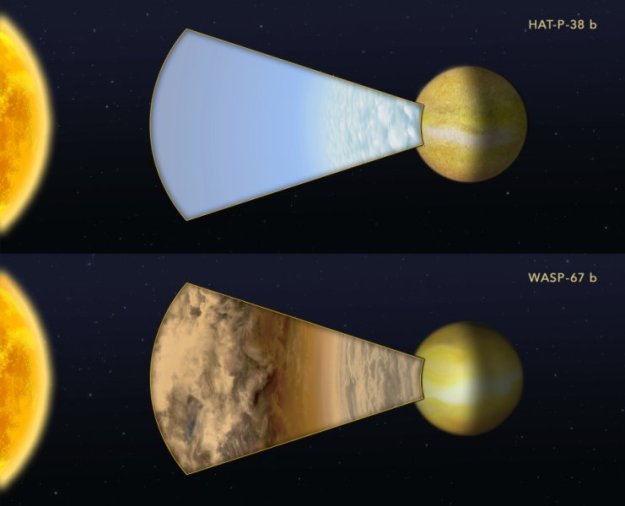
NASA have put out a press release entitled: “Hubble’s Tale of Two Exoplanets: Nature vs. Nurture”.

The article compares WASP-67b and HAT-P-38b, noting how similar they are in size and temperature, both orbiting similar stars at a similar orbital distance. But then Hubble’s Wide Field Camera 3 found that WASP-67b has a very cloudy atmosphere whereas HAT-P-38b has much clearer skies.

From the press release: Perhaps one planet formed differently than the other, under a different set of circumstances. “You can say it’s nature versus nurture,” explains co-investigator Kevin Stevenson. “Right now, they appear to have the same physical properties. So, if their measured composition is defined by their current state, then it should be the same for both planets. But that’s not the case. Instead, it looks like their formation histories could be playing an important role.”

“Astronomers measured how light from each parent star is filtered through each planet’s atmosphere. HAT-P-38 b did have a water signature indicated by the absorption-feature peak in the spectrum. This is interpreted as indicating the upper atmosphere is free of clouds or hazes. WASP-67 b, has a flat spectrum that lacks any water-absorption feature, suggesting most of the planet’s atmosphere is masked by high-altitude clouds.”

The NASA press release has been picked up and reported on several dozen science-related websites.

Credits: Artwork: NASA, ESA, and Z. Levy (STScI); Science: NASA, ESA, and G. Bruno (STScI)

Hubble finds a stratosphere in WASP-121b

Orbiting a hot F-star in only 1.27 days, WASP-121b is a highly irradiated hot Jupiter found by Laëtitia Delrez et al using the WASP-South survey. A team led by Tom Evans at Exeter has now pointed the Hubble Space Telescope at WASP-121b and found that its atmosphere shows a “stratosphere”. That is, the higher layers of the atmosphere appear to be hotter than the lower layers.

This is possible if molecules high in the atmosphere absorb radiation very efficiently. The “stratosphere” interpretation comes from finding spectral features caused by water, but seeing them in emission (as expected if the atmospheric temperature increases with height) rather than in absorption (expected if the temperature declines with height).

The data show the Hubble spectrum observed during transit using the WFC3 instrument. The red line is a model including a stratosphere. The blue lines are, for comparison, colder “brown dwarfs” which don’t have a stratosphere. The WFC3 data (circles with error bars) clearly favour the stratosphere interpretation.

NASA have put out a press release about the discovery, while the press team at Exeter have produced an illustration of the highly irradiated planet:

The story has been picked up by CNN, The Telegraph, New Scientist, NDTV, phys.org, the Mail Online, the International Business Times, Gizmodo Australia and over 40 other news and science websites.

Super-Neptune WASP-107b has an oblique orbit

WASP-107b is only twice the mass of Neptune but nearly the radius of Jupiter. It is thus a hugely bloated and fluffy exoplanet and one of the more important of the recent WASP discoveries, being a prime target for atmospheric characterisation (see the discovery paper by Anderson et al 2017).

WASP-107b was also in the Campaign-10 field of the K2 mission, leading to a Kepler-quality photometric lightcurve. Recent papers by two teams, led by Teo Močnik and Fei Dai, have arrived at a similar conclusion: WASP-107b seems to be in an oblique orbit, rather than in an orbit aligned with the rotation axis of the host star.

spot_tran

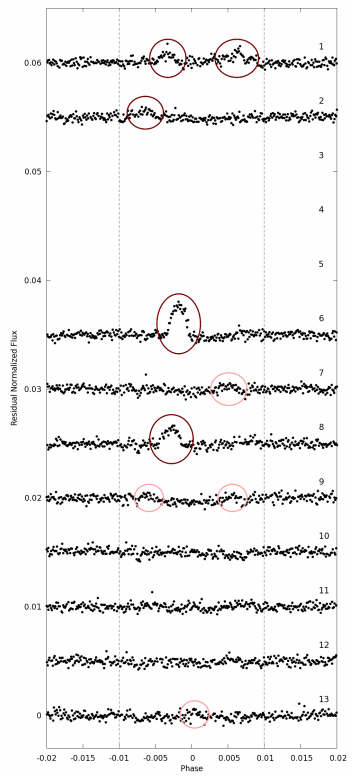
The conclusion comes from star spots. If the orbit is aligned, consecutive transits will repeatedly cross the same star spot, producing a “bump” in the lightcurve each time, whereas if the orbit is oblique this will not happen.

Thus one can play the game of looking for transit bumps and seeing if they repeat. But spots can change, by growing or shrinking, so is a smaller bump in the next transit the same spot, or a different one? Also, if there is some uncertainty in the rotational period of the star, then we’re not fully sure exactly where in the next transit the spot will recur.

Star spots in transits of exoplanet WASP-107b

In the figure at left (in which the transit itself, between the dashed lines, has been removed, leaving only the starspot bumps), obvious spots are circled in red, while possible spots are marked with a lighter red. The rotational period of the star is nearly three times the orbital period of the planet, and so, if the spots recurred, they would be seen every three transits. (The gap, and thus the missing of transits 3, 4 and 5, arose from a spacecraft malfunction.)

The conclusion is that the star spots do not seem to recur and thus that WASP-107b is in an oblique orbit.

WASP-118 is pulsating

The K2 spacecraft is monitoring a series of fields along the ecliptic and so producing Kepler-quality photometry on some of the exoplanet systems previously discovered by WASP.

WASP-118b is an inflated hot-Jupiter planet (0.5 Jupiter masses but 1.4 Jupiter radii) on a 4-day orbit around a bright F-type star of V = 11. It was observed for 75 days in K2‘s Campaign 8. Teo Močnik et al have now analysed the data and see transits of the planet, as expected:

WASP-118 transits as observed with K2

The upper black curve is the raw data, while the lower red curve has been corrected for artefacts caused by drifts in K2‘s pointing. Nineteen transits are seen, recurring with the 4-day orbital period.

But Teo Močnik noticed that the out-of-transit photometry was not as flat as expected. After further investigation he deduced that the host star is pulsating:

WASP-118 is a pulsating star

The pulsations have a timescale of 1.9 days and a very low amplitude of 2 parts in 10 000, only discernable given a lightcurve with Kepler‘s photometric accuracy. Thus WASP-118 appears to be a γ-Doradus pulsator, possibly the first γ-Dor variable known to host a transiting exoplanet.

WASP-43b has an aligned orbit

WASP-43b is the hot Jupiter that is closest to its parent star, around which it orbits in only 19 hours. At such a close location, tidal interactions between the planet and the star will be intense. That means that we expect the planet to be phase locked (with its rotation period equalling the orbital period, so that the same side always faces the star), and we expect the orbit to be circular (any eccentricity having been damped by tides), and we expect the orbit to be aligned with the rotation axis of the star.

Tidal damping of the alignment of the orbit is the subject of much investigation. It seems to be most efficient if the planet orbits cooler stars, and much less efficient if the planet orbits a hotter star. This might be because cooler stars have large “convective zones” in their outer layers, which can efficiently dissipate tidal energy, whereas hotter stars have only very shallow convective zones with little mass in them.

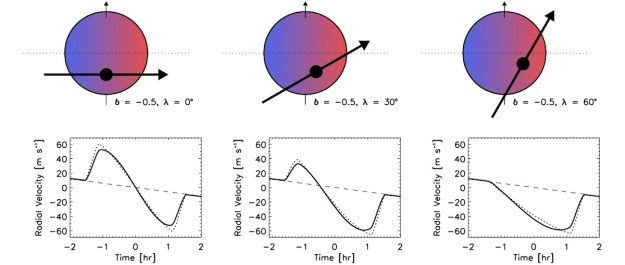
Since WASP-43b orbits a cool star, a K7 star with a surface temperature of only 4400 Kelvin, that’s another reason for expecting its orbit to be aligned. This has now been confirmed by observations with the Italian Telescopio Nazionale Galileo. The way to measure the orbital alignment of a transiting exoplanet is by the Rossiter–McLaughlin effect. As the planet transits a rotating star, it first obscures one limb and then the other, and since the different limbs will be either blue-shifted or red-shifted, according to how the star is spinning, the effect on the overall light of star will reveal the path of the orbit.

Rossiter-McLaughlin effect

A new paper by Esposito et al reports R–M measurements for three planets including WASP-43b. The data show the classic R–M signature of an aligned planet.

Rossiter-McLaughlin effect for exoplanet WASP-43b

The upper panel shows the change in stellar radial-velocity around the planet’s orbit, caused by the gravitational tug of the planet. The lowest panel highlights the data through transit, showing the expected excursion first to a redder light (when blue-shifted light on the approaching limb is occulted) and then to blue light (when the red-shifted receding limb is occulted).

Gaia detects transits of WASP exoplanets

ESA’s Gaia satellite is a €740-million mission to map a billion stars in our galaxy. By observing repeatedly with unprecedented astrometric precision it is measuring the parallaxes, and thus the distances, of hundreds of millions of stars, and so mapping out the 3-D structure of our galaxy.

Gaia can detect exoplanets in two ways, first by astrometry (measuring the position of a star), so detecting the wobble in the star’s location caused by an orbiting massive planet, and secondly by the transit method, detecting the dip in the light of a star caused by a transiting planet.

The Gaia team have just announced the first detections of exoplanet transits, by looking at the accumulated Gaia data on two already-known WASP planets.

ESA's Gaia satellite detects its first exoplanet transit

The plot shows a year’s worth of Gaia data of the star WASP-19, folded on the 0.79-day orbital period of the planet WASP-19b (the three different panels are the star’s magnitude in three different colours). The coverage is sparse — it is designed for astrometric measurements, not for recording lightcurves — but one observation was made in-transit, demonstrating that Gaia can indeed detect exoplanet transits.

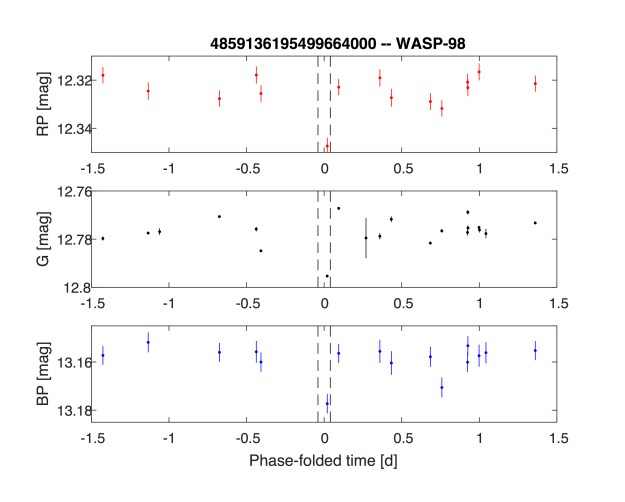
The ESA/Gaia team have also looked at the data on WASP-98, and again detect the transit of WASP-98b.

ESA's Gaia satellite detects exoplanet transit of WASP-98b

Is there potassium in WASP-31b’s atmosphere?

Many forefront facilities such as the Hubble Space Telescope and ESO’s Very Large Telescope are being pointed at exoplanets to try to find out what their atmospheres are made of. Yet such work is right at the limit of what can currently be done (though we hope that the James Webb Space Telescope will soon change that). So to what extent can we trust the results?

Here is an interesting puzzle. A new paper by Neale Gibson et al reports a spectrum of the atmosphere of WASP-31b, obtained with the FORS2 instrument on the VLT.

VLT/FORS2 Spectrum of the atmosphere of exoplanet WASP-31b

The spectrum is mostly flat, implying that the planet has a fairly cloudy atmosphere, but towards the right-hand side the orange line (a computed model) shows a strong emission line owing to potassium. The problem is that while one data point from previous HST data (small grey circle) indicates the presence of a strong potassium line, the new data from the VLT (the green-square data point) is incompatible with the HST data and would mean that there is no strong potassium line.

Gibson and co-authors put a lot of effort into trying to resolve the discrepancy, and consider whether Earth’s atmosphere might be contaminating the ground-based data, or whether unknown systematic uncertainties might be affecting the Hubble data. Overall they can only “highlight the need for caution” in interpreting such features. This illustrates that science at the cutting edge is never easy, and that much of an astronomer’s time is spent investigating whether one can trust the data one is working with.