Monthly Archives: November 2020

A second planet for WASP-107

WASP-107b is a hugely bloated planet, with a mass of only two Neptunes, but a radius near that of Jupiter, making it one of the puffiest planets known. As such it has been heavily studied, and indeed was the exoplanet showing the first detection of helium.

Long-term monitoring of the WASP-107 system with the Keck telescope has now revealed a companion planet, WASP-107c, as announced by Caroline Piaulet et al.

The new planet is in a much wider orbit, with a period of 1088 days and a high eccentricity of e = 0.26. It likely does not transit, and has a mass of perhaps a third that of Jupiter.

The discovery of a second planet is important for understanding the nature of WASP-107b itself. The tight, 5.7-d orbit, and the fact that the orbit is mis-aligned with the star’s rotation, might be explained by gravitational interactions with the second planet. The bloated size could then result from tidal interactions with the host star, as the planet circularised in its orbit, after the interactions with WASP-107c.

The authors conclude that, “Looking ahead, WASP-107b will be a keystone planet to understand the physics of gas envelope accretion”, starting with a planned observation with the soon-to-be-launched JWST.
WASP-62b, in James Webb’s continuous-viewing zone, has a clear atmosphere

James Webb’s “Continuous Viewing Zone” is the patch of sky where the satellite can point continuously at a target and so observe it most efficiently. Exoplanets within the CVZ that are suitable for atmospheric characterisation are thus of high importance, and so far WASP-62b is the only gas giant known within the CVZ.

Munazza Alam et al have now pointed the Hubble and Spitzer space telescopes at WASP-62b to see what its atmosphere looks like. Importantly, they find that WASP-62b has clear skies. This matters since cloudy or haze-filled atmospheres tend to produce flat spectra lacking any spectral features, and so don’t tell us much.

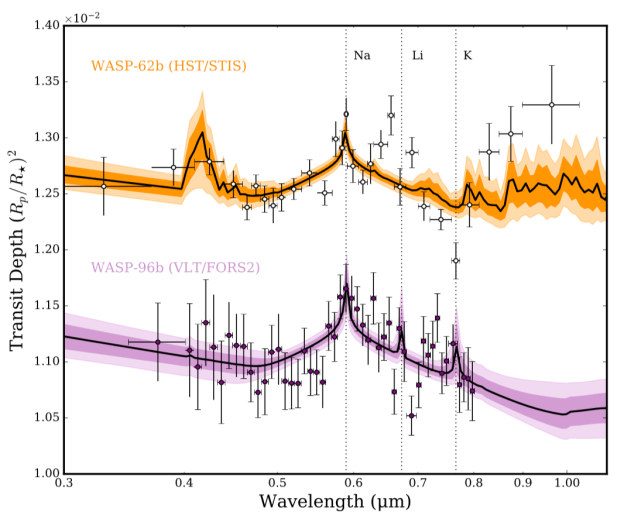
Here, Alam et al plot the spectrum near the sodium (Na) line, showing that it has a broad base, akin to that in the clear-skied planet WASP-96b. The broad base of the line means that it is being widened by “pressure broadening”, and that can only happen deep in the planet’s atmosphere where the pressure is high. And we can only see deep into the atmosphere if it is clear rather than cloudy.

Clear skies mean that spectral features produced by the molecules in the atmosphere should be readily detectable with JWST. Here Alam et al simulate what we expect to see with JWST, showing that Na, H2O, NH3, FeH, SiH, CO, CO2, and CH4 can all be detected.

They conclude by saying that: “As the only transiting giant planet currently known in the JWST Continuous Viewing Zone, WASP-62b could prove a benchmark giant exoplanet for detailed atmospheric characterization in the James Webb era.

ESPRESSO looks at ultra-hot-Jupiter WASP-121b

ESPRESSO is ESO’s state-of-the-art spectrograph for the Very Large Telescope, specifically designed to get the best data possible on planetary systems.

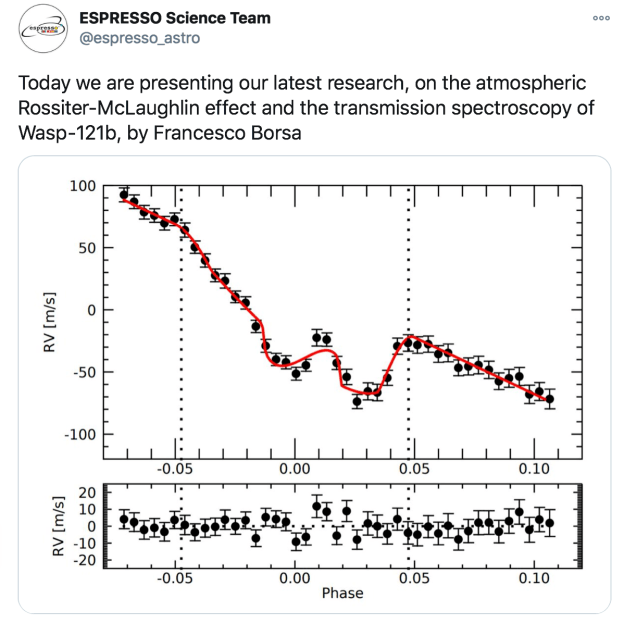
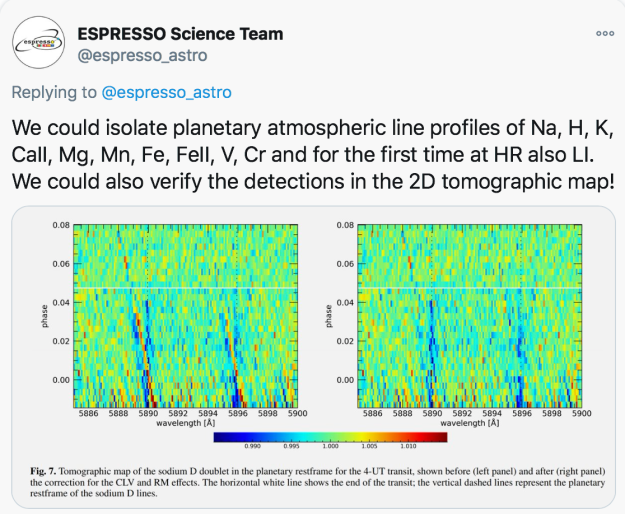
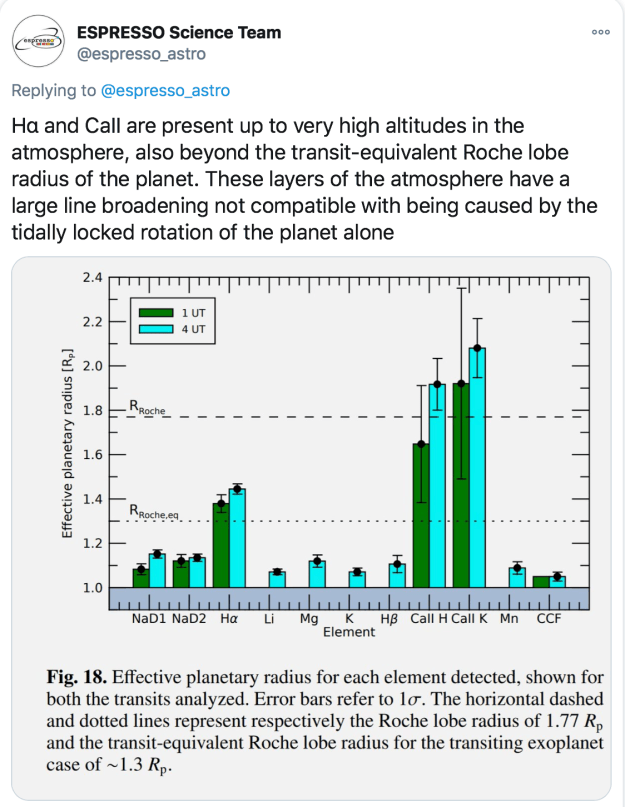
Francesco Borsa et al have pointed ESPRESSO at transits of the ultra-hot-Jupiter WASP-121b, and the ESPRESSO team have put out a series of Tweets explaining the paper: