Monthly Archives: October 2019

No period change for WASP-19b

Since close-orbiting hot Jupiters are expected to be gradually spiralling inwards, under the influence of tidal interactions with their stars, and since, in addition, the influence of extra, unseen planets in the system could cause changes in transit times, many groups worldwide are monitoring timings of transits of WASP planets.

The latest report on timings of WASP-19b has just been announced by Petrucci et al. The result is the following diagram, showing deviations of timings from a constant ephemeris, plotted against cycle number.
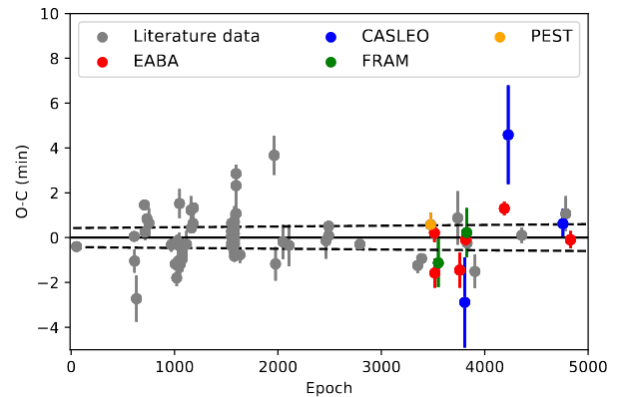
The upshot is that there is no indication of any period change, which then puts limits on how efficient the tidal bulges, caused by the gravitational interaction of the planet with the star, are at dissipating energy.

It is notable, however, that there is clear scatter about the constant-period line, beyond that expected from the error bars on the timings. This means either that the error bars are under-estimating the uncertainties (as would occur if “red noise” in the lightcurves is unaccounted for), or that there is astrophysically real scatter in the timings, perhaps caused by magnetic activity (star spots) on the surface of the star being transited. We need to better understand such timing scatter if we are to be able to judge whether claims of period changes are actually real.

WASP-South detection of transits of HD 219666b

Transiting a bright star, the “Neptune desert” planet HD 219666b was one of the more important early discoveries from the TESS survey. With a depth of only 0.17 per cent, the transits would be a challenge for any ground-based transit survey.

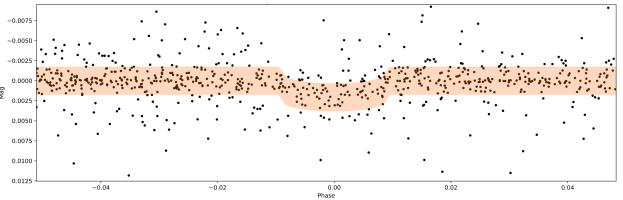
Nevertheless, we think we’ve found them in WASP-South lightcurves dating back to 2010. Here they are:

The orange lines show times of transit, as found by the WASP transit-detection algorithms. The shallow dips seem to be real, since they align both in period and in phase with the dips seen in the TESS lightcurve. The output from the WASP search algorithm is not itself that convincing:

However, the period that it finds (6.03446 days) matches the TESS period to an accuracy of 0.03 per cent, and the WASP ephemeris then predicts the times of the TESS transits bang on (they occur at 420.99999 cycles on the WASP ephemeris), which together mean that the detection must be real. Here are the WASP data folded on a template of the TESS transit:

With a depth of 0.17 per cent, the transits of HD 219666b are the shallowest that WASP has detected.

The benefit of looking for such pre-detections of TESS planets is that we can then produce a transit ephemeris based on data spanning a baseline of 8 years, rather than the 20 days spanned by the TESS transits. This means we can predict future transits to an accuracy of minutes, instead of hours, which is highly useful for future observations. Hence this WASP-South detection of HD 219666b transits is well worth an AAS Research Note.

Nobel Prize for Michel Mayor and Didier Queloz


Naturally, we at WASP are chuffed at the award of the Nobel Prize in Physics to Michel Mayor and Didier Queloz for their discovery of 51 Peg b, the first extra-solar planet found orbiting a sun-like star. Congratulations to them both! The award is a welcome boost and recognition of the burgeoning field of exoplanets.

The WASP-South camera array

When, back in 2006, we built WASP-South in South Africa and started our Southern survey for transiting exoplanets, the Geneva Observatory team led by Mayor and Queloz were the obvious collaborators, given their world-leading track-record in the radial-velocity discovery of exoplanets, and their Euler telescope with its CORALIE spectrograph, situated at La Silla in Chile.

Prof Queloz, and his then-students Michaël Gillon and Amaury Triaud, started the radial-velocity observations of WASP-South transit candidates. Since many transit candidates turn out to be transit mimics, both the transit data and RV data are necessary to prove the discovery of a planet. That collaboration still continues, and has involved the Geneva Observatory team observing 1500 WASP candidates over many hundreds of clear nights with Euler/CORALIE.

Euler telescope

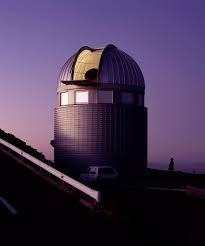
The Euler 1.2-m telescope

The result has been the discovery of over 150 exoplanets transiting bright stars, and many of them are among the most valuable exoplanets for further observation and study. So far the collaboration between Prof Queloz’s team and WASP-South has led to over 100 refereed papers in leading journals, that have so far been cited over 5000 times.