Monthly Archives: November 2018

WASP-18 is observed by TESS

The TESS mission will survey the entire sky for new transiting exoplanets, and as a by-product will produce space-quality lightcurves of all the WASP exoplanet systems. The first such paper has just appeared on arXiv, where Avi Shporer et al report on the TESS lightcurve of WASP-18.

WASP-18b is the most massive planet found by WASP, a 12-Jupiter-mass planet in a very tight orbit lasting only 0.94 days. This means it has the strongest planet–star tidal interaction of any known planetary system, such that the planet’s gravity gives rise to large tidal bulges on the host star. Here are the TESS data folded on the orbital cycle:

The out-of-transit data are clearly not flat (shown on a larger scale in the middle panel), and show the “ellipsoidal modulation” caused by the tidal bulges on the star. The heated face of the planet is also eclipsed by the star at phase 0.5, producing a secondary eclipse.

By analysing the lightcurve the authors conclude that very little heat is being redistributed from the heated face of the planet. Strong winds could carry heat to the un-irradiated cooler hemisphere, but there is little sign of this in the data.

So far the results of the analysis are in line with theoretical expectations, though the work points to the potential for similar analyses of other previously-known exoplanet systems.
WASP-166b, a Neptune-desert planet

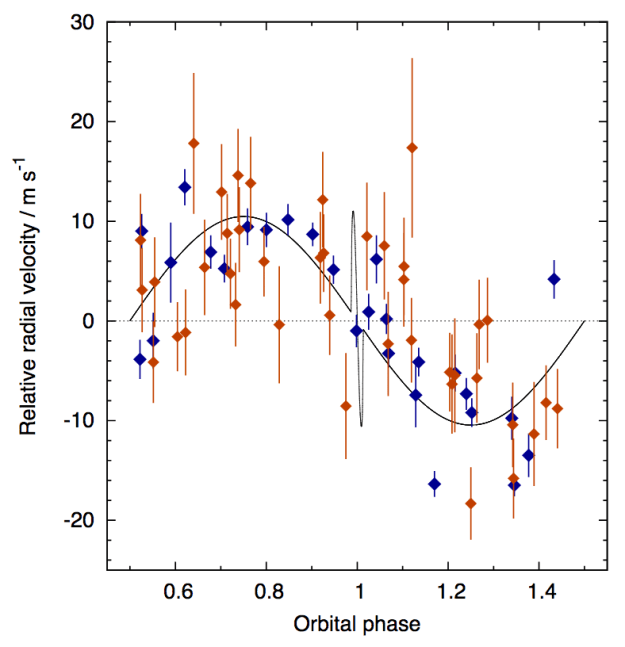
WASP-166b, newly announced on arXiv, is a planet we’ve been following for a while. As we routinely do, we measure the mass of the planet from how much its gravity tugs the host star around, and we measure that from the Doppler shift of its spectrum. The “radial velocity” data for WASP-166, however, didn’t neatly fit the expected orbital motion (the fitted line in the figure), showing, in addition, deviations from the model.

It took us a while to understand this. One suggestion was that it was caused by a second planet also tugging the host star around. So we obtained more data, hoping to trace out the orbit of the second planet, only to find that that didn’t properly explain the data. Eventually we attributed the deviations to magnetic activity on the host star. If we plot the deviations as a function of time we obtain:

Faculae on our Sun

The green sinusoidal lines are at the 12-day period at which we think the star rotates, as judged from the width of the spectral lines (which tells us how fast the star rotates). This suggests that the radial velocity varies with the rotational period of the star, and thus that the deviations are caused by “faculae”, magnetically active patches on the surface of the star.

WASP-166b is a low-mass planet, only a tenth that of Jupiter and twice that of Neptune. It has a large radius, however, at 63% of that of Jupiter. Thus it is a bloated planet with a low surface gravity.

Such planets are rare, especially in short-period orbits around fairly hot stars, as is WASP-166b. Indeed the lack of such planets is called the “Neptune desert”.

The explanation is thought to involve irradiation, heat from the host star evaporating off the atmosphere of the planet. Jupiter-mass planets can resist this because they have a lot of mass and thus gravity to keep hold of the atmosphere. Similarly, smaller, compact planets can survive because they are rocky and denser. But, in the middle, gaseous Neptune-mass planets find it hard to survive when subjected to high irradiation.

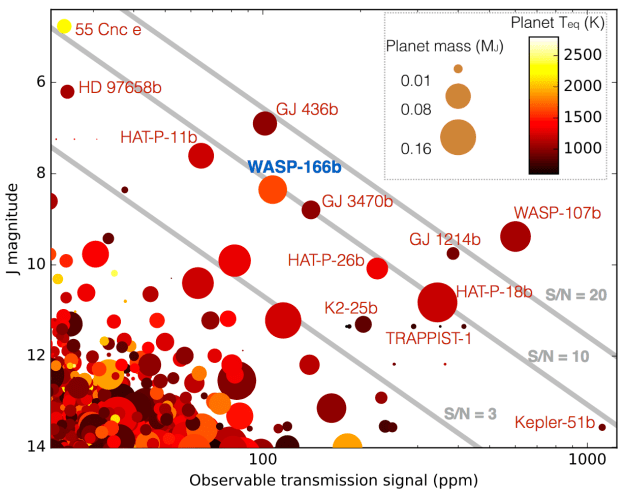
Another notable fact about WASP-166b is that it transits a host star with a bright visual magnitude of V = 9.4. The combination of a fluffy atmosphere and bright host star make it one of the best targets for studying the atmosphere by “transmission spectroscopy”, as can be obtained when the planet is projected against the stellar disc during transit. The plot compares the expected atmospheric signal of WASP-166b to the other best targets already known.

Aluminium Oxide in the atmosphere of WASP-33b?

The Instituto de Astrofisica de Canarias have put out a press release on a new paper by von Essen et al, reporting a study of WASP-33b using the 10-meter Gran Telescopio Canarias.

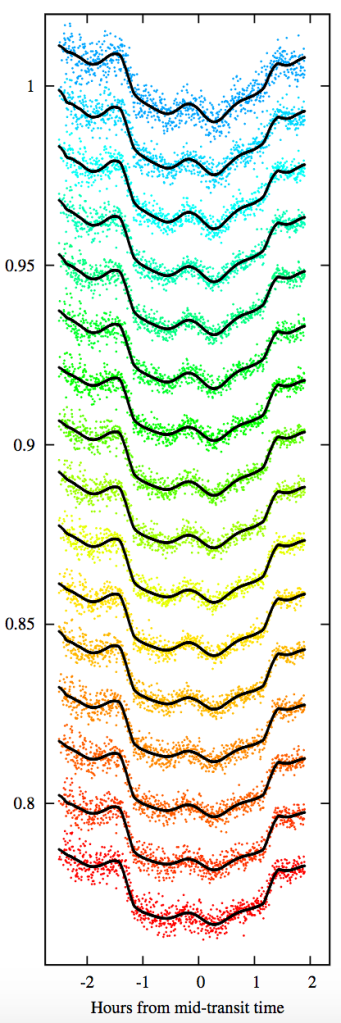
WASP-33 is a hard system to analyse since the host star is a delta-Scuti star, which means that it pulsates. That produces transit lightcurves like these, where the usual transit profile has pulsations superimposed on it. The figure shows the transit in different wavebands across the optical, from blue to red, as obtained with the OSIRIS spectrograph. That meant that the authors first had to model and subtract the effect of the pulsations.

After doing that they analysed how the transit depth depended on wavelength, which reveals how the planet’s atmosphere absorbs light. “We find that the feature observed between 450 and 550 nm can best be explained by aluminium oxide in its atmosphere” says lead author, Carolina von Essen.

“The current models of exoplanetary atmospheres predict that the Ultra Hot Jupiters should be free of clouds, and present a range of oxides in the visible spectrum, such as vanadium oxide, titanium oxide, and aluminium oxide”. This work on WASP-33b is the first observational indication of the presence of aluminium oxide.