Monthly Archives: March 2018

Comparing WASP-173 to KELT-22

WASP-173 and KELT-22 are the same object. The WASP and KELT teams are both trying to find transiting exoplanets around relatively bright stars, and this means that sometimes our discoveries overlap. We announced that WASP-173 hosts a hot Jupiter in a paper on arXiv on the 7th March, and then on the 21st March KELT reported an entirely independent discovery of the same planet.

Since the two teams use different facilities, techniques and software, comparing the two sets of system parameters provides an interesting check on the methods. So let’s see how similar the reports are.

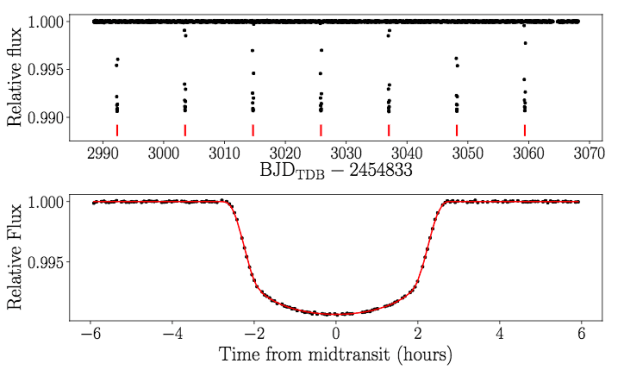
WASP-173Ab discovery photometry

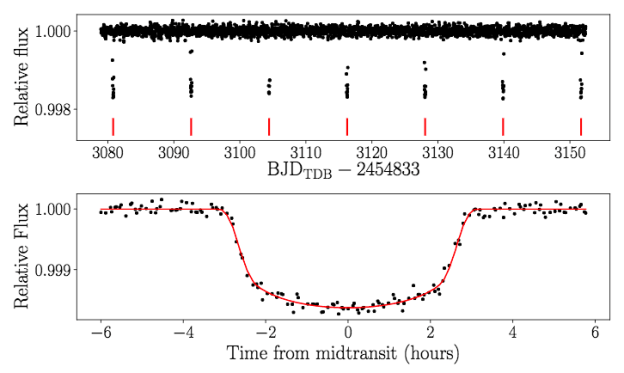
The biggest difference is a somewhat different transit depth. We (WASP) report a depth of 0.0123 ± 0.0002 whereas KELT report 0.0145 ± 0.0008, where the difference is greater than the error bars quoted. Now this system is a double star, with a companion star 6 arcsecs away and 0.8 magnitudes fainter. That makes it hard to measure the depth. One either uses a much smaller photometric aperture than normal, excluding the nearby star, or one uses a much wider aperture, containing both stars, and makes a correction for the dilution of the companion. Either approach could introduce systematic errors more than normal. Then, of course, there could be red noise in the light-curves owing to observing conditions or stellar activity.

KELT-22Ab transit photometry

The greater depth in the KELT paper means they arrive at a slightly larger planet radius (1.29 ± 0.10 Jupiter radii) than we do (1.20 ± 0.06) but here the error ranges overlap. The planet mass (derived mostly from the radial velocity data) is comparable, 3.47 ± 0.15 Jupiter masses in the KELT paper, and 3.69 ± 0.18 in ours.

WASP-173Ab radial velocities (from CORALIE)

The differences in the parameters of the host star are all within the error ranges. KELT report a G2 star with an effective temperature of 5770 ± 50 K, a surface gravity (log g) of 4.39 ± 0.05, and a mass and radius of 1.09 ± 0.05 and 1.10 ± 0.08 in solar units, whereas WASP report a G3 star with effective temperature of 5700 ± 150 K, a surface gravity of 4.5 ± 0.2, and a mass and radius of 1.05 ± 0.08 and 1.11 ± 0.05.

KELT-22Ab radial velocities (from TrES)

Another comparison is the “impact factor” (how near the center-line the transit chord is), which we have as 0.40 ± 0.08 while KELT report 0.31 ± 0.18. Our higher value results from our having a higher transit width, 0.0957 ± 0.0007 days, compared to KELT’s 0.0981 ± 0.0025. Again, the differences point to red noise in the transit lightcurves, which is likely to produce uncertainties greater than the formal error bars.

Overall, the values are sufficiently similar that we can have broad confidence in the values, but the presence of systematic noise does need to be borne in mind.

Two K2 planets transiting bright stars

With the launch of the James Webb Space Telescope only a year away the exoplanet community is gearing up to exploit its capability for characterising exoplanet atmospheres. A new paper by Yu et al contains a plot of the best targets, giving the expected “signal to noise” for each planet as a function of the planet’s mass. The higher the S/N the better, enabling more atmospheric features to be discerned.

It is notable that most of the best targets do not come from Kepler (which had a relatively small field of view, and so looked at mainly fainter stars), but instead from the ground-based transit surveys (which focus mainly on brighter stars, which are thus better targets for follow-up). WASP features strongly, supplying half of the best targets.

The focus of the Yu et al paper, however, is the discovery of two very good targets from the K2 phase of Kepler‘s mission. K2 is observing more fields for less time than the original Kepler, and so covers more bright stars.

HD 89345b (labelled in red above) is only 10% of Jupiter’s mass but is bloated to 0.6 Jupiter radii. Transiting a bright star of V = 9.4 makes it a prime target.

The transit depth of only 0.15% means that it is too shallow to have been detected by WASP (which can do 0.2–0.3% at best), especially given the 11.8-day orbit, which means that it produces fewer transits than shorter-period planets.

The other new discovery, HD 286123b (which had also been independently found by Brahm et al), is a larger and more massive planet producing a 0.8% dip. This one should have been within the reach of the WASP survey, but happens to lie in a region of the Northern sky where SuperWASP-North has only limited data.

Comprehensive Spectrum of WASP-39b

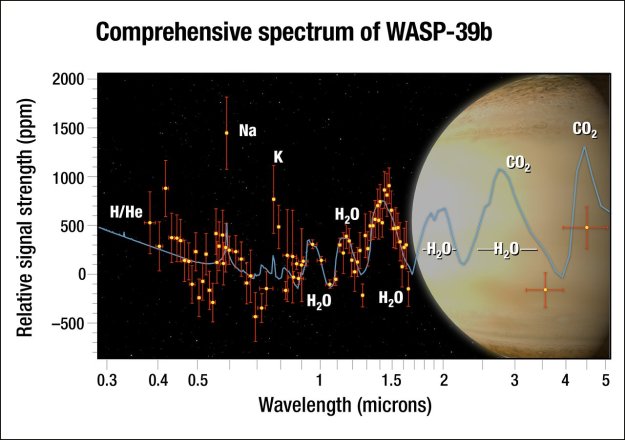
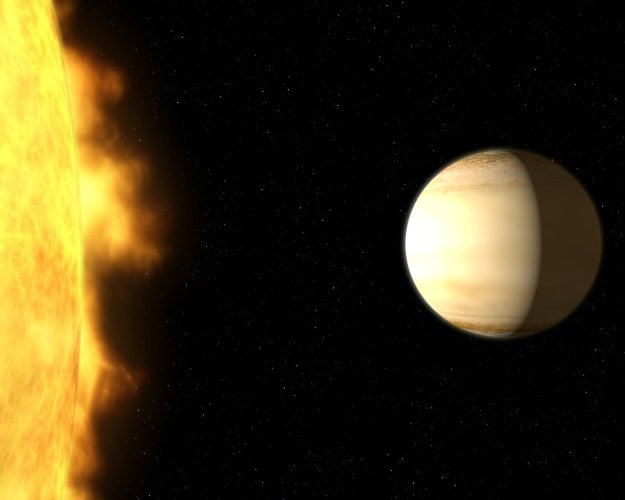
NASA, ESA and JPL have put out press releases on the atmospheric spectrum of WASP-39b. The paper by Hannah Wakeford et al combined Hubble and Spitzer data to produce a comprehensive spectrum with broad spectral coverage.

“Using Hubble and Spitzer, the team has captured the most complete spectrum of an exoplanet’s atmosphere possible with present-day technology. “This spectrum is thus far the most beautiful example we have of what a clear exoplanet atmosphere looks like,” said Wakeford.”

“WASP-39b shows exoplanets can have much different compositions than those of our solar system,” said co-author David Sing of the University of Exeter. “Hopefully, this diversity we see in exoplanets will give us clues in figuring out all the different ways a planet can form and evolve.”

The strongest features in the spectrum are caused by water:

“Although the researchers predicted they’d see water, they were surprised by how much water they found in this “hot Saturn.” Because WASP-39b has so much more water than our famously ringed neighbor, it must have formed differently. The amount of water suggests that the planet actually developed far away from the star, where it was bombarded by a lot of icy material. WASP-39b likely had an interesting evolutionary history as it migrated in, taking an epic journey across its planetary system and perhaps obliterating planetary objects in its path.”

Coverage of the press release includes that by Newsweek, the International Business Times, the Daily Mail and about 30 other websites.