Monthly Archives: August 2016

Using the stellar rotation to trace a planet’s orbit

As a transiting exoplanet tracks across its star it progressively blocks out different regions of the face of the star. Since the star will be rotating, one limb of the star will be moving towards us (and so its light will be blueshifted) while the other limb recedes (producing a redshift). The blocking of light by the planet thus changes the spectral lines from the star. This is called the Rossiter–McLaughlin effect, and it can be used to discern the track of the planet’s orbit.

Brett Addison and Jonti Horner have written a nice introduction to such techniques on the widely read The Conversation website. Since large numbers of WASP planets orbit stars bright enough to enable a detection of the Rossiter–McLaughlin effect, around half of the planets with measured orbits are WASP planets.

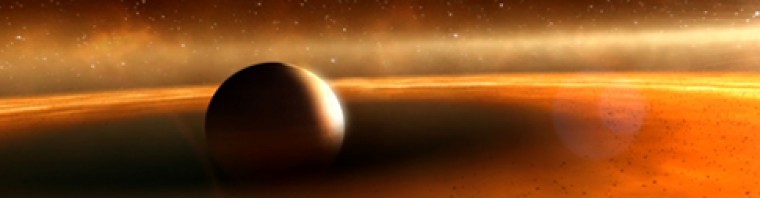
Addison and Horner illustrate their piece with an artist’s conception of the polar orbit of WASP-79b:

Hot Jupiter exoplanet WASP-79b polar orbit

KELT-16b and sub-1-day hot-Jupiter exoplanets

Until recently the only hot-Jupiter exoplanets known with orbital periods below one day were the four discovered by WASP-South (WASP-18b, WASP-19b, WASP-43b and WASP-103b). But last month HATSouth reported that HATS-18b has a 0.84-day period and now KELT have announced KELT-16b at 0.97 days.

The KELT team, lead by Thomas Oberst, have produced this figure showing planetary masses against orbital separation (semi-major axis):

Short-period hot Jupiter exoplanets

One can see that all the planets just mentioned are Jupiter-mass or heavier. There are relatively few planets in the blue-shaded region, where they would have both Neptune-like masses and very short orbital periods. There are, though, Earth-mass planets known at these orbital periods. The paucity of short-period Neptunes cannot just be a selection effect, since they would have been readily found in the Kepler mission.

Instead, the currently favoured explanation is that planets in the blue-shaded region would rapidly be evaporated and be stripped down to their cores. At such short separations from their stars planets are subject to high irradiation and tidal forces. The combination can inflate the planets to the point that their atmospheres “boil off” and overflow the planet’s Roche lobe.

They avoid this fate only if the planet has enough mass, and thus gravity, to hold on to its atmosphere. Thus, at these very short orbital periods, we see either large, Jupiter-mass planets, or small, dense, rocky planets (possibly remnant cores of evaporated larger planets) — but not any in-between planets the size of Neptune.

Changeable weather on exoplanet WASP-43b?

WASP-43b is the “hot Jupiter” exoplanet with the orbit closest-in to its star, producing an ultra-short orbital period of only 20 hours. The dayside face is thus strongly heated, making it a prime system for studying exoplanet atmospheres.

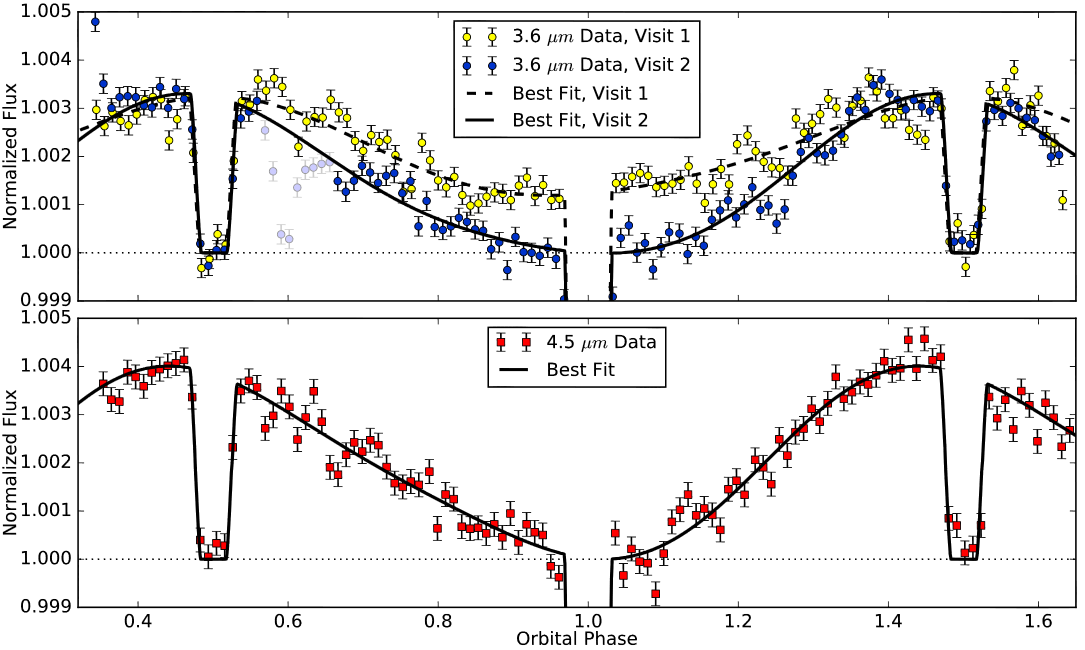
Kevin Stevenson et al have pointed NASA’s Spitzer Space Telescope at WASP-43, covering the full orbit of the planet on three different occasions. Spitzer observed the infrared light from the heated face in two bands around 3.6 microns and 4.5 microns.

The three resulting “phase curves” are shown in the figure:

Spitzer phase curves of exoplanet WASP-43b

The 4.5-micron data from one visit are shown in red in the lower panel; the 3.6-micron data from the two other visits are in the upper panel. The transit (when the planet passes in front of the star) is at phase 1.0, and drops below the plotted figure. The planet occultation (when it passes behind the star) is at phase 0.5. The sinusoidal variation results from the heated face of the planet facing towards us (near phase 0.5) or away (near phase 1.0).

Intriguingly, the depth of the variation in the 3.6-micron data is clearly different between the two visits. Why is this? Well, Stevenson et al are not sure. One possibility is that the data are not well calibrated and that the difference results from systematic errors in the observations. After all, such observations are pushing the instruments to their very limits, beyond what they had been designed to do (back when no exoplanets were known and such observations were not conceived of).

More intriguingly, the planet might genuinely have been different on the different occasions. The authors report that, in order to model the spectra of the planet as it appears to be during the “blue” Visit 2 in the figure, the night-time face needs to be predominantly cloudy. But, if the clouds cleared, more heat would be let out and the infrared emission would be stronger. That might explain the higher flux during the “yellow” Visit 1. Here on Earth the sky regularly turns from cloudy to clear; is the same happening on WASP-43b?