Monthly Archives: March 2016

The atmosphere of exoplanet WASP-36b

WASP-36b transits

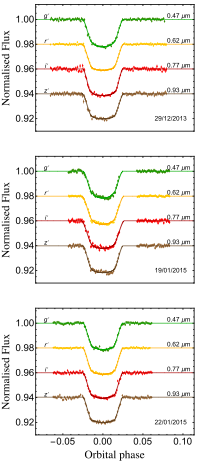
Transits of WASP-36b in multiple colours and from different nights.

A new paper by Luigi Mancini et al reports transits of the hot-Jupiter exoplanet WASP-36b in multiple colours. The point is to record the transit depth as a function of wavelength, and thus deduce how opaque the planet’s atmosphere is at different wavelengths. That, in turn, might tell us what the atmosphere is made of.

To do this Mancini et al have used the GROND instrument on ESO’s 2.2-m telescope, which records light in four different colours simultaneously. They observed four different transits of WASP-36b over 2012 to 2015.

The result is the figure below showing the transit depth in the four different passbands (greater depth implying a larger planet radius, plotted as the ratio of planet to star, Rb/RA).

The black crosses show the transit depth. The dashed versions are corrected for possible star-spots in the transit light curves. The coloured lines represent different atmospheric models.
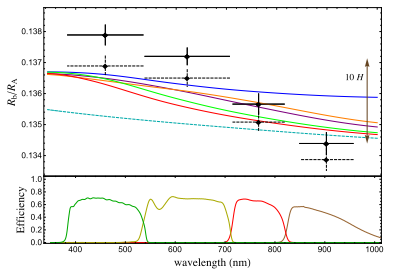
WASP-36b transits versus passband

The data show a clear and strong trend to greater depth in the blue, steeper than would be explained by any of the models shown. This means that something in the planet’s atmosphere is absorbing strongly at bluer wavelengths. What is causing this is unclear, and will require further investigation.

WASP exoplanet skies in Forbes Magazine

A recent article by Brian Koberlein in Forbes Magazine, on “The Wonder of Exoplanet Skies”, features WASP. The article is based on a recent paper by Jake Turner et al which includes observations of 15 hot Jupiters, of which seven are WASP planets.

The paper is one of the first to compile exoplanet transits in the near-UV “U” band. By comparing transit depths at different wavelengths one can discern facts about the exoplanet’s sky, such as whether is it clear or cloudy.

The most interesting result is apparently anomalous U-band transit depths in WASP-1b and WASP-36b, which appear shallower than in the optical, a finding that is hard to explain. Most likely this will have been caused by some observational bias, especially since there appears to be “red noise” in some of the transit profiles.

The image shows transits in the red (Harris R) and the near-UV (Bessell U), along with the residuals against a fitted model.

WASP-36b U-band transit

This sort of work is hard to do from the ground, but such studies point to a bright future for parameterising exoplanet atmospheres.

Spin-orbit alignments for three more WASP planets

A team led by Brett Addison has been pointing the Anglo-Australian Telescope at WASP planets, trying to discern whether the planet’s orbit is aligned with the star’s spin axis.

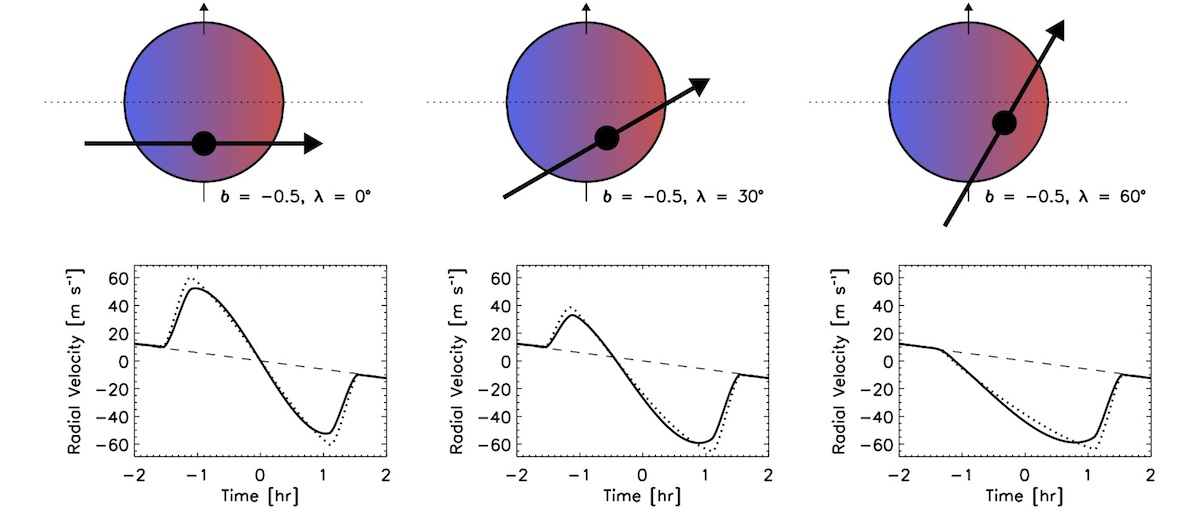
The rotation of the star means that one limb is approaching us, and so is blue-shifted, while the other limb is receding, and so is red-shifted. The planet can occult blue-shifted light (making a spectral line redder) and then red-shifted light. This is called the Rossiter–McLaughlin (or R–M) effect, and allows us to deduce the path of a transiting planet across the face of its star.

Rossiter-McLaughlin effect

Brett Addison and colleagues report the R–M effect for three more WASP planets, WASP-66b, WASP-87b and WASP-103b. Here are their data for WASP-87b:

WASP-87 Rossiter-McLaughlin effect

All three planets appear to have orbital axes aligned with the star’s spin axis. The authors discuss the mechanisms and timescales by which orbits get “damped” by tidal effects and so become aligned with their star.

WASP-157b, a transiting Hot Jupiter observed with K2

Hot on to arXiv is our latest discovery paper. WASP-157b marks a jump upwards in WASP numbering, since we’ve somewhat rushed this one out. WASP-157 was flagged as a WASP candidate in 2014 and added to our program for radial-velocity (RV) and photometric follow-up. Meanwhile, being in the field of K2 Campaign 6, it was observed by Kepler from July to September 2015. Since K2 data are public, this meant that other groups would soon be on its trail.

A TRAPPIST observation of the transit, shortly before the K2 data were due to be released, along with prioritising it for CORALIE and HARPS RVs, rapidly accumulated enough observations to prove it was a planet. Keele student Teo Močnik then did a good job of analysing the K2 data and turning all the observations into a paper. A gap of only four days between the last CORALIE radial-velocity observation and the paper appearing on arXiv is efficient work!

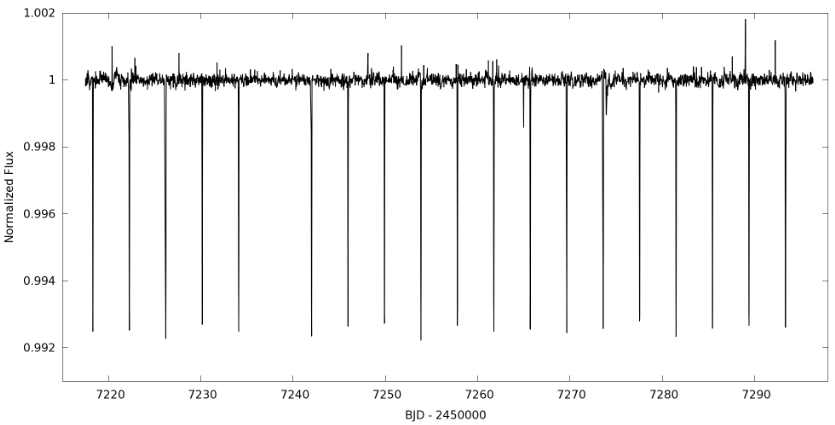
Here is the K2 lightcurve showing the transits of WASP-157b:

Lightcurve of WASP-157b observed with Kepler K2

Orbital-period decay in hot-Jupiter WASP-12b?

Closely orbiting hot-Jupiter exoplanets are likely to be spiralling inwards towards their host star as a result of tidal interactions with the star. A new paper by Maciejewski et al reports a possible detection of this orbital-period decay in WASP-12b.

The authors have acquired 31 new transit light-curves over four years, and detect a trend under which the latest transits occur about a minute early compared to an unchanging ephemeris.

WASP-12b orbital period decay

Transits of WASP-12b. O–C is the observed time compared to that calculated from an unchanging orbital period. The time (x-axis) is given in both a count of days (BJD) and a count of transits.

This is the most convincing claim yet of a changing orbital period in a hot Jupiter. Whether it shows the spiral infall, though, is less clear. As the authors explain, other tidal interactions between the star and the planet, such as that causing apsidal precession, could account for the effect. Further, in close binary stars there are known to be similar period changes on decade-long timescales that are not fully understood, but which might be caused by Solar-like magnetic cycles on the star.

One suggestion that this is not spiral infall comes from the deduced value of the tidal quality factor, Q, which the authors calculate as 2.5 x 10⁵. This is lower than other estimates of Q as nearer 107.

The way to settle the issue will be to accumulate more data over a longer timespan until the case for spiral infall becomes overwhelming. It will thus be important to continue monitoring WASP-12b, and the other short-period hot Jupiters, over the coming decades.