
Monthly Archives: October 2014

The atmosphere of hot-Jupiter exoplanet WASP-31b

Characterising the atmospheres of exoplanets is a rapidly growing field that is set to increase in importance even more with the forthcoming launch of JWST. WASP planets are prime targets for such work since they transit relatively bright stars. Comparing spectra in and out of transit then gives a transmission spectrum of the planet’s atmosphere.

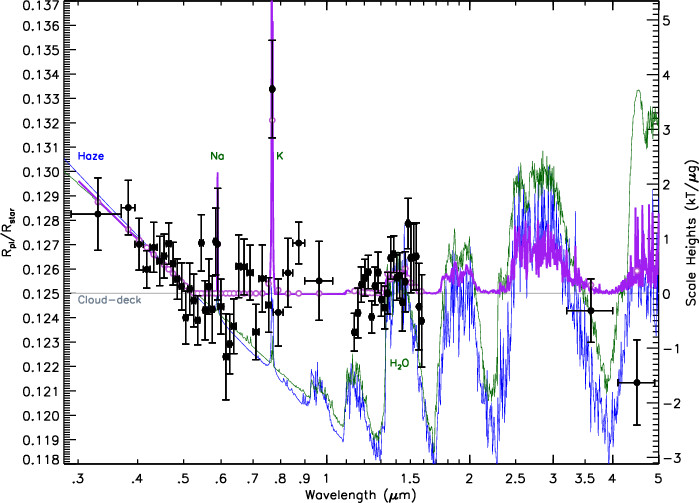
A new study by David Sing et al presents a state-of-the-art analysis of WASP-31b’s atmosphere using the STIS instrument on the Hubble Space Telescope.
w31_atmos

Notable features include the presence of potassium absorption (the peak labelled K) and the fact that this is stronger than sodium (Na) absorption. The absence of many of the broad features in the plotted models implies a “cloud deck” that results in few spectral features. Also seen is a “Rayleigh scattering” slope implying small atmospheric particles floating above the cloud layer.

WASP-31b is a planet of 0.5 Jupiter masses that is bloated up to 1.5 Jupiter radii. This gives it a large atmospheric scale height that makes it a good target for transmission spectroscopy, since the fluffier atmosphere covers a larger fraction of the star during transit.

WASP-31b was discovered in 2010 by the WASP-South team led by David Anderson.

2014: A bumper year for WASP planets

2014 is proving to be the WASP project’s most successful year yet for the publication of transiting exoplanets. With two months to go before the end of the year, there are already 17 new planets published in 2014 in refereed journals. 12 more planets have been announced on the arXiv preprint server, though many of those will likely appear with a 2015 publication date.

We are currently finding transiting exoplanets at a rate of about 30 a year (WASP-117 is the highest number published, though we have currently got as far as WASP-134). This results from improvements in data quality owing to adding multiple years of observation. Further, the combination of WASP-South with the TRAPPIST photometer and the Euler/CORALIE spectrograph is proving to be a highly effective team. The process involves a lot of telescope time and hard work — only 1 in 10 of candidates followed up proves to be a planet — but the reward is the strong worldwide interest in studying WASP planets.

Hubble maps the atmosphere of WASP-43b

WASP-43b is one of the more extreme hot Jupiters found by WASP-South, orbiting its star in only 19 hours, making it the hot-Jupiter planet closest to its star, where its atmosphere gets blasted by the stellar irradiation. Since the host star is relatively dim, a K7V dwarf smaller and fainter than our Sun, the planet’s light is relatively easy to see and thus the system is a prime target for characterising exoplanet atmospheres.

Now, NASA have put out a press release regarding a Hubble Space Telescope observation of WASP-43b which monitored the planet around three of its orbits.

By recording the changes in the observed light around the orbit, as the irradiated face of the planet swings into view and then faces away again, the team have mapped the temperature and the distribution of water vapour of the planet’s atmosphere.

Exoplanet WASP-43b orbits its parent star

The image (Credit: NASA, ESA, and Z. Levay (STScI)) shows the changing view of WASP-43b around its orbit, illustrating the hot, blasted heated face and the darker atmosphere pointing away from the star.

The planet is phase-locked to the orbit by tidal forces, always pointing the same face to its star, and thus we expect dramatic winds as the planet’s atmosphere redistributes heat from the star-facing side to the cooler side.

The Hubble observations are reported in three papers, one accepted for Science, lead by Kevin Stevenson of the University of Chicago (arXiv link). A second paper, led by Laura Kreidberg, also of the University of Chicago, shows that the abundance of water in WASP-43b’s atmosphere is compatible with that in the Sun (arXiv link). A third paper, led by Tiffany Kataria of the University of Arizona, models the planet’s atmospheric circulation (arXiv link).

WASP-43b was announced in 2011 by the WASP-South team in a paper led by Coel Hellier of Keele University.