Tag Archives: WASP-76b

CHEOPS sees a “glory” effect on WASP-76b

The European Space Agency have put out a press release reporting the observation of a “glory effect” in observations of ultra-hot-Jupiter WASP-76b by the CHEOPS satellite.

“Cheops intensively monitored WASP-76b as it passed in front of and around its Sun-like star. After 23 observations over three years, the data showed a surprising increase in the amount of light coming from the planet’s eastern ‘terminator’ – the boundary where night meets day.”

Artist impression of glory on exoplanet WASP-76b (Credit: ESA)

“This discovery leads us to hypothesise that this unexpected glow could be caused by a strong, localised and anisotropic (directionally dependent) reflection”, said Olivier Demangeon, lead author of the study, producing a glory effect akin to a rainbow.

“You need atmospheric particles that are close-to-perfectly spherical, completely uniform and stable enough to be observed over a long time. The planet’s nearby star needs to shine directly at it, with the observer – here Cheops – at just the right orientation.”

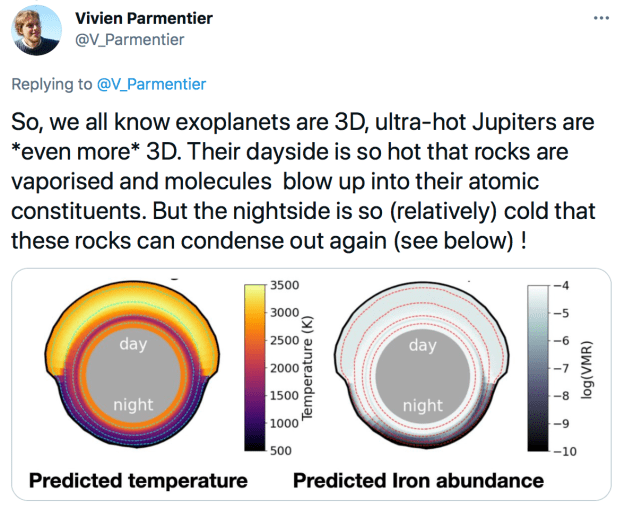
Cold-trapping on the nightside of giant exoplanet WASP-76b

The University of Montreal have put out a press release about a study of ultra-hot-Jupiter WASP-76b. The work, published in Nature by Stefan Pelletier et al, is based on observations with the 8-m Gemini-North telescope.

Pelletier et al measure the abundances of elements in the atmosphere of WASP-76b and compare them to abundances in the Sun.

Elements with condensation temperatures below 1550 K match solar abundances. Elements with higher condensation temperatures appear to be severely depleted. This is likely because they are “cold trapped”, condensed on the night-side of the planet, which, facing away from its host star, is much colder. The work has been widely reported in the media.

Detection of barium in the atmospheres of WASP-76b and WASP-121b

ESO have put out a press release reporting the discovery of barium in the atmospheres of ultra-hot Jupiters WASP-76b and WASP-121b, based on observations with the ESPRESSO spectrograph on ESO’s Very Large Telescope. Barium is the heaviest element so far detected in an exoplanet.

“The puzzling and counterintuitive part is: why is there such a heavy element in the upper layers of the atmosphere of these planets?” says Tomás Azevedo Silva, lead author of the paper.

This artist’s impression shows an ultra-hot exoplanet, a planet beyond our Solar System, as it is about to transit in front of its host star. When the light from the star passes through the planet’s atmosphere, it is filtered by the chemical elements and molecules in the gaseous layer. With sensitive instruments, the signatures of those elements and molecules can be observed from Earth. Using the ESPRESSO instrument of ESO’s Very Large Telescope, astronomers have found the heaviest element yet in an exoplanet's atmosphere, barium, in the two ultra-hot Jupiters WASP-76 b and WASP-121 b.

The work has been reported by dozens of newspapers and media websites, such as CNN and The Independent.

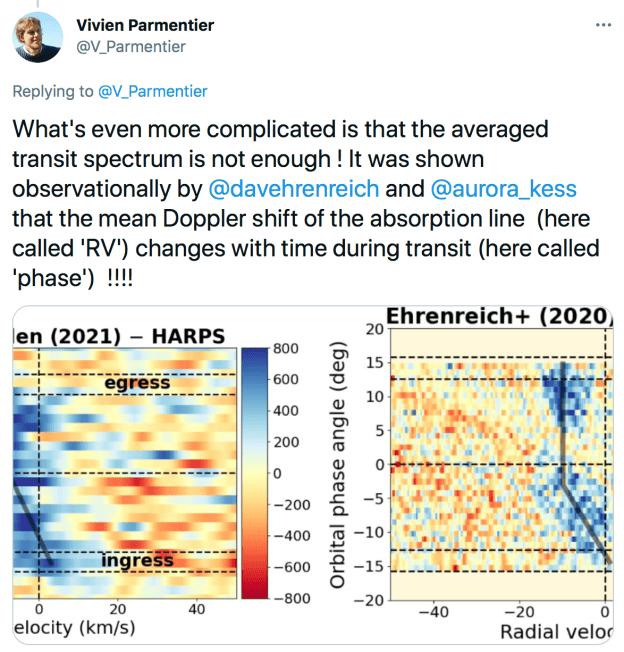
It’s raining iron on WASP-76b

ESO have produced a press release about a Nature paper on WASP-76b. The study was led by David Ehrenreich of the Geneva Observatory, and used observations with the new ESPRESSO spectrograph on the ESO VLT.

“The ultra-hot giant exoplanet has a day side where temperatures climb above 2400 degrees Celsius, high enough to vaporise metals. Strong winds carry iron vapour to the cooler night side where it condenses into iron droplets.”

“One could say that this planet gets rainy in the evening, except it rains iron,” says Ehrenreich. “The observations show that iron vapour is abundant in the atmosphere of the hot day side of WASP-76b,” adds María Osorio, chair of the ESPRESSO science team. “A fraction of this iron is injected into the night side owing to the planet’s rotation and atmospheric winds. There, the iron encounters much cooler environments, condenses and rains down.”

ESO have produced an artist’s impression of iron rain as dusk on WASP-76b:

Artist’s impression of the night side of WASP-76b (Credit: ESO/M. Kornmesser).

ESO have also produced videos of WASP-76b and its host star.

Media coverage from the press release includes The BBC, CNN, The Guardian, The Times, The Independent, the NY Times, Newsweek, NBC News, the Canadian Broadcasting Company, the Canberra Times, and others amounting to over 50 English-language articles plus coverage in German, French, Chinese, Polish, and other languages.