Helium reveals the extended atmosphere of WASP-107b

Here’s a plot from a new paper on WASP-107b by James Kirk et al. It shows data taken with a near-infra-red spectrograph on the 10-m Keck II telescope on Mauna Kea, and is focused on the Helium line at 10833 Å. The plot shows the spectra as a function of time (y-axis), though a transit. When the planet passes in front of its host star (white horizontal lines are times of ingress and egress) the helium line shows excess absorption. This helium is in the atmosphere of the planet and is absorbing some of the starlight. There is a slight change in the wavelength of the absorption owing to the orbital motion of the planet (denoted by the dashed white lines).

The paper shows, firstly, that ground-based telescopes such as Keck can do a fine job of discerning the compositions of exoplanet atmospheres. Secondly, the fact that the absorption extends beyond transit-egress indicates that the atmosphere is boiling off the surface of WASP-107b, under the fierce irradiation of the star, and is forming a comet-like tail.

Amaury Triaud wins the RAS Fowler Award

Congratulations to Dr Amaury Triaud, now at the University of Birmingham, recipient of the 2020 Fowler Award from the Royal Astronomical Society. The Fowler Award is for scientists making a “particularly noteworthy contribution to Astronomy & Geophysics at an early stage of their research career”.

Amaury Triaud

The citation reads: “Between 2007 and 2017, Dr Triaud led the radial-velocity follow-up of planet candidates south of declination −10 degrees from the Wide-Angle Search for Planets (WASP). His programme led to the discovery of over 130 planets from some 1000 candidates, making WASP the most successful of all ground-based transit searches.”

Amaury started looking for WASP exoplanets as a graduate student at the Geneva Observatory, under the direction of Didier Queloz (himself recipient of the 2019 Nobel Prize for Physics for his discoveries of exoplanets). Didier’s group at Geneva operated the CORALIE spectrograph on the 1.2-m Euler telescope at La Silla in Chile. Euler/CORALIE was the ideal follow-up instrument to vet the transiting exoplanet candidates coming from WASP-South, able to show which ones were genuinely the transits of planetary-mass bodies (only 1-in-10 of all candidates), and which were merely transit mimics. Amaury organised and ran the campaign, observing of order 1500 candidates and leading to the discovery of around 150 planets.

Euler telescope

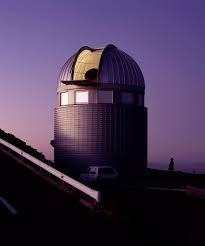
The Euler 1.2-m telescope

While the citation mentions the campaign for Southern candidates south of declination −10 degrees, the Geneva group were also responsible for much of the follow-up in the equatorial strip from −10 to +10 degrees, where the candidates came jointly from data from WASP-South and from SuperWASP-North on La Palma.

Amaury’s work extended into studying the orbits of the WASP exoplanets, showing that many of the orbits were misaligned. He also developed programs identifying and studying the low-mass binary stars that also came from the WASP survey, and is now looking for circumbinary planets orbiting these low-mass binaries.

The IAU announces names for WASP exoplanets

The IAU have recently announced the outcome of their campaign allowing the people of the world to name recently discovered exoplanets and their host stars. The names chosen for WASP exoplanet systems are:

WASP-6 and WASP-6b: Márohu and Boinayel (Márohu and Boinayel are the god of drought and the god of rain, respectively, from the mythology of the Taino people of the Dominican Republic).

WASP-13 and WASP-13b: Gloas and Cruinlagh (in Manx Gaelic, Gloas means to shine, like a star, while Cruinlagh means to orbit).

WASP-15 and WASP-15b: Nyamien and Asye (Nyamien is the supreme creator deity in the Akan mythology of the Ivory Coast, while Asye is the Earth goddess).

WASP-17 and WASP-17b: Dìwö and Ditsö̀ (from the Bribri language of Costa Rica, Dìwö means the Sun, while Ditsö̀ is the name the god Sibö̀ gave to the Bribri people).

WASP-21 and WASP-21b: Tangra and Bendida (Tangra is the supreme creator god in early Bulgarian mythology, while Bendida is the Great Mother goddess of the Thracians).

WASP-22 and WASP-22b: Tojil and Koyopa’ (Tojil is a Mayan deity related to rain, storms and fire, while Koyopa’ means lightning in the K’iche’ Mayan language).

WASP-34 and WASP-34b: Amansinaya and Haik (Aman Sinaya is the primordial deity of the ocean in the Philippine’s Tagalog mythology while Haik succeeded Aman Sinaya as God of the Sea).

WASP-38 and WASP-38b: Irena and Iztok (Iztok and Irena are characters from a traditional story from Slovenia).

WASP-39 and WASP-39b: Malmok and Bocaprins (Malmok and Boca Prins are scenic, sandy beaches in Aruba).

WASP-50 and WASP-50b: Chaophraya and Maeping (Chao Phraya is the great river of Thailand, while Mae Ping is a tributary).

WASP-52 and WASP-52b: Anadolu and Göktürk (Anadolu is the motherland of the Turkish people while Göktürk was the first Turkish state, established in the 5th century).

WASP-60 and WASP-60b: Morava and Vlasina (Morava is the longest river in Serbia, while Vlasina is a tributary).

WASP-62 and WASP-62b: Naledi and Krotoa (Naledi means “star” in the Sesotho, SeTswana and SePedi languages of South Africa, while Krotoa is considered the Mother of Africa and member of the Khoi people).

WASP-64 and WASP-64b: Atakoraka and Agouto (Atakoraka is a mountain range in Togo, while Agouto is the highest peak).

WASP-71 and WASP-71b: Mpingo and Tanzanite (Mpingo is a tree that grows in southern Tanzania producing ebony wood for musical instruments, while Tanzanite is a precious stone).

WASP-72 and WASP-72b: Diya and Cuptor (Diya is an oil lamp used in the festival of Diwali in Mauritius, while Cuptor is a traditional clay oven).

WASP-79 and WASP-79b: Montuno and Pollera (the names are the traditional costumes worn by the man and the woman, respectively, in the El Punto folk dance of Panama).

WASP-80 and WASP-80b: Petra and Wadirum (Wadi Rum is a valley in southern Jordan while Petra is an ancient city).

WASP-161 and WASP-161b: Tislit and Isli (both are lakes in the Atlas Mountains of Morocco, and also mean “bride” and “groom” in the Amazigh language).

The tidal shape of the exoplanet WASP-121b

The moon’s gravity causes a tidal bulge in Earth’s oceans, so that the water facing the moon is raised several metres. Similarly, close-orbiting exoplanets will have a tidally distorted shape, with a tidal bulge facing the host star. The amount of distortion can be quantified by the “Love number” h (named after the mathematician Augustus Love)

Specifically, h2 tells us the relative height of the tidal bulge, and would be zero for a perfectly rigid body that did not distort at all, and would be 2.5 for a perfectly fluid body that adapted fully to the tidal potential. Gas-giant planets have large envelopes of gaseous fluid, so would be expected to have fairly high values of h2. However, they also might have rocky or metallic cores, and so would have values less than 2.5. For example Jupiter has h2 = 1.6 while Saturn has h2 = 1.4.

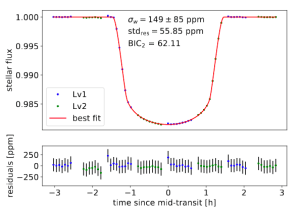
Transit of WASP-121b observed by HST with a model fit by Hellard et al.

A new paper by Hugo Hellard et al discusses whether h2 for a hot-Jupiter exoplanet can be measured from the shape of the transit lightcurve, given good-enough photometry such as that from the Hubble Space Telescope.

The main problem is that the transit profile is heavily affected by variations in the brightness of the stellar disc, in particular the limb darkening (a star’s limbs appear a bit dimmer, because a tangential line-of-sight into a gas cloud skims only the cooler, upper layers). Thus the Hellard et al paper discusses at length different ways to model the limb darkening.

A star’s disk is dimmer at the edges, so a transiting exoplanet removes less light (here Venus, top right, is transiting the Sun).

The end-result, however, is a claim to have measured h2 for WASP-121b, with a value of h2 = 1.4 ± 0.8. This is not (yet) a strong constraint, but points to the potential in the future, and also flags up the need to understand and properly parametrise limb darkening.

TESS phase curve of WASP-19b

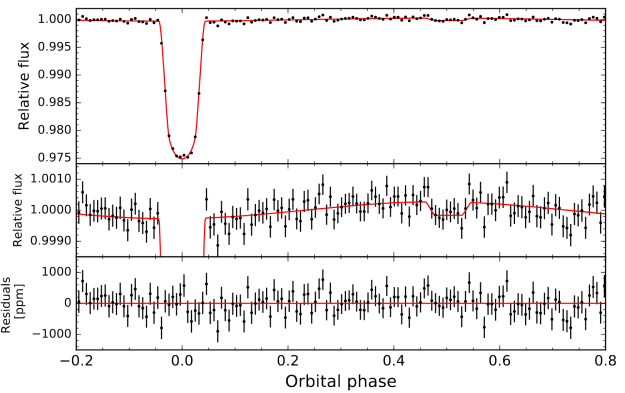
The space-based photometry from the TESS satellite is producing high-quality light curves of many of the WASP exoplanets. Here is the lightcurve of WASP-19b, from a new paper by Ian Wong et al:

In addition to the transit (phase zero), the lightcurve shows a shallower eclipse of the planet (phase 0.5) and a broad variation caused by the changing aspect of the heated face of the planet. Unlike in some planets, the hottest part of the planet directly faces the star, so there is no offset in the phase of the broad modulation.

Wong et al deduce that the dayside face of the planet is heated to 2240 ± 40 K, that there is no flux detected from the colder night side, and that the planet reflects 16 ± 4 percent of the light that falls on it. The last value is relatively high compared to other planets.

Water in exoplanet atmospheres

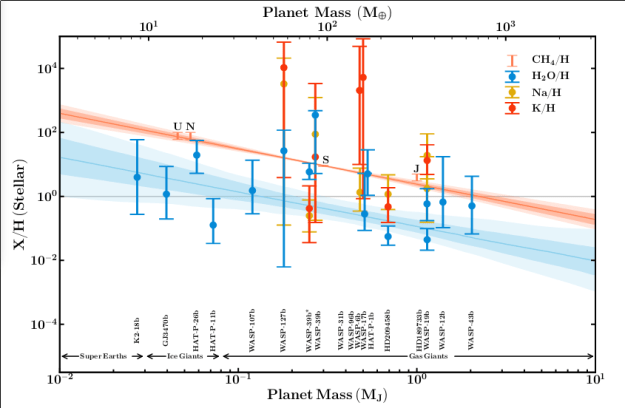
The Cambridge Institute of Astronomy have put out a press release based on a new paper analysing the water abundance in the atmospheres of 19 exoplanets, 11 of them being WASP planets.

The plot shows the measured water abundance versus the planet’s mass. Welbanks et al state that: “We find a mass–metallicity trend of increasing H2O abundances with decreasing mass”, and also that: “The H2O abundances in hot gas giants are likely due to low oxygen abundances relative to other elements rather than low overall metallicities, and provide new constraints on their formation mechanisms”.

The press release explains that: “The researchers found that while water vapour is common in the atmospheres of many exoplanets, the amounts were surprisingly lower than expected, while the amounts of other elements found in some planets were consistent with expectations”.

The press release has led to coverage in the Daily Express, Astronomy Now, and Science News, among other sites, accompanied by this graphic:

The atmosphere of the inflated hot Jupiter WASP-6b

Atmospheric characterisation of hot Jupiters continues apace, using both ground-based telescopes such as ESO’s Very Large Telescope and satellites such as Hubble.

Aarynn Carter et al have just produced a new analysis of WASP-6b:

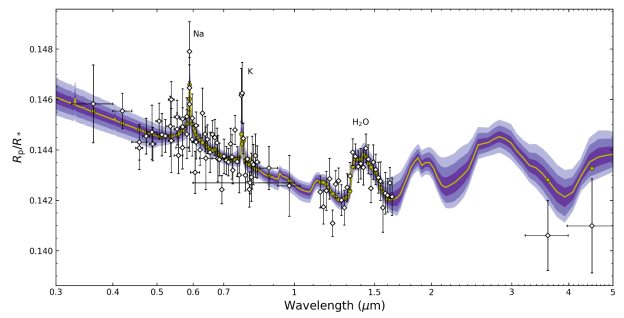
The spectrum shows absorption due to sodium (Na), potassium (K) and water vapour, while the modelling implies that the atmosphere is partially hazy. Carter et al state that: “despite this presence of haze, WASP-6b remains a favourable object for future atmospheric characterisation with upcoming missions such as the James Webb Space Telescope.

The spectrum of the bloated, sub-Saturn-mass planet WASP-127b

Here is the latest analysis of the spectrum of WASP-127b, led by Jessica Spake and newly announced on arXiv.

The different datasets come from the Hubble Space Telescope and the Spitzer Space Telescope. Spake et al see obvious features from sodium, potassium, water and carbon dioxide. They conclude that the planet has a super-solar metallicity and that its skies are relatively cloud-free.

WASP-127b is a highly observable target since, despite being less than Saturn’s mass, it is bloated to larger than Jupiter. The puffy atmosphere projected against the host star gives results in a strong signal observable during transit. Spake et al look forward to observing the planet with the James Webb Space Telescope, and say: “the hint of a large absorption feature around 4.5 microns is strong evidence that future observations of WASP-127b with JWST will be able to measure the abundances of carbon-bearing species in its atmosphere”.

The orbit of WASP-12b is decaying

Here’s the latest update on the changes in the orbital period of WASP-12b, from a new paper by Samuel Yee et al.

The times of transit are getting earlier, which means that the period is decreasing slightly. By also considering the times of occultation (when the planet passes behind the star), and also the radial-velocity measurements of the system, the authors deduce that the changes are not the effect of some other planet, but are a real decay in the orbit of WASP-12b. This is expected to occur as a result of tidal interactions between the planet and its host star.

One notable conclusion is that the rate of period decay in WASP-12b is much faster than that in WASP-19b, which shows no detectable period change yet, despite it being an even shorter-period hot Jupiter, which should increase tidal interactions. Yee et al suggest that the difference could arise if the host star WASP-12 is a sub-giant star, whereas WASP-19 is not.

Update: Following an article on WASP-12b’s orbital decay, supplied by Liz Fuller-Wright of Princeton University, and appearing in phys.org and Science Daily, the work has gained media attention from CNN, Science Times, Universe Today, and the UK’s Metro.

Gravity darkening of planet-host MASCARA-4

MASCARA is one of WASP’s competitor transit-search projects, so let’s celebrate a neat result from TESS data of transits of MASCARA-4b. The host star, MASCARA-4, is a hot, fast-rotating A-type star. As a result of its fast rotation, the equatorial regions are being flung outwards by centrifugal forces, such that the star has a flattened, oblate shape. As a result, the force of gravity will be less at the equator than at the poles of the star, and that means that the equatorial regions will be slightly cooler and so a bit dimmer (in outline, that’s because gravity inward pull is balanced by gas pressure, and so lower gravity means lower pressure, and the temperature of a gas is related to its temperature through the perfect gas law). This effect is called “gravity darkening”.

The star spins around its axis (thick line) while the planet orbits at an oblique angle.

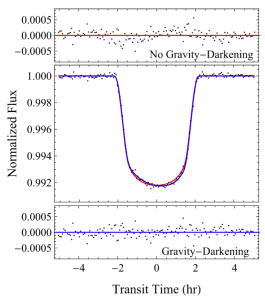
In a new paper, John Ahlers et al have detected the effect of gravity darkening on a transit lightcurve of the hot Jupiter MASCARA-4b. The planet has a misaligned orbit, first coming onto the stellar face near the equator, and then moving towards a pole. That means it moves from slightly cooler regions to slightly hotter regions, and that changes the amount of light occulted by the planet.

If gravity darkening is not taken into account then the model fit is a bit too deep at the start and a bit too shallow at the end of the transit. One of the benefits of detecting this effect of gravity darkening is that it then tells us the true angle between the star’s spin axis and the planet’s orbit (whereas other methods, such as Doppler tomography, only tell us the projection of that angle onto the sky).