Companions to WASP planets

When the first “hot Jupiter” planets were found they were a big surprise — no-one had expected to find massive Jupiter-sized planets very close to stars, in orbits of only a few days. Most planet-formation theory says that they can’t have formed there, and must have formed much further out, beyond the “snow line” where it is much colder.

Much investigation has gone into discovering what moves the planets inwards to become hot Jupiters. One favourite explanation is the long-term effect of gravitational perturbations to the planet’s orbit, caused by another massive planet or low-mass companion star much further out.

If this is right we should be able to find these outer companions, and one method is to monitor the radial-velocity motion of the host star, looking for the gravitational pull caused by the outer companion. Hence one would expect the stars’ radial velocity to show a short-term cycle with the period of hot Jupiter, plus a much longer term trend.

Keck Telescopes at dusk

An important paper just announced by Heather Knutson and colleagues announces the results of monitoring 51 hot-Jupiter systems — including 18 WASP planets — using the HIRES spectrograph on the 10-m Keck telescopes on top of Mauna Kea in Hawaii. They confirm long-term radial-velocity trends previously suspected in 9 systems and report newly found trends in 7 other systems.

Four WASP systems (WASP-8, WASP-10, WASP-22 and WASP-34) are found to have radial-velocity trends indicating a massive outer companion. The plot has the radial-velocity on the y-axis (units of metres per sec) plotted against time (years since 2000).

RV trends for WASP planets

In WASP-8 and WASP-34 the orbit of the companion is beginning to be constrained, while for WASP-10 and WASP-22 the timescale of the orbit appears to be longer. Further monitoring of these systems and other hot Jupiters (the plot also shows planets from the HAT and XO projects) might help to answer the question of whether these outer companions are the cause of hot Jupiters.

Three more planets from WASP-South, Euler and TRAPPIST

The latest three WASP-South planets appeared on the preprint server arXiv today, announcing WASP-68b, WASP-73b and WASP-88b.

TRAPPIST by night

The paper is led by the University of Liège, who operate the TRAPPIST robotic 0.6-m photometer, sited at La Silla in Chile. TRAPPIST plays a crucial role in WASP-South planet discovery. Since the WASP photometry, from 200mm, f/1.8 lenses, is relatively crude, a TRAPPIST lightcurve of a candidate gives a better idea of whether the candidate is worth pursuing. Further, the large pixels of WASP data mean that apparent transits are often caused by deeply eclipsing fainter stars within the WASP photometry aperture. TRAPPIST photometry shows up such blends, and thus avoids wasting valuable radial-velocity observations.

Blend image

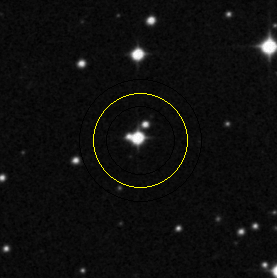
As an example, the candidate 1SWASPJ113725.66–261925.6 showed a shallow 1% dip recurring with a period of 1.33 days, possibly caused by a planet transit. However, close by are two fainter stars (left, the yellow circle is the extraction aperture used for the WASP photometry; WASP pixels are much bigger than in this Sky Survey image, and so the candidate and the two close stars are merged).

blend

TRAPPIST is able to resolve the stars, and followup photometry showed that the dip is caused by the closest faint star, which is an eclipsing binary with a 20% deep eclipse (the image is reversed left–right). In photometry centered on the bright candidate this eclipse is diluted to a shallow planet-like dip.

NASA finds water on three WASP planets

A team using NASA’s Hubble Space Telescope has detected water in the atmosphere of five exoplanets. Three of these are WASP planets, WASP-12b, WASP-17b and WASP-19b. They were chosen because they orbit relatively bright stars and because they are close-in “hot Jupiter” planets with bloated and puffed-up atmospheres, the best targets for the highly demanding task of discerning molecules in those atmospheres. This study demonstrates how valuable WASP planets are for exoplanet research.
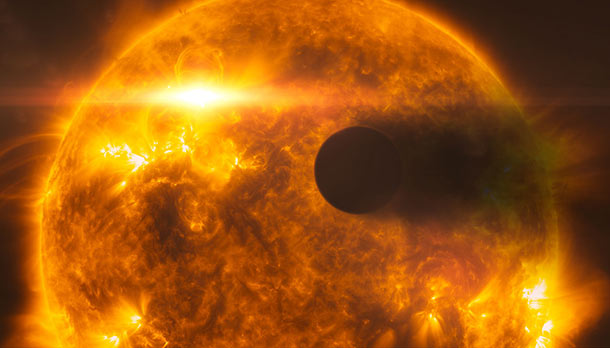
WASP-12b illustration.

An artist’s conception of WASP-12b, a hot-Jupiter planet orbiting so closely that its atmosphere is blasted by irradiation from its star

The NASA press release has been reported by websites and newspapers worldwide. It reads:

Hubble Traces Subtle Signals of Water on Hazy Worlds      Dec. 3, 2013

Using the powerful­ eye of NASA’s Hubble Space Telescope, two teams of scientists have found faint signatures of water in the atmospheres of five distant planets.

The presence of atmospheric water was reported previously on a few exoplanets orbiting stars beyond our solar system, but this is the first study to conclusively measure and compare the profiles and intensities of these signatures on multiple worlds.

The five planets — WASP-17b, HD209458b, WASP-12b, WASP-19b and XO-1b — orbit nearby stars. The strengths of their water signatures varied. WASP-17b, a planet with an especially puffed-up atmosphere, and HD209458b had the strongest signals. The signatures for the other three planets, WASP-12b, WASP-19b and XO-1b, also are consistent with water.

“We’re very confident that we see a water signature for multiple planets,” said Avi Mandell, a planetary scientist at NASA’s Goddard Space Flight Center in Greenbelt, Md., and lead author of an Astrophysical Journal paper, published today, describing the findings for WASP-12b, WASP-17b and WASP-19b. “This work really opens the door for comparing how much water is present in atmospheres on different kinds of exoplanets, for example hotter versus cooler ones.”

The studies were part of a census of exoplanet atmospheres led by L. Drake Deming of the University of Maryland in College Park. Both teams used Hubble’s Wide Field Camera 3 to explore the details of absorption of light through the planets’ atmospheres. The observations were made in a range of infrared wavelengths where the water signature, if present, would appear. The teams compared the shapes and intensities of the absorption profiles, and the consistency of the signatures gave them confidence they saw water. The observations demonstrate Hubble’s continuing exemplary performance in exoplanet research.

“To actually detect the atmosphere of an exoplanet is extraordinarily difficult. But we were able to pull out a very clear signal, and it is water,” said Deming, whose team reported results for HD209458b and XO-1b in a Sept. 10 paper in the same journal. Deming’s team employed a new technique with longer exposure times, which increased the sensitivity of their measurements.

The water signals were all less pronounced than expected, and the scientists suspect this is because a layer of haze or dust blankets each of the five planets. This haze can reduce the intensity of all signals from the atmosphere in the same way fog can make colors in a photograph appear muted. At the same time, haze alters the profiles of water signals and other important molecules in a distinctive way.

The five planets are hot Jupiters, massive worlds that orbit close to their host stars. The researchers were initially surprised that all five appeared to be hazy. But Deming and Mandell noted that other researchers are finding evidence of haze around exoplanets.

“These studies, combined with other Hubble observations, are showing us that there are a surprisingly large number of systems for which the signal of water is either attenuated or completely absent,” said Heather Knutson of the California Institute of Technology, a co-author on Deming’s paper. “This suggests that cloudy or hazy atmospheres may in fact be rather common for hot Jupiters.”Hubble’s high-performance Wide Field Camera 3 is one of few capable of peering into the atmospheres of exoplanets many trillions of miles away. These exceptionally challenging studies can be done only if the planets are spotted while they are passing in front of their stars. Researchers can identify the gases in a planet’s atmosphere by determining which wavelengths of the star’s light are transmitted and which are partially absorbed.
WASP’s 100th planet pushes exoplanet tally over 1000

With the announcement of 13 WASP planets on the same day, including a batch of seven pushing WASP numbering over 100, the worldwide tally of known exoplanets was pushed over 1000. Jean Schneider of the Paris Observatory keeps a tally at the site exoplanet.eu.

The BBC reports the news:

The number of observed exoplanets — worlds circling distant stars — has passed 1,000. Of these, 12 could be habitable – orbiting at a distance where it is neither “too hot” nor “too cold” for water to be liquid on the surface. The planets are given away by tiny dips in light as they pass in front of their stars or through gravitational “tugs” on the star from an orbiting world.

These new worlds are listed in the Extrasolar Planets Encyclopaedia. The tally now stands at 1,010 new exoplanets, bolstered by 11 new finds from the UK’s Wide Angle Search for Planets (WASP).

continue reading the BBC report