Hubble maps the atmosphere of WASP-43b

WASP-43b is one of the more extreme hot Jupiters found by WASP-South, orbiting its star in only 19 hours, making it the hot-Jupiter planet closest to its star, where its atmosphere gets blasted by the stellar irradiation. Since the host star is relatively dim, a K7V dwarf smaller and fainter than our Sun, the planet’s light is relatively easy to see and thus the system is a prime target for characterising exoplanet atmospheres.

Now, NASA have put out a press release regarding a Hubble Space Telescope observation of WASP-43b which monitored the planet around three of its orbits.

By recording the changes in the observed light around the orbit, as the irradiated face of the planet swings into view and then faces away again, the team have mapped the temperature and the distribution of water vapour of the planet’s atmosphere.

Exoplanet WASP-43b orbits its parent star

The image (Credit: NASA, ESA, and Z. Levay (STScI)) shows the changing view of WASP-43b around its orbit, illustrating the hot, blasted heated face and the darker atmosphere pointing away from the star.

The planet is phase-locked to the orbit by tidal forces, always pointing the same face to its star, and thus we expect dramatic winds as the planet’s atmosphere redistributes heat from the star-facing side to the cooler side.

The Hubble observations are reported in three papers, one accepted for Science, lead by Kevin Stevenson of the University of Chicago (arXiv link). A second paper, led by Laura Kreidberg, also of the University of Chicago, shows that the abundance of water in WASP-43b’s atmosphere is compatible with that in the Sun (arXiv link). A third paper, led by Tiffany Kataria of the University of Arizona, models the planet’s atmospheric circulation (arXiv link).

WASP-43b was announced in 2011 by the WASP-South team in a paper led by Coel Hellier of Keele University.

WASP-94: “cousin” planets around twin stars

Press release regarding our discovery of planets around binary stars WASP-94A and WASP-94B:

European astronomers have found two new Jupiter-sized extra-solar planets, each orbiting one star of a binary-star system. Most known extra-solar planets orbit stars that are alone, like our Sun. Yet many stars are part of binary systems, twin stars formed from the same gas cloud. Now, for the first time, two stars of a binary system are both found to host a “hot Jupiter” exoplanet.

The discoveries, around the stars WASP-94A and WASP-94B, were made by a team of British, Swiss and Belgian astronomers. The British WASP-South survey, operated by Keele University, found tiny dips in the light of WASP-94A, suggesting that a Jupiter-like planet was transiting the star; Swiss astronomers then showed the existence of planets around both WASP-94A and then its twin WASP-94B.

Marion Neveu-VanMalle (Geneva Observatory), who wrote the announcement paper, explains: “We observed the other star by accident, and then found a planet around that one also!”.

Hot Jupiter planets are much closer to their stars than our own Jupiter, with a “year” lasting only a few days. They are rare, so it would be unlikely to find two Hot Jupiters in the same star system by chance. Perhaps WASP-94 has just the right conditions for producing Hot Jupiters? If so WASP-94 could be an important system for understanding why Hot Jupiters are so close to the star they orbit.

The existence of huge, Jupiter-size planets so near to their stars is a long-standing puzzle, since they cannot form near to the star where it is far too hot. They must form much further out, where it is cool enough for ices to freeze out of the proto-planetary disk circling the young star, hence forming the core of a new planet. Something must then move the planet into a close orbit, and one likely mechanism is an interaction with another planet or star. Finding Hot-Jupiter planets in two stars of a binary pair might allow us to study the processes that move the planets inward.

Professor Coel Hellier, of Keele University, remarks: “WASP-94 could turn into one of the most important discoveries from WASP-South. The two stars are relatively bright, making it easy to study their planets, so WASP-94 could be used to discover the compositions of the atmospheres of exoplanets”.

The WASP survey is the world’s most successful search for hot-Jupiter planets that pass in front of (transit) their star. The WASP-South survey instrument scans the sky every clear night, searching hundreds of thousands of stars for transits. The Belgian team selects the best WASP candidates by obtaining high-quality data of transit lightcurves. Geneva Observatory astronomers then show that the transiting body is a planet by measuring its mass, which they do by detecting the planet’s gravitational tug on the host star.

The collaboration has now found over 100 hot-Jupiter planets, many of them around relatively bright stars that are easy to study, leading to strong interest in WASP planets from astronomers worldwide.

 An illustration of a planet orbiting one star of a binary system.  In WASP-94, the planet would transit the brighter star, causing a dip in the light that can be detected from Earth.  Another planet orbits the second star at lower-left. It does not transit and is not directly visible, but it can be detected by its gravitational tug on the second star.

An illustration of a planet orbiting one star of a binary system. In WASP-94, the planet would transit the brighter star, causing a dip in the light that can be detected from Earth. Another planet orbits the second star at lower-left. It does not transit and is not directly visible, but it can be detected by its gravitational tug on the second star. [ Image Credit: ESO/L. Calçada/Nick Risinger]

Update: This press release has resulted in articles in phys.org, sciencedaily.com, world-science.net, yahoo.news, Science World Report, and breakingnews.ie.

NASA’s Chandra X-ray Observatory observes WASP-18

NASA have put out a press release about an observation of WASP-18 by the Chandra X-ray observatory.

WASP-18 was the first planet discovered to have an orbital period of less than 1 day and has the highest tidal interaction between a planet and a star of any known planetary system.

“We think the planet is ageing the star by wreaking havoc on its innards”, report the authors of the paper, “The planet’s gravity may cause motions of gas in the interior of the star that weaken the convection”, which “results in the magnetic field becoming weaker and the star to age prematurely”.

NASA have also produced a nice graphic of WASP-18 and its planet (image credit: NASA/CXC/M.Weiss):

wasp18_chandra

The press release has been picked up by several media outlets including Astronomy magazine, Phys.org, the Daily Mail online, and the International Business Times. (Spot the error in the last outlet’s sentence that: “Scientists have used data provided by NASA’s Chandra X-ray Observatory to find a planet that causes the star it orbits to act much older than it actually is, according to a new study” (added emphasis)!)

WASP planets will get names in a public vote

Written by Tom Wagg

WASP planets, like all exoplanets, get catalogue numbers but, so far, have not been actually named. The International Astronomical Union policy is now about to change, with the announcement of a contest in which astronomy clubs and non-profit organisations can submit names for exoplanets.

The worldwide public will then be able to vote on their favourite name for an exoplanet and the winning names will be officially sanctioned by the IAU.

IAU

Among the 305 exoplanets which have been selected for the first round of naming are 10 of the earliest discovered WASP exoplanets. These include WASP-12b, which has recently been found to contain water, and WASP-10b, which is thought to have a massive outer companion.

The host stars of WASP-7b and WASP-14b are both bright enough to be visible in a pair of binoculars, one in the Northern Hemisphere and the other in the Southern Hemisphere, which means that it will be possible to name a WASP planetary system that you can readily point to at a star party.

Members of the public can propose names for just one exoplanet, or for a whole planetary system such as 55 Cancri which includes five exoplanets.

Once the naming process is over we will post the new names of our WASP planets and the creators of these names on this blog. To get involved simply follow this link and submit your proposed exoplanet names for your chance to be credited with naming your own exoplanet!

The grazing transit of WASP-67b

The hot-Jupiter exoplanet WASP-67b is a curiosity, being the only known exoplanet with a grazing transit, such that not all of the planet transits the host-star’s disc. This means that the characteristic “second contact” and “third contact” points are missing from the transit lightcurves. These are the points where, usually, the whole planet is now in front of the star, and the transit is then flat-bottomed, apart from the relatively small effects of stellar “limb darkening”.

The four "contact" points of a planetary transit, illustrated for Mercury transiting our Sun.

The four “contact” points of a planetary transit, illustrated for Mercury transiting our Sun.

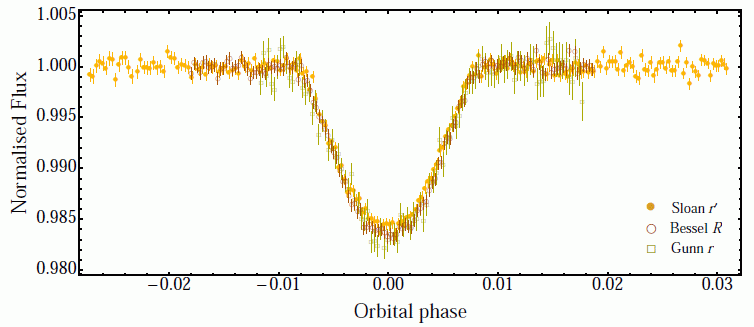
In WASP-67b’s grazing transit the planet is never completely in transit and thus the transit lightcurve has a continuously varying V shape. The grazing nature of WASP-67b was confirmed by a detailed study of new transit lightcurves by Mancini et al (2014), who used the GROND instrument on ESO’s 2.2-m telescope at the La Silla observatory.

The transit of WASP-67b from Mancini et al. (2014)

The transit of WASP-67b from Mancini et al. (2014)

The lack of second and third contact makes the system parameters hard to tie down, and thus obtaining a secure estimate of the planet’s radius and density requires Mancini et al’s high-quality lightcurves. WASP-67 is also notable for being in one of the target fields of the revamped Kepler spacecraft’s K2 mission, and thus we can expect ongoing detailed study of this system.

WASP-117b: a longer-period planet in an eccentric, misaligned orbit

WASP-117b is an important milestone for the WASP project, being our first confirmed planet with an orbital period longer than 10 days. WASP is strongly biased towards short-period planets since these transit much more often and so are easy to detect, but by accumulating data from multiple seasons we can extend the coverage out to longer periods.

The planet WASP-117b is in a highly eccentric orbit that is misaligned with the spin of the host star. This is in keeping with the suggestion that shorter-period planets are forced into aligned, circular orbits by tidal dissipation. Since tidal dissipation weakens markedly as the orbit widens, we expect the longer-period planets to have un-damped orbits.

Since WASP-117b is a Saturn-mass planet, and given the long, eccentric orbit, it took much more follow-up study than usual in order to tie down its characteristics. Tracing out the radial-velocity orbit took 70 observations with the 1.2-m Euler telescope and CORALIE spectrograph, plus 53 more with the ESO 3.6-m telescope and HARPS spectrograph. As usual for WASP-South planets, EulerCAM and TRAPPIST produced the high-quality transit lightcurves.

Since WASP-117b orbits a relatively bright star, at V = 10.1, it will be an important object for studying the population of longer-period exoplanets,

WASP thesis wins European Astronomical Society prize

Congratulations to Dr Amaury Triaud for winning the highly prestigious 2014 MERAC Prize, awarded by the European Astronomy Society for the Best Doctoral Thesis in Observational Astrophysics. Dr Triaud was a PhD student at the Geneva Observatory of the University of Geneva, supervised by Prof. Didier Queloz.

Amaury Triaud

Amaury Triaud took charge of the radial-velocity campaign following up WASP-South planet candidates, using the Coralie spectrograph on the Swiss/Euler 1.2-m telescope at La Silla, and has thus played a major part on the discovery of all WASP-South transiting exoplanets. The MERAC prize highights the success of the European collaboration between the British WASP-South transit search, the Swiss Euler/Coralie spectrograph, and the Belgian-led TRAPPIST robotic photometer.

Euler telescope

The Euler 1.2-m telescope

In addition to the planet discoveries, Amaury Triaud lead-authored a landmark paper on the dynamical origins of hot-Jupiter exoplanets, deduced by measuring the angle between the planet’s orbit and the host-star’s spin, which has already been cited 170 times. Amaury’s work provided strong evidence that hot Jupiters formed much further out than their current orbits, and were moved inwards by the Kozai mechanism.

NASA’s Kepler looks at a WASP planet

NASA’s Kepler planet-hunting mission is entering the “K2” phase of its life. The loss of reaction wheels and thus pointing stability mean that it couldn’t continue looking at the original Kepler field, but Kepler engineers have worked out that it can point to fields in the ecliptic by using the pressure of the Sun’s light to stablise the spacecraft.

Kepler's transit of WASP-28b

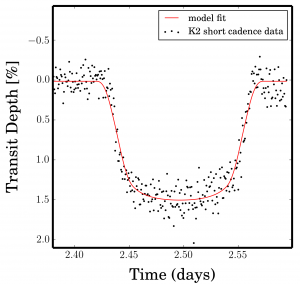
Kepler’s transit of WASP-28b

In engineering observations to test his concept Kepler pointed at WASP-28b, a hot-Jupiter planet previously found by WASP-South. The lightcurve from a short test in Jan 2014 shows that Kepler is working well and can still detect planets.

Several more WASP planets, incuding WASP-47b, WASP-67b, WASP-75b and WASP-85b are in planned Kepler-2 fields, promising high-quality Kepler lightcurves to really nail down the masses and radii of these planets.

The atmosphere of WASP-80b

WASP-80b is one of the most important planets found by WASP-South. It is hot Jupiter, in a 3-day orbit, but its host star is unusually small and dim, being an K7/M1 star with a mass of only 0.59 that of the Sun. Only one other such system is known, namely Kepler-45, but that is faint at V = 16.9 and so hard to study. WASP-80 is much brighter, at V = 11.9.

A new paper by Mancini etal reports observing a transit of WASP-80b in four colours simultaneously, using the GROND instrument on the 2.2-m/ESO telescope at La Silla.

Transit of WASP-80b in four colours

The transit depth is distinctly different in the different colours. Why might this be? The planet, of course, does not have a hard edge, it has an atmosphere, and a gaseous atmosphere can be more transparent to some colours of light and less transparent to others. Thus the planet will appear to be a slightly different size in different colours, and hence the transit can have a slightly different depth.

This is not easy to interpret, however, since the host star is also gaseous, with no sharp edge. Owing to limb-darkening it also appears to be a different size in different colours, which can complicate the interpretation. Studies such as this are in their infancy, but should allow us to prove the temperatures and compositions of atmospheres of exoplanets. This is one of the main aims of the forthcoming JWST mission and proposed exoplanet missions such as ESA’s EChO.

Kepler-91b: a hot-Jupiter planet orbiting a red-giant star

When we at WASP search for candidate transit dips we usually ignore any star that we think is a red giant star. Such stars have evolved off the Main Sequence and the outer layers are becoming bloated and puffed-up to many times their original size. Because of this there is no room for a hot-Jupiter planet in a typical orbit of 2 to 4 days, it would be inside the star. Thus if we see a short-period dip apparently on a red giant, it usually means that the system is blended, and that the dip is caused by a fainter, unseen binary.

However, a team led by Jorge Lillo-Box at the Centro de Astrobiología in Madrid have reported that the Kepler “object of interest” KOI-2133 — now promoted to being called Kepler-91 — is a red giant orbited by a Jupiter-mass planet on an orbit of 6.2 days.

This star is the biggest known to host a planet, with a bloated radius of 6.3 times that of the Sun. The planet orbits just outside, and, since the red giant star is still expanding, the authors estimate that it will be engulfed within 50 million years, a very short time compared to usual planet lifetimes. Viewed from the planet the star would fill nearly half the sky.

Artists conception of Kepler-91 and its planet

So puffed up and tenuous are the star’s outer layers, and so close are they to the planet, that the planet’s presence distorts them into an ellipsoidal shape. This produces a modulation of the star’s light at the planet’s orbital period, a modulation that had previously led to Kepler-91 being considered to be a binary star, not a planet host.

Lightcurve of Kepler-91

The Kepler lightcurve of Kepler-91b showing the transits and the “ellipsoidal modulation” caused by the planet distorting the star’s outer layers

The WASP cameras have also been watching Kepler-91 over the years, accumulating 20,000 data points, but could never detect the dip caused by Kepler-91b. Not only is Kepler-91 relatively faint, at V = 12.9, but the transit dip is very shallow.

A typical hot-Jupiter planet transiting a typical star produces a dip of about 1% in the light, which is detectable by WASP. However with Kepler-91 being bloated to 6.3 solar radii its surface area will be 40 times bigger, and hence the planet occults only 1/40th as much of the light, producing a vastly shallower dip. The transit depth in Kepler-91 is only 0.04%, detectable by the superb Kepler photometry from the stability of space, but not detectable from the ground, another reason why WASP ignores stars that are giants.