Precise masses for the WASP-47 exoplanetary system

In the discovery paper the exoplanet WASP-47b was introduced to the world with the description: “With an orbital period of 4.16 d, a mass of 1.14 MJup and a radius of 1.15 RJup, WASP-47b is an entirely typical hot Jupiter”.

And it did appear to be entirely typical until Juliette Becker et al looked at K2 lightcurves and found two more planets, a super-Earth orbiting inside the hot Jupiter (WASP-47e in a 0.79-d orbit) and a Neptune orbiting just outside it (WASP-47d in a 9-d orbit). Around the same time Neveu-VanMalle et al announced long-term monitoring showing another Jupiter-mass planet (WASP-47c), this one in a much wider orbit of 580 days. Thus WASP-47 was shown to host a whole exoplanetary system, one that is so-far unique.

Since then WASP-47 has been observed intensively in order to measure the planet masses and investigate the dynamics of the exoplanetary system. The state of play is now reported by Andrew Vanderburg et al. The planets’ host star is tugged around by the gravitational pull of the orbiting planets, leading to the following cyclical variations in the observed radial velocities:

Combining all the information, Vanderburg et al deduce that the innermost “super-Earth”, WASP-47e, is not dense enough to be made only of rock. Instead it likely has a liquid or gaseous envelope (possibly water or steam) surrounding an Earth-like core. That is unlike other ultra-short-period super-Earths which appear to be fully rocky.

From modelling the dynamical history of the system Vanderburg et al also deduce that the outermost planet, WASP-47c, is likely in an orbit that is in the same plane as those of the inner planets. If this were not the case then the system would not be stable. Thus they conclude that the likelihood that WASP-47c also transits its star, as seen from Earth, is relatively high, which should motivate a campaign to look for those transits.

First results on the atmosphere of WASP-107b

Being a Neptune-mass planet (0.12 MJ) bloated to a near-Jupiter radius (0.94 RJ) makes WASP-107b’s atmosphere very fluffy, and that, coupled with it transiting a moderately bright K star (V = 11.6) makes it a superb target for atmospheric characterisation.

Laura Kreidberg et al have pointed the Hubble Space Telescope at WASP-107b to make the first atmospheric study. Here’s the WFC3 spectrum:

Hubble Space Telescope spectrum of WASP-107b

The broad features at 1.15 and 1.4 microns are due to water absorption in WASP-107b’s atmosphere. Kreidberg et al model the features, finding that they are compatible with expectations given solar abundances. They are not deep enough, though, to be produced by fully clear skies, and a layer of high-altitude cloud is also required.

WASP-107b is one of the prime exoplanets already chosen for early observations with the imminent James Webb Space Telescope, so it is exciting to know that its atmosphere does show prominent molecular features.

Outer orbits of binary stars hosting WASP planets

Many of the WASP transiting exoplanets have a companion star visible close to the planet-host star, and these are usually genuine binary companions rather than chance alignments. This raises questions as to whether the gravitational perturbation of the companion affects the planet formation, and whether the cumulative affect of perturbations alters the planetary orbits.

The very existence of close-in hot-Jupiter planets might owe to the Kozai effect, in which companion stars perturb planets into highly eccentric orbits that have very close approaches to their host star, leading to tidal capture into close, circular hot-Jupiter orbits.

A new paper led by Daniel Evans, from Keele University, uses lucky-imaging techniques to look for close companions of known exoplanet hosts. For the first time, they also report observations of the companions over several epochs, which then gives constraints on their orbits.

The above figure for WASP-77 (left) and WASP-85 (right) shows the observed locations of the companion stars (black symbols; the scale is in Astronomical Units from the planet-host star). The blue lines are possible orbits, computed to be consistent with the data. In both cases the companion stars are shown to be in moderately eccentric orbits with separations of hundreds of AU.

Titanium oxide in the atmosphere of WASP-19b

The European Southern Observatory have put out press release about observations of WASP-19b with the Very Large Telescope. A team led by ESO Fellow Elyar Sedaghati have found titanium oxide in the atmosphere of an exoplanet for the first time.

ESO’s graphic (credit: ESO/M. Kornmesser) illustrates how observations during transit allow us to analyse an exoplanet’s atmosphere. The star light shines through the atmosphere, where light at particular wavelengths is absorbed by molecules, causing the light that we see to carry a distinctive signature of the atmosphere’s composition.

The team observed three different transits of WASP-19b, each in a different colour, to produce one of the best transmission spectra of an exoplanet so far. The titanium oxide (TiO) features are marked, along with those from water (H2O), sodium (Na) and scattering due to haze.

ESO’s press release has led to coverage on several dozen news- and science-related websites. ESO have also produced an artist’s impression of WASP-19b:

WASP-12b a “Blistering Pitch-Black Planet”.

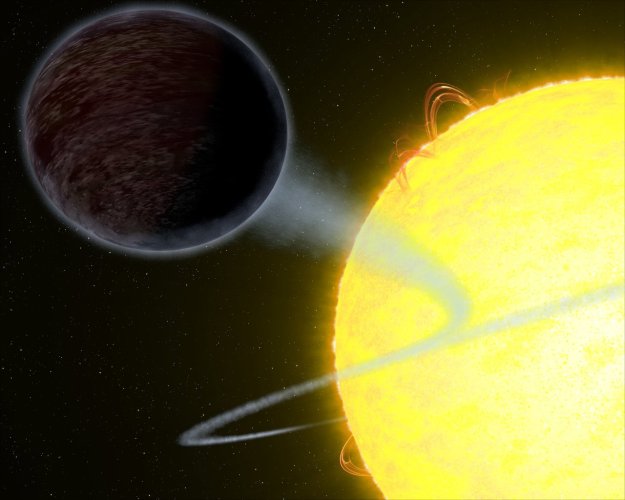
NASA has put out a press release about Hubble Space Telescope observations of WASP-12b. Taylor Bell et al find that WASP-12b “traps at least 94 percent of the visible starlight falling into its atmosphere”, making it “as black as fresh asphalt”.

WASP-12b “as black as asphalt” (Credit: NASA, ESA, and G. Bacon, STScI)

The article explains that WASP-12b, in a very close, 1.2-day orbit, is so irradiated by its host star that “clouds probably cannot form to reflect light back into space. Instead, incoming light penetrates deep into the planet’s atmosphere where it is absorbed by hydrogen atoms and converted to heat energy”. NASA’s press release has led to coverage on several dozen websites.

WASP-12b is one of the more important of the WASP discoveries, with over 30 refereed papers so far focused on understanding it. Most notably, the fierce stellar irradiation means that material is boiling off the planet and forming a cloud surrounding it.

Strong Sodium and Potassium absorption in the atmosphere of WASP-103b

Characterising the atmospheres of extrasolar planets is a booming activity, both from ground-based observatories and using the Hubble Space Telescope. The latest study is of the highly-irradiated and hot planet WASP-103b, which was found by WASP-South transiting a star with an ultra-short orbit of only 0.93 days (Michaël Gillon et al 2014).

Monika Lendl et al have now used the Gemini/GMOS instrument to probe its atmosphere. The main finding is prominent features caused by absorption of light by sodium (Na) and potassium (K) ions:

Such features imply that WASP-103b has relatively clear skies, since cloudy or hazy atmospheres tend to produce flat, featureless spectra. The authors explain that: “This finding is in line with previous studies on cloud occurrence on exoplanets which find that clouds dominate the transmission spectra of cool, low surface gravity planets while hot, high surface gravity planets are either cloud-free, or possess clouds located below the altitudes probed by transmission spectra”.

The first transiting exo-comets?

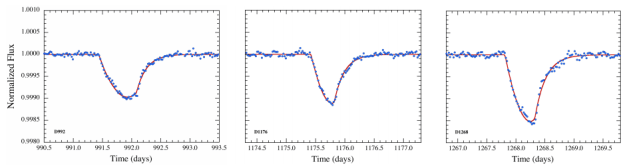
Transits of extra-solar planets are pretty routine these days, but planets are not the only bodies expected to be orbiting nearby stars. How about exo-comets? Unlike planets, comets are fuzzy and changeable, so exocomet transits would vary in shape and depth. A team led by Saul Rappaport have now searched the entire archive of Kepler lightcurves looking for dips that could be exocomet transits. Here’s one in the data for the star KIC 11084727:

The authors reproduce such dips (red line) with a model of a comet about the size of Halley’s comet and having a tail made of dust, hence giving an asymmetric dip. Another Kepler, KIC 3542116, shows six possible comet transits. Here are three:

WASP-South finds the smallest known star

In order to qualify as a proper “star” (as opposed to a brown dwarf or a stellar remnant) it needs to be producing nuclear fusion of hydrogen in its central regions. That requires a mass of at least 83 times that of Jupiter in order for gravity to compress the central regions sufficiently.

Interestingly, despite having masses far greater than any planet, the smallest possible stars are expected to have radii very similar to that of Saturn or Jupiter. That means that in a transit survey such as WASP they can look very like planets, it is only the radial-velocity follow-up observations that show that they a stellar mass.

Alexander von Boetticher et al have just announced the discovery of the smallest known star, which with a mass of 85 ± 4 Jupiters is right at the lower limit of what is possible. The mass and radius of the object, dubbed EBLM J0555−57Ab, are shown below compared to other stars and brown dwarfs, along with (red and blue lines) theoretical models for different ages.

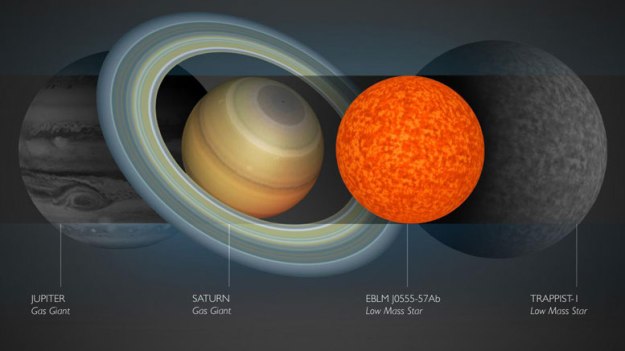
The discovery of EBLM J0555 was a by-product of the WASP-South survey, found because of its planet-like size. In the graphic below the star is compared with Saturn and the slightly larger M-dwarf star TRAPPIST-1.

The discovery has been carried by many websites including The Atlantic, CNET, The Daily Mail, The Smithsonian, Astronomy Magazine, gizmodo, astrobites, phys.org and over 30 others.

Discovery of the hot Jupiter WASP-167b (KELT-13b)

The websites sci-news.com and phys.org have published articles on our recent discovery of WASP-167b (KELT-13b) — the highest WASP number so far announced — along with an image comparing it to Jupiter:

WASP-167b is notable for two reasons. First, it orbits a hot star with a surface temperature of 7000 Kelvin. Planets transiting hot stars are harder to validate since the star’s spectra shows only broad and weak spectral lines, which makes it harder to get accurate radial-velocity measurements and thus prove that the transiting object has the right mass to be a planet.

The WASP project had tended to put such candidates on the back-burner and go after easier targets, but having succeeded in finding over 100 planets transiting cooler stars we are now focussing on the hot ones.

Secondly, WASP-167b is a joint discovery with the KELT project (hence the additional name of KELT-13b), the first time two of the transit-search teams have combined an announcement. Both projects had put much effort and telescope time into following up this candidate, and a joint paper recognises both of these campaigns.

Hubble’s tale of two exoplanets: WASP-67b and HAT-P-38b

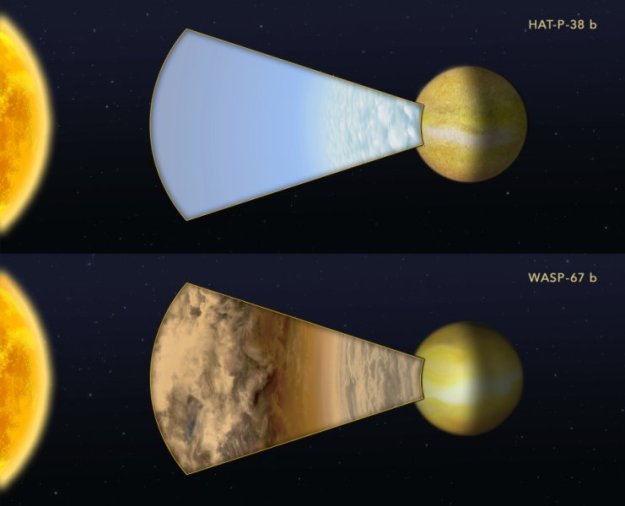
NASA have put out a press release entitled: “Hubble’s Tale of Two Exoplanets: Nature vs. Nurture”.

The article compares WASP-67b and HAT-P-38b, noting how similar they are in size and temperature, both orbiting similar stars at a similar orbital distance. But then Hubble’s Wide Field Camera 3 found that WASP-67b has a very cloudy atmosphere whereas HAT-P-38b has much clearer skies.

From the press release: Perhaps one planet formed differently than the other, under a different set of circumstances. “You can say it’s nature versus nurture,” explains co-investigator Kevin Stevenson. “Right now, they appear to have the same physical properties. So, if their measured composition is defined by their current state, then it should be the same for both planets. But that’s not the case. Instead, it looks like their formation histories could be playing an important role.”

“Astronomers measured how light from each parent star is filtered through each planet’s atmosphere. HAT-P-38 b did have a water signature indicated by the absorption-feature peak in the spectrum. This is interpreted as indicating the upper atmosphere is free of clouds or hazes. WASP-67 b, has a flat spectrum that lacks any water-absorption feature, suggesting most of the planet’s atmosphere is masked by high-altitude clouds.”

The NASA press release has been picked up and reported on several dozen science-related websites.

Credits: Artwork: NASA, ESA, and Z. Levy (STScI); Science: NASA, ESA, and G. Bruno (STScI)