Category Archives: Hot Jupiters

Hubble study of water in hot-Jupiter atmospheres

NASA have put out a press release regarding the largest-ever study of hot-Jupiter atmospheres by the Hubble Space Telescope and the Spitzer Space Telescope. Of the ten planets studied, six are WASP discoveries.

Clear to cloudy hot Jupiters (annotated)

The results, published in Nature, report that hot Jupiters are a diverse group that have atmospheres ranging from clear to cloudy. Strong water absorption lines are seen when the planets have a clear atmosphere, but less so when the atmospheres are dominated by clouds and hazes.

hubble_water

Planets such as WASP-17b and WASP-19b have clear atmospheres and show the strongest water features, whereas planets such as WASP-12b and WASP-31b are more cloudy.

The NASA press release has so far resulted in articles on over 110 news websites worldwide. The paper was lead-authored by David Sing of the University of Exeter.

Possible orbital period decay in WASP-43b?

Since hot-Jupiter planets have close-in orbits they will raise a tidal bulge on their host star. Since the planet’s orbit is faster than the star’s rotation, that bulge will tend to lag behind the planet. Its gravity will thus pull back the planet slightly, draining angular momentum from the planet’s orbit.

Hot Jupiters, especially the shortest-period ones, are thus expected to be gradually spiralling inwards, and many will eventually spiral into their star. An important issue is how fast this happens. We can obtain theoretical estimates, but it would be good to have a direct measurement of the decay. Thus the transits of the shortest-period hot Jupiters are being monitored to see whether their orbital period is decreasing.

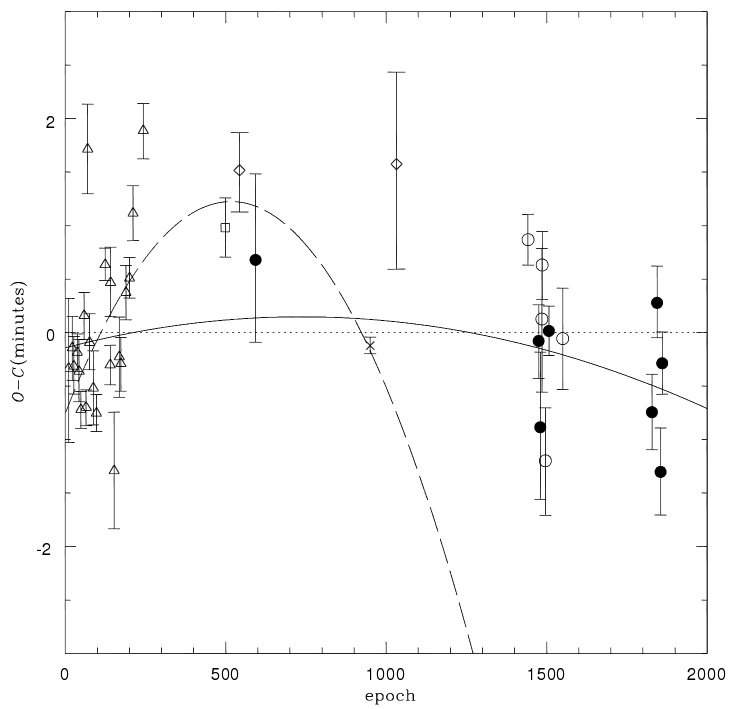
Ing-Guey Jiang et al have just produced a paper based on new transit observations of WASP-43b, an ultra-short-period hot Jupiter which orbits in 0.81 days. They arrive at this plot:

Transit timings and period decay in WASP-43b

The x-axis is time, in a count of transits, while the y-axis is the “observed minus calculated” time of transits, being the observed deviation of a transit timing from the expected time. The data points are the transit timings by Jiang et al and from previous papers.

A constant orbital period would correspond to the dotted line. A very fast period change (as has been previously suggested) would correspond to the dashed curve, and Jiang et al now rule that out. Their best fit is the solid curved line, which has a slower rate of change, but still seems to suggest a changing orbital period.

This is interesting work, and if it really does reveal a period change in WASP-43b then it is highly important. My feeling is to be cautious for now. It is clear from the plot that there is scatter in the transit timings that is larger than the error bars, and we don’t really know what short-term or medium-term “noise” there might be in exoplanet transit timings, since we’re only beginning to study them.

The period change suggested by Jiang et al corresponds to a tidal decay rate specified by the number Q = 105 (where “Q” is the tidal “quality factor” that depends on how much energy is dissipated in the tidal bulge on the star during each orbit). However, it is generally considered that the Q values are more likely to be 107 for hot Jupiters (see here), which would produce a much slower orbital decay.

Thus, the period change in the above figure could be a short-timescale fluctuation (for ill-understood reasons) rather than the true long-term orbital-period decay. The fact that, by adding more timings, Jiang et al have reduced the previous estimate for the period change by an order of magnitude suggests that the same might happen given future timings. Still, this is important work, and it will be interesting to see how it progresses.

Four planets around WASP-47!

As NASA’s Kepler mission covers fields in the ecliptic previously surveyed by WASP, it is obtaining photometry of unprecedented quality on some WASP planets. The big news this week is the discovery of two more transiting planets in the WASP-47 system.

WASP-47 had seemed to be a relatively routine hot-Jupiter system with the discovery of a Jupiter-sized planet in a 4-day orbit, reported in a batch of transiting planets from WASP-South by Hellier et al 2012.

But WASP-47 is anything but routine. Now Becker et al have announced that the Kepler K2 lightcurves show two more transiting planets: a super-Earth planet in an orbit of only 0.79 days, and a Neptune-sized planet in an orbit of 9.0 days. Being much smaller, these planets cause transits that are too shallow to have been seen in the original WASP data.

WASP-47 transits with Kepler K2

The super-Earth, labelled WASP-47c, has a radius of 1.8 Earths while the Neptune, labelled WASP-47d, has a radius of 3.6 Earths. The triple-planet system is dynamically stable, but the gravitational interaction causes perturbations in the orbits, leading to variations in the times of the transits.

Such “transit-timing variations” or TTVs lead to estimates of the planetary masses. Becker et al find that the hot Jupiter has a mass of 340 Earths (consistent with the mass of 360 Earths originally reported by Hellier et al from radial-velocity measurements), while the Neptune has a mass of 9 Earths. The super-Earth must be less massive than that, but current timing measurements are not sensitive enough to say more.

WASP-47 TTVs Transit timing variations

As if three planets were not enough, there is a probable fourth planet orbiting WASP-47. The Geneva Observatory group routinely monitor known WASP systems, taking radial-velocity measurements over years, to look for longer-period planets. Marion Neveu-VanMalle and colleagues have recently reported the detection of another Jupiter-mass planet orbiting WASP-47, this time in a much wider orbit of 571 days.

The WASP-47 system has now become hugely interesting for understanding exoplanets, and will trigger many additional observations of the system. For example, being bright enough to allow good radial-velocity data, it will provide a much-needed check that the mass estimates from TTVs match those from the more traditional radial-velocity technique.

The system will also be of strong interest to theorists, who will want to understand the formation and origin of a planetary system with this architecture. One immediate consequence is that it shows that a hot Jupiter can arise by inward migration through the proto-planetary disk, without destroying all other planets in its path.

NASA’s Hubble Telescope Detects ‘Sunscreen’ Layer on WASP-33b

NASA have put out a press release about Hubble Space Telescope observations of WASP-33b.

WASP-33b is the hottest of the WASP planets, being the only one so far found orbiting a very hot A-type star. A team led by Korey Haynes from NASA’s Goddard Space Flight Center, have used Hubble to show that WASP-33b has a “stratosphere”. The spectrum in the infra-red is best explained by a temperature inversion caused by the presence of Titanium Oxide in the atmosphere.

Titanium Oxide is noted for its ability to absorb light, which is why it is often used in sunscreen lotion. NASA’s graphic shows how an absorbing layer in the atmosphere produces a “temperature inversion” with a hotter layer higher up:

WASP-33b stratosphere

WASP-33b’s stratosphere was detected by measuring the drop in light as the planet passed behind its star (top). Temperatures in the low stratosphere rise because of molecules absorbing radiation from the star (right). Without a stratosphere, temperatures would cool down at higher altitudes (left). [Image: NASA/GSFC]

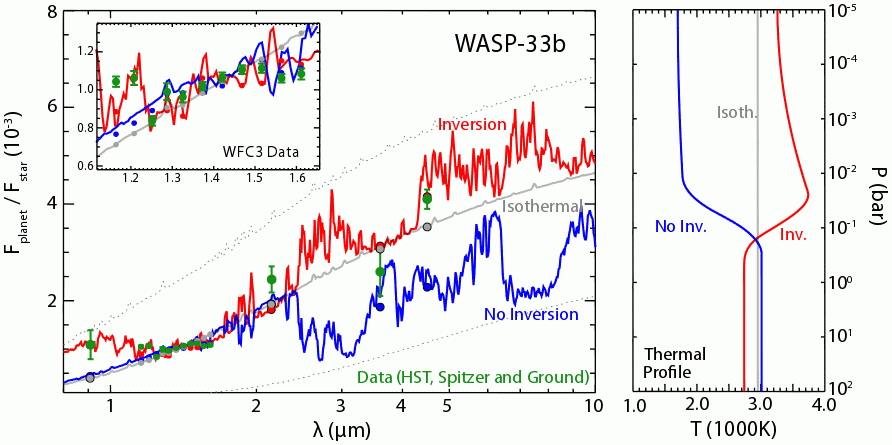
By comparing models with and without a temperature inversion to the spectrum of WASP-33b, as observed with Hubble’s WFC3 instrument, Haynes et al “make a very convincing case that we have detected a stratosphere on an exoplanet”.

Spectrum of stratosphere in WASP-33b

The figure shows the spectrum of WASP-33b (left) and the temperature profile of the atmosphere (right), both for models with a temperature inversion (red) and without an inversion (blue). (From Haynes et al 2015)

The work has been reported widely, in over 100 news and science websites, such as by SciTechDaily, Pioneer News, The Daily Mail, and NY City Today.

15-yr-old work-experience schoolboy discovers a new planet

Press release:

A 15-yr-old schoolboy has discovered a new planet orbiting a star 1000 light years away in our galaxy. Tom Wagg was doing work-experience at Keele University when he spotted the planet by finding a tiny dip in the light of a star as a planet passed in front of it.

“I’m hugely excited to have found a new planet, and I’m very impressed that we can find them so far away”, says Tom, now aged 17. It has taken two years of further observations to prove that Tom’s discovery really is a planet.

Tom found the planet by looking at data collected by the WASP project, which surveys the night skies monitoring millions of stars to look for the tell-tale tiny dips (transits) caused by planets passing in front of their host star.

Tom’s planet has been given the catalogue number WASP-142b, being the 142nd discovery by the WASP collaboration. It is in the Southern constellation of Hydra. While astronomers worldwide have now found over 1000 extra-solar planets, Tom is possibly the youngest ever to have done so.

“The WASP software was impressive, enabling me to search through hundreds of different stars, looking for ones that have a planet”, says Tom. The planet is the same size as Jupiter, but orbits its star in only 2 days. With such a short orbital period the transits occur frequently, making such planets much easier to find.

While the planet is much too far away to see directly, an artist’s impression shows how it might look. The hemisphere facing the star is hot, blasted by the irradiation from the star, while the other hemisphere is much cooler.

Tom Wagg at Keele Observatory 3.

Tom Wagg at Keele Observatory    (Click for high-res version; 3MB)

Tom, a pupil at Newcastle-under-Lyme School who has always been keen on science, asked for the work-experience week after learning that Keele University had a research group studying extra-solar planets.

“Tom is keen to learn about science, so it was easy to train him to look for planets”, says Professor Coel Hellier, who leads the WASP project at Keele. Tom has since achieved 12 GCSEs, all at A*, and wants to study physics at university.

The planet is one of a class of “hot Jupiter” planets, which — unlike the planets in our own Solar System — have very tight orbits close to their stars. They are thought to have migrated inwards through interactions with another planet. Thus it is likely that Tom’s planet is not the only planet orbiting that star.

Artist's impression of Tom's planet, WASP-142b, orbiting its star, WASP-142. The  planet is depicted as seen from a hypothetical moon. A second, dimmer star is seen in the background. Being 1000 light years away, the planet is too distant to  obtain a direct image.

An artist’s impression of the planet WASP-142b, depicted as seen from a hypothetical moon.
(Credit: David A. Hardy. http://www.astroart.org/)    Click for high-res version (1.5MB)

For more information email waspplanets@gmail.com

Updates: Coverage on about 300 news websites worldwide, including: BBC News, ITV News, CNN, TIME, Salon, Yahoo News, The Huffington Post, The Washington Post, Toronto Star, The Telegraph, The Guardian, The Independent, Der Spiegel, News Deutschland, India Today, IOL South Africa, France, Chile, Australia, Mexico, China, and Russia.

[Err, Wow!, successful press release! Now on about 650 news websites worldwide, about 205 in English, 59 in German, 48 in Spanish, 106 in Russian, 30 in Chinese, 23 in French, 20 in Italian, 40 in Turkish, 26 in Portuguese, 23 in Indonesian, 14 in Greek, 12 in Bulgarian, 11 in Hungarian, 8 in Polish, 4 in Slovakian, and others including Tamil, Vietnamese, Thai and Malayalam!]

WASP planet on BBC2’s Horizon: Secrets of the Solar System

BBC2’s flagship science programme, Horizon, dedicated yesterday’s episode to Secrets of the Solar System. The programme explained how the discovery and understanding of exoplanets had led directly to improvements in our understanding of our own Solar System.

Whereas traditionally our Solar System has been regarded as a static array of planets, which formed early after our star’s birth, about 4 billion years ago, and which since then have merely cycled through their orbits, we now understand that planets can radically change their orbits by interacting with each other and with the proto-planetary disk from which they formed.

BBC Horizon: Secrets of the Solar System

A major part of this picture has been developed through understanding “hot Jupiters”, a class of planets which is now dominated by WASP discoveries. In particular the finding of hot Jupiters in retrograde orbits around their star was based largely on WASP planets, starting with WASP-17b.

Yesterday’s programme, on prime-time BBC television, featured a 20-minute discussion of hot Jupiters which was anchored around an observation of WASP-84b using the Telescopio Nazionale Galileo on La Palma.

Telescopio Nazionale Galileo

Telescopio Nazionale Galileo

WASP-84b is a WASP-South planet that was announced in a 2014 paper led by Keele University postdoc David Anderson. The finding of an aligned orbit for this planet, announced in a 2015 follow-up paper which was also led by Anderson, is evidence that this particular hot Jupiter migrated inwards by interaction with the proto-planetary disk, and not by a close encounter with another large planet.

Thus the BBC’s Horizon showed how WASP discoveries are having a direct impact on our understanding of our Solar System, and thus of the origin of our own Earth. The audience for the programme was 2.03 million in the UK, and Horizon programmes are re-broadcast worldwide.

Hubble maps the atmosphere of WASP-43b

WASP-43b is one of the more extreme hot Jupiters found by WASP-South, orbiting its star in only 19 hours, making it the hot-Jupiter planet closest to its star, where its atmosphere gets blasted by the stellar irradiation. Since the host star is relatively dim, a K7V dwarf smaller and fainter than our Sun, the planet’s light is relatively easy to see and thus the system is a prime target for characterising exoplanet atmospheres.

Now, NASA have put out a press release regarding a Hubble Space Telescope observation of WASP-43b which monitored the planet around three of its orbits.

By recording the changes in the observed light around the orbit, as the irradiated face of the planet swings into view and then faces away again, the team have mapped the temperature and the distribution of water vapour of the planet’s atmosphere.

Exoplanet WASP-43b orbits its parent star

The image (Credit: NASA, ESA, and Z. Levay (STScI)) shows the changing view of WASP-43b around its orbit, illustrating the hot, blasted heated face and the darker atmosphere pointing away from the star.

The planet is phase-locked to the orbit by tidal forces, always pointing the same face to its star, and thus we expect dramatic winds as the planet’s atmosphere redistributes heat from the star-facing side to the cooler side.

The Hubble observations are reported in three papers, one accepted for Science, lead by Kevin Stevenson of the University of Chicago (arXiv link). A second paper, led by Laura Kreidberg, also of the University of Chicago, shows that the abundance of water in WASP-43b’s atmosphere is compatible with that in the Sun (arXiv link). A third paper, led by Tiffany Kataria of the University of Arizona, models the planet’s atmospheric circulation (arXiv link).

WASP-43b was announced in 2011 by the WASP-South team in a paper led by Coel Hellier of Keele University.

WASP-94: “cousin” planets around twin stars

Press release regarding our discovery of planets around binary stars WASP-94A and WASP-94B:

European astronomers have found two new Jupiter-sized extra-solar planets, each orbiting one star of a binary-star system. Most known extra-solar planets orbit stars that are alone, like our Sun. Yet many stars are part of binary systems, twin stars formed from the same gas cloud. Now, for the first time, two stars of a binary system are both found to host a “hot Jupiter” exoplanet.

The discoveries, around the stars WASP-94A and WASP-94B, were made by a team of British, Swiss and Belgian astronomers. The British WASP-South survey, operated by Keele University, found tiny dips in the light of WASP-94A, suggesting that a Jupiter-like planet was transiting the star; Swiss astronomers then showed the existence of planets around both WASP-94A and then its twin WASP-94B.

Marion Neveu-VanMalle (Geneva Observatory), who wrote the announcement paper, explains: “We observed the other star by accident, and then found a planet around that one also!”.

Hot Jupiter planets are much closer to their stars than our own Jupiter, with a “year” lasting only a few days. They are rare, so it would be unlikely to find two Hot Jupiters in the same star system by chance. Perhaps WASP-94 has just the right conditions for producing Hot Jupiters? If so WASP-94 could be an important system for understanding why Hot Jupiters are so close to the star they orbit.

The existence of huge, Jupiter-size planets so near to their stars is a long-standing puzzle, since they cannot form near to the star where it is far too hot. They must form much further out, where it is cool enough for ices to freeze out of the proto-planetary disk circling the young star, hence forming the core of a new planet. Something must then move the planet into a close orbit, and one likely mechanism is an interaction with another planet or star. Finding Hot-Jupiter planets in two stars of a binary pair might allow us to study the processes that move the planets inward.

Professor Coel Hellier, of Keele University, remarks: “WASP-94 could turn into one of the most important discoveries from WASP-South. The two stars are relatively bright, making it easy to study their planets, so WASP-94 could be used to discover the compositions of the atmospheres of exoplanets”.

The WASP survey is the world’s most successful search for hot-Jupiter planets that pass in front of (transit) their star. The WASP-South survey instrument scans the sky every clear night, searching hundreds of thousands of stars for transits. The Belgian team selects the best WASP candidates by obtaining high-quality data of transit lightcurves. Geneva Observatory astronomers then show that the transiting body is a planet by measuring its mass, which they do by detecting the planet’s gravitational tug on the host star.

The collaboration has now found over 100 hot-Jupiter planets, many of them around relatively bright stars that are easy to study, leading to strong interest in WASP planets from astronomers worldwide.

 An illustration of a planet orbiting one star of a binary system.  In WASP-94, the planet would transit the brighter star, causing a dip in the light that can be detected from Earth.  Another planet orbits the second star at lower-left. It does not transit and is not directly visible, but it can be detected by its gravitational tug on the second star.

An illustration of a planet orbiting one star of a binary system. In WASP-94, the planet would transit the brighter star, causing a dip in the light that can be detected from Earth. Another planet orbits the second star at lower-left. It does not transit and is not directly visible, but it can be detected by its gravitational tug on the second star. [ Image Credit: ESO/L. Calçada/Nick Risinger]

Update: This press release has resulted in articles in phys.org, sciencedaily.com, world-science.net, yahoo.news, Science World Report, and breakingnews.ie.

The grazing transit of WASP-67b

The hot-Jupiter exoplanet WASP-67b is a curiosity, being the only known exoplanet with a grazing transit, such that not all of the planet transits the host-star’s disc. This means that the characteristic “second contact” and “third contact” points are missing from the transit lightcurves. These are the points where, usually, the whole planet is now in front of the star, and the transit is then flat-bottomed, apart from the relatively small effects of stellar “limb darkening”.

The four "contact" points of a planetary transit, illustrated for Mercury transiting our Sun.

The four “contact” points of a planetary transit, illustrated for Mercury transiting our Sun.

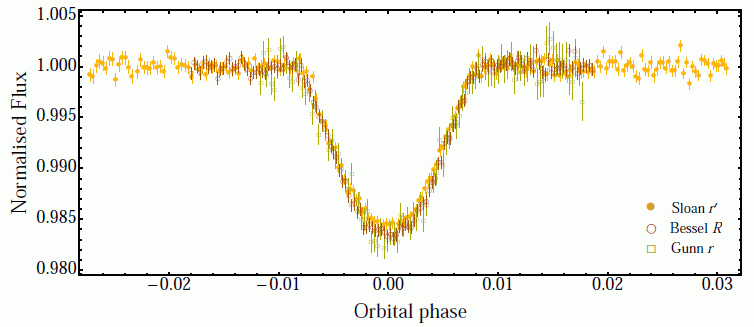
In WASP-67b’s grazing transit the planet is never completely in transit and thus the transit lightcurve has a continuously varying V shape. The grazing nature of WASP-67b was confirmed by a detailed study of new transit lightcurves by Mancini et al (2014), who used the GROND instrument on ESO’s 2.2-m telescope at the La Silla observatory.

The transit of WASP-67b from Mancini et al. (2014)

The transit of WASP-67b from Mancini et al. (2014)

The lack of second and third contact makes the system parameters hard to tie down, and thus obtaining a secure estimate of the planet’s radius and density requires Mancini et al’s high-quality lightcurves. WASP-67 is also notable for being in one of the target fields of the revamped Kepler spacecraft’s K2 mission, and thus we can expect ongoing detailed study of this system.

WASP thesis wins European Astronomical Society prize

Congratulations to Dr Amaury Triaud for winning the highly prestigious 2014 MERAC Prize, awarded by the European Astronomy Society for the Best Doctoral Thesis in Observational Astrophysics. Dr Triaud was a PhD student at the Geneva Observatory of the University of Geneva, supervised by Prof. Didier Queloz.

Amaury Triaud

Amaury Triaud took charge of the radial-velocity campaign following up WASP-South planet candidates, using the Coralie spectrograph on the Swiss/Euler 1.2-m telescope at La Silla, and has thus played a major part on the discovery of all WASP-South transiting exoplanets. The MERAC prize highights the success of the European collaboration between the British WASP-South transit search, the Swiss Euler/Coralie spectrograph, and the Belgian-led TRAPPIST robotic photometer.

Euler telescope

The Euler 1.2-m telescope

In addition to the planet discoveries, Amaury Triaud lead-authored a landmark paper on the dynamical origins of hot-Jupiter exoplanets, deduced by measuring the angle between the planet’s orbit and the host-star’s spin, which has already been cited 170 times. Amaury’s work provided strong evidence that hot Jupiters formed much further out than their current orbits, and were moved inwards by the Kozai mechanism.