Monthly Archives: June 2023

The IAU names more WASP exoplanets

The International Astronomical Union is periodically running contests to allow young people worldwide to name exoplanets, including those found by the WASP project.

Results of the 2022/23 naming process have just been announced.

The star WASP-19 is named Wattle (a genus of 1000 species of shrubs and trees native to Australia) while planet WASP-19b is Banksia (a genus of Australian wildflowers of medicinal and cultural importance to indigenous Australians).

The star WASP-43 is named Gnomon (after the astronomical instrument) while planet WASP-43b is Astrolábos (Greek for the astronomical instrument used in navigation).

The star WASP-63 is named Kosjenka while planet WASP-63b is Regoč (the names being characters in a popular Croatian fairy tale).

The star WASP-69 is named Wouri while planet WASP-69b is Makombé (being a major river in Cameroon and its tributary).

The star WASP-121 is named Dilmun (the Sumerian name of an ancient civilisation of the Bahrain archipelago) while planet WASP-121b is Tylos (the ancient Greek name for Bahrain island.).

The star WASP-166 is named Filetdor while planet WASP-166b is Catalineta (being a sea-serpent and heroine from the Mallorcan folktale “Na Filet d’Or”).

Water vapour in the atmosphere of WASP-18b

NASA have put out a press release about observations of the ultra-hot gas-giant WASP-18b by the James Webb Space Telescope.

By measuring the radiation of the planet as it is eclipsed by its host star, once every orbit, the team, led by Louis-Philippe Coulombe, mapped out the heat of the planet’s atmosphere. With WASP-18b being so hot, water vapour is likely disassociated over much of the “day side” of the planet, where it is blasted by the host-star’s radiation. But the sensitivity of JWST allowed it to detect water vapour from cooler regions on the planet’s limbs.

Cold-trapping on the nightside of giant exoplanet WASP-76b

The University of Montreal have put out a press release about a study of ultra-hot-Jupiter WASP-76b. The work, published in Nature by Stefan Pelletier et al, is based on observations with the 8-m Gemini-North telescope.

Pelletier et al measure the abundances of elements in the atmosphere of WASP-76b and compare them to abundances in the Sun.

Elements with condensation temperatures below 1550 K match solar abundances. Elements with higher condensation temperatures appear to be severely depleted. This is likely because they are “cold trapped”, condensed on the night-side of the planet, which, facing away from its host star, is much colder. The work has been widely reported in the media.

A hot super-Earth in the WASP-84 planetary system

When Kepler’s K2 mission started monitoring planetary systems where WASP had previously found hot Jupiters, one of the early discoveries was extra planets in the WASP-47 system, small rocky planets with transits too shallow to have been found by WASP.

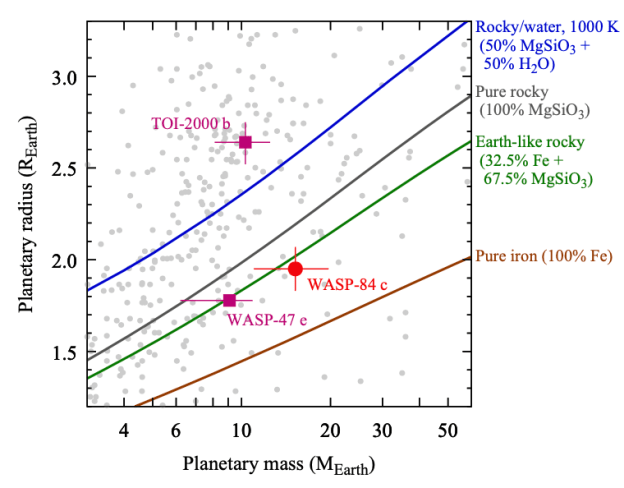
Now, a similar finding for the WASP-84 system has been announced by Gracjan Maciejewski etal. WASP found a Jupiter-sized planet in an 8-day orbit, while lightcurves from NASA’s TESS satellite also show a super-Earth planet with an orbit of 1.4 days.

The mass of both planets can be gained from the radial-velocity motion of the host star:

The new planet has a rocky, Earth-like composition.