
Monthly Archives: April 2021

The spectrum of hot Jupiter WASP-79b

Bloated hot-Jupiter WASP-79b, one of the largest known exoplanets with a radius near twice that of Jupiter, is among the planets scheduled to be observed with the keenly-awaited JWST. In a new paper, Alexander Rathcke et al report on observations made with Hubble. Here’s the spectrum:
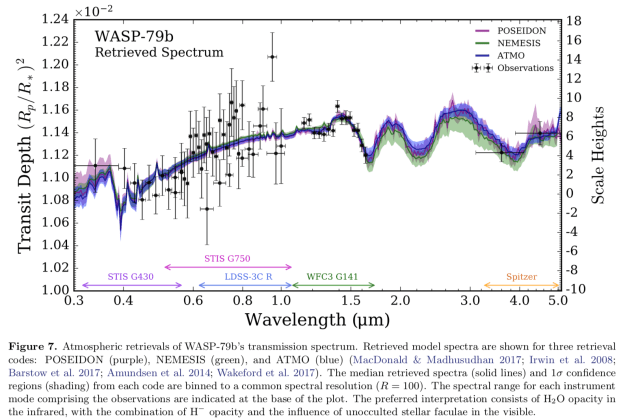
The clearest spectral feature, in the range observed with the WFC3 G141 grating, is attributed to water vapour. The authors also interpret the spectrum as showing opacity due to H ions and the effects of faculae on the host star, that are 500 K hotter than most of the star’s surface. They say that this “underscores the importance” of observing a wide wavelength range in order to “disentangle the influence of unocculted stellar heterogeneities from planetary transmission spectra”.
No clouds on the dayside of WASP-43b

As you’ll likely know from flying in an aircraft above the weather, clouds are bright, they reflect a lot of sunlight. This means that if a hot-Jupiter exoplanet has a cloudy atmosphere, then it should also be relatively bright, and so we should be able to detect a discernible drop in light when it it eclipsed behind its host star.

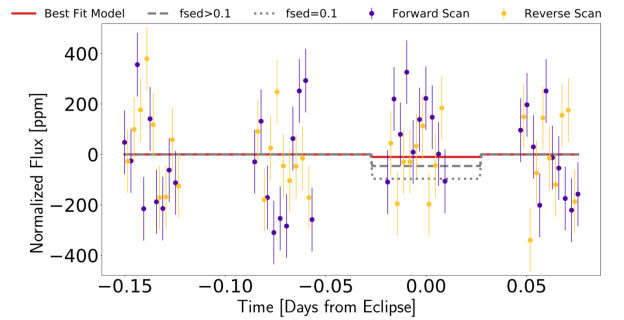
A new paper by Jonathan Fraine et al analyses data obtained with the Hubble Space Telescope WFCS/UVIS instrument to look for the eclipse of WASP-43b. Here is the result (with the data compared to model eclipse profiles):

The authors find no significant eclipse, deriving only an upper limit to any drop in light of 67 parts-per-million, which means that the dayside face of the planet is reflecting less than 6% of the illuminating starlight. And that means “that we can rule out a high altitude, bright, uniform cloud layer”.

Fraine et al remark that “Because of its observational and atmospheric viability for spectroscopic detections, WASP-43b has become a benchmark planet for current and future hot Jupiter observations. Upcoming … JWST observations [will] map the thermal structure and chemical composition of this exoplanet with exquisite detail … We expect that no other exoplanet has or will be observed with this much precision and wavelength coverage for many years to come.”

The importance of cloud-free skies is that one can then see atomic and molecular spectral features much more readily, and so learn much more about the atmosphere’s composition.