Monthly Archives: December 2020

TESS observes the WASP-148 system

The hot Jupiter WASP-148b is rather unusual, since it has a sibling planet, WASP-148c in a 35-day orbit (Hébrard et al. 2020). The system was recently observed by TESS leading to a new paper by Gracjan Maciejewski et al. (Nicolaus Copernicus University and the Instituto de Astrofísica de Andalucía).

The gravitational tug of the outer planet WASP-148c perturbs the orbit of the hot Jupiter WASP-148b. Here are deviations in the timings of the hot-Jupiter’s transit (the green points are new timings from TESS, the blue points are from observations from the Sierra Nevada Observatory, the red line is a model based on the masses and orbits of the planets):
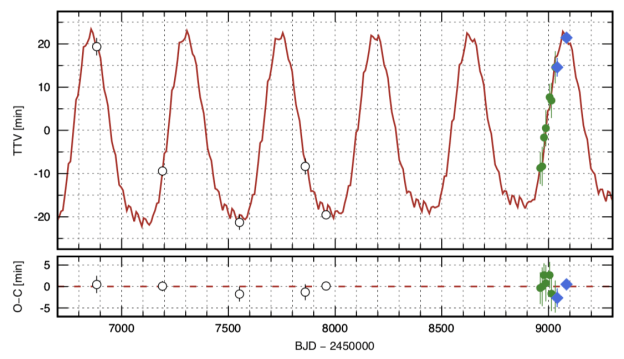
The great boon of transit-timing information is that it leads to measurements of the masses of the planets, which can be combined with radial-velocity measurements to give a better overall characterisation of the system.
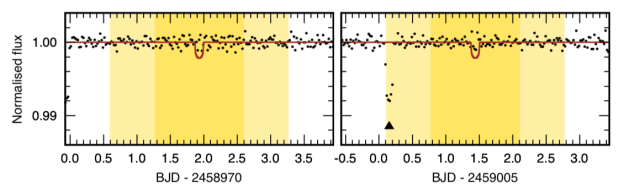
Maciejewski et al. also searched the TESS data for transits of the outer planet. The yellow areas are the predicted time of transit, should the planet’s orbital inclination be sufficiently high (the red line is a model showing the predicted depth of the transit; the black triangle marks a transit of the hot Jupiter WASP-148b). There is no indication that WASP-148c transits.

Confirmation of the changing orbital period of WASP-12b

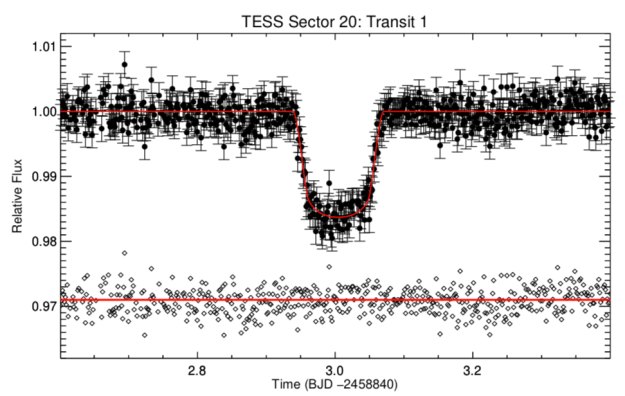
A new paper by Jake Turner et al (Cornell University) analyses TESS data on WASP-12b, showing that the transit timings confirm that the orbital period of the planet is getting shorter.

The orbit is changing on a timescale of 3 Myrs — if it continues the planet will spiral into its star on that timescale. The natural interpretation is that the orbital decay is being caused by tides that the gravitational pull of the planet arouses in the host star. We don’t yet properly understand the effect that tides have on the star, or how internal waves created by the tides then dissipate their energy. Thus the observations of WASP-12b point to the need for a better theoretical understanding of stellar interiors.

Of course the period change has only been measured over a decade, and this is vastly shorter than the orbital-decay timescale. Thus it could be that other mechanisms that we don’t know about can cause short-term changes in planet’s orbital periods. Ongoing monitoring of all the WASP hot Jupiters is thus needed to properly understand what is going on. The TESS satellite, which will observe most hot Jupiters every two years or so, on an ongoing basis, is the perfect tool for the task.

Update: Here’s a Twitter thread by the lead author, Jake Turner.