WASP Planets

Transiting exoplanets from the Wide Angle Search for Planets

Skip to content
  • Home
  • About
  • Naming
  • Status
  • WASP Planets
  • Story of WASP
  • Papers
  • Technical
    • Images

Katy Chubb on aluminium oxide in WASP-43b’s atmosphere

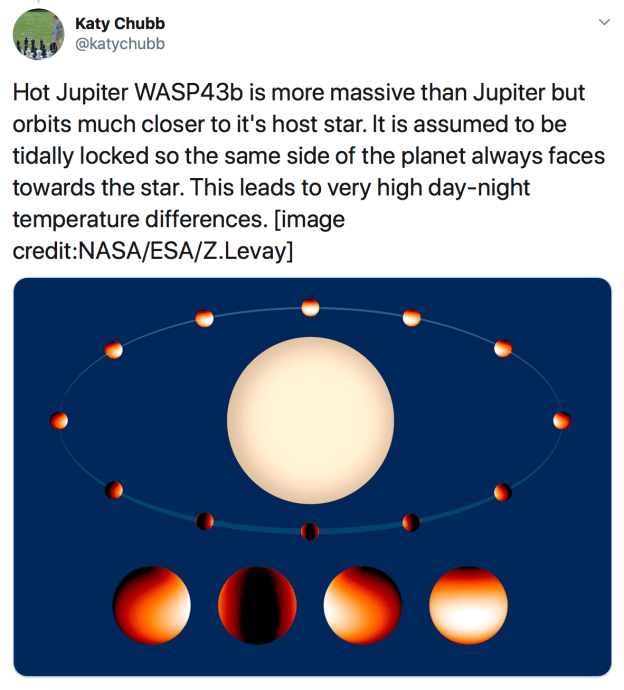
Thread by @katychubb (Dr Katy Chubb, SRON, Utrecht) about WASP-43b (paper):

Related

This entry was posted in exoplanet atmospheres, WASP planets and tagged aluminium oxide, Katy Chubb, WASP-43b on July 1, 2020 by waspplanets.

Post navigation

← Tidal inflation explains bloated exoplanet envelopes First results from ESA’s Cheops: WASP-189b →

Recent Posts

  • JWST maps the weather on exoplanet WASP-43b
  • CHEOPS sees a “glory” effect on WASP-76b
  • “Sand clouds” detected by JWST in the atmosphere of WASP-107b
  • NASA’s Webb identifies methane in the atmosphere of WASP-80b
  • The changing atmosphere of WASP-121b
  • WASP-69b’s comet-like tail
  • Quartz Crystal clouds in the atmosphere of gas-giant exoplanet WASP-17b
  • The IAU names more WASP exoplanets

WASP planet papers

Search ADS for latest WASP papers

Enter your email address to follow this blog and receive notifications of new posts by email.

Contact

waspplanets@gmail.com
Twitter: @WASPplanets

Categories

  • exoplanet atmospheres
  • Exoplanet formation
  • exoplanets
  • HATnet planets
  • Hot Jupiters
  • Hot Neptunes
  • Hubble Space Telescope
  • James Webb Space Telescope
  • K2 planets
  • KELT planets
  • Kepler planets
  • Solar System
  • TESS
  • Uncategorized
  • WASP planets
  • WASP project

Tags

  • albedo
  • aluminium oxide
  • Amaury Triaud
  • brown dwarfs
  • Cheops
  • clouds
  • companion planets
  • Coralie
  • Euler
  • exomoons
  • exoplanet discovery
  • exoplanet names
  • exoplanets
  • exoplanet transits
  • gravity darkening
  • helium
  • Hot Jupiter
  • Hubble Space Telescope
  • IAU
  • irradiation
  • JWST
  • K2
  • Keck
  • Kepler
  • Laura Kreidberg
  • magnetic activity
  • MASCARA
  • metallicity
  • Michel Mayor
  • NASA
  • occultation
  • orbital decay
  • orbital obliquity
  • orbital period decay
  • period change
  • phase curve
  • planet formation
  • RAS
  • Rossiter-McLaughlin effect
  • Sodium
  • Spitzer
  • Spitzer Space Telescope
  • starspots
  • stratosphere
  • super-Earths
  • Telescopio Nazionale Galileo
  • tidal damping
  • tidal decay
  • tidal interaction
  • transit
  • transit depth
  • transits
  • transit times
  • transit timing
  • transmission spectroscopy
  • TRAPPIST
  • TTVs
  • Ultra-hot Jupiters
  • Vivien Parmentier
  • VLT
  • WASP-4b
  • WASP-6b
  • WASP-8b
  • WASP-10
  • WASP-10b
  • WASP-12b
  • WASP-17b
  • WASP-18
  • WASP-18b
  • WASP-19b
  • WASP-22
  • WASP-31b
  • WASP-33b
  • WASP-36b
  • WASP-39b
  • WASP-43
  • WASP-43b
  • WASP-47
  • WASP-53
  • WASP-62b
  • WASP-67b
  • WASP-69b
  • WASP-76b
  • WASP-79b
  • WASP-80b
  • WASP-84b
  • WASP-85
  • WASP-96b
  • WASP-100b
  • WASP-103b
  • WASP-104b
  • WASP-107b
  • WASP-121
  • WASP-121b
  • WASP-126b
  • WASP-127b
  • WASP-166b
  • WASP-189
  • WASP-South
  • water

Archives

Blogroll

  • CHEOPS
  • EChO
  • Exoplanet.eu
  • Exoplanets.org
  • Kepler
  • NGTS
  • SWEET-Cat
  • TEPCat
  • TESS
  • Twinkle

Archive

WASP archive @NASA
Blog at WordPress.com.
Privacy & Cookies: This site uses cookies. By continuing to use this website, you agree to their use.
To find out more, including how to control cookies, see here: Cookie Policy
  • Reblog
  • Subscribe Subscribed
    • WASP Planets
    • Join 86 other subscribers
    • Already have a WordPress.com account? Log in now.
    • WASP Planets
    • Subscribe Subscribed
    • Sign up
    • Log in
    • Copy shortlink
    • Report this content
    • View post in Reader
    • Manage subscriptions
    • Collapse this bar
 

Loading Comments...