Monthly Archives: April 2020

Aluminium oxide in the atmosphere of hot-Jupiter WASP-43b?

WASP-43b is one of the favourite planets for atmospheric characterisation, being in such a tight, short-period orbit that it is heated up by its host star, such that the molecules in its atmosphere should be easy to discern.

A new paper by Katy Chubb et al re-analyses observations made with the Hubble Space Telescope and concludes that the observations show signs of aluminium oxide.

It is important to realise that this work is not easy, being right at the limit of what can be done, even with Hubble. Neither the spectral resolution nor the signal-to-noise ratio of the data are sufficient to unambiguously discern features of particular molecules. Instead, the art is to guess the molecules that might be present, simulate the resulting spectrum if the guess were right, and then compare that to the observed spectrum. This leads to figures such as this, from Katy Chubb’s paper:
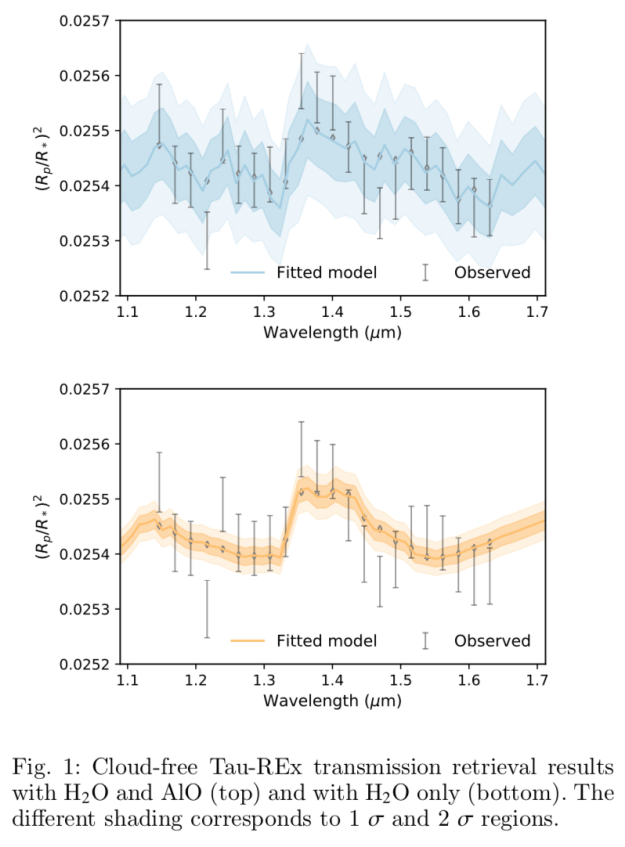
The grey lines are the data (shown as error bars). The coloured lines are the calculated model (with the coloured bands then allowing for uncertainties), and the grey diamonds are where error-free data would be if the model were perfect. The x-axis is wavelength, and the y-axis is the effective radius of the planet’s atmosphere at that wavelength, which tells us how good it is at absorbing light of that wavelength.

The bottom panel (orange) fits the data with water vapour only, while the upper panel (blue) includes both water and aluminium oxide. The later gives a significantly better fit. The authors write that, in addition to water, “AlO is the molecule that fits the data to the highest level of confidence”, while “We find no evidence of the presence of CO, CO2, or CH4“.

However this could be a puzzle, since: “AlO is not expected from the equilibrium chemistry at the temperatures and pressures of the atmospheric layer that is being probed by the observed data. Its presence therefore implies direct evidence of some disequilibrium processes with links to atmospheric dynamics.”

As with all current characterisation of exoplanet atmospheres, we await the James Webb Space Telescope (which has been designed to do this work; Hubble was designed before exoplanets were even known), to tell us how reliable the current results are.
WASP-4 is accelerating toward the Earth

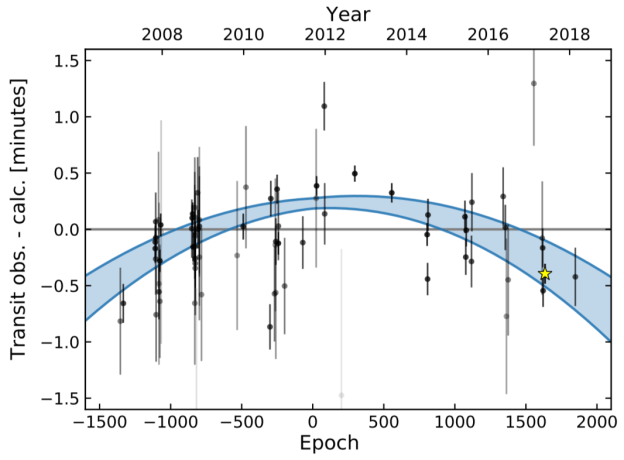
Here is a plot of the timings of the transits of WASP-4b, taken from a new paper led by Luke Bouma:

The curve in the plot shows that the transits are occurring progressively earlier as time passes. One possible explanation is that the planet’s orbit is decaying under the influence of the tidal interaction between the star and planet. This is expected to occur in most hot Jupiters, though how quickly is debated.

However, Bouma have also obtained radial-velocity observations of the system, which show that the star is accelerating towards us. This can result from it being in a wide orbit with another object (the authors suggest a wide-orbiting companion of 10-to-300 Jupiter masses at a distance of 10-to-100 AU). Since the system is accelerating towards us, the light-travel time is decreasing, and this (not orbital decay) means that the transits occur earlier.

Wide companions are expected in hot-Jupiter systems, since, in most theories for the occurrence of hot Jupiters, the gravitational perturbation of a distant companion is needed to shrink the hot-Jupiter orbit down to the current values of only a few days.

Bouma et al recommend continued radial-velocity monitoring of hot Jupiters in order to distinguish orbital decay from accelerations caused by orbiting companions.

The morning and evening terminators are different

Hot Jupiter exoplanets are “phase locked” by tidal forces, meaning that the same face of the planet always faces the star. Being blasted by radiation it is far hotter than the night side. This means that strong winds must be racing around the planet, redistributing the heat.

And that means that the “evening” terminator (where winds flow from the hot day-side face to the cooler night side) will be much hotter than the “morning” terminator (where winds flow from the night side to the day side). Here’s an illustration from a new paper by Ryan MacDonald, Jayesh Goyal and Nikole Lewis:

Of course the terminators are exactly the regions of the planet’s atmosphere that are being sampled by atmospheric-characterisation studies, since that’s the regions that are seen projected against the host star.

As Ryan MacDonald et al point out, most atmospheric-characterisation studies assume that the two limbs are the same, since that’s the easiest thing to do. However, the authors argue, while doing that might produce an acceptable fit to the data, the resulting parameter values could be very wrong.

Thus, the fitted temperature profile could be “hundreds of degrees cooler” than reality. As a result, the fitted abundances of molecular species could also be wrong. MacDonald et al conclude that: “these biases provide an explanation for the cold retrieved temperatures reported for WASP-17b and WASP-12b” and say that: “to overcome biases associated with 1D atmospheric models, there is an urgent need to develop multidimensional retrieval techniques”.

More TESS phase curves of WASP exoplanets

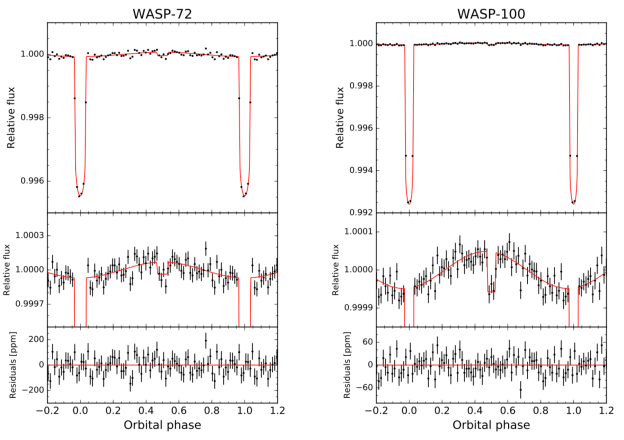
Ian Wong et al have produced a new analysis of the TESS data on previously known WASP exoplanets. Their main interest is the “phase curve”, the variation of the light around the planet’s orbit.

Two examples are the systems WASP-72 and WASP-100:

In addition to the main transit (planet passing in front of the star) the phase curves show secondary eclipses (planet passing behind the star, at phase 0.5) and a sinusoidal variation due to the heated face of the planet. By modelling the phase-curves of these and other similar planets, Wong et al make the tentative suggestion that the hotter the planet (which can be measured from the depth of the secondary eclipse) the more reflective the atmosphere of the planet is.

Here’s a similar plot for WASP-30. Note, though, that the phase-curve variation peaks at phases 0.25 and 0.75, unlike those for WASP-72 and WASP-100. That’s because WASP-30b is not a planet but a brown dwarf, with a mass of 63 Jupiters. That is massive enough for its gravity to distort the host star into an ellipsoidal shape, and so in this system the variation of the light is caused by the varying projection of the distorted star around the orbit.