Monthly Archives: December 2019

The tidal shape of the exoplanet WASP-121b

The moon’s gravity causes a tidal bulge in Earth’s oceans, so that the water facing the moon is raised several metres. Similarly, close-orbiting exoplanets will have a tidally distorted shape, with a tidal bulge facing the host star. The amount of distortion can be quantified by the “Love number” h (named after the mathematician Augustus Love)

Specifically, h2 tells us the relative height of the tidal bulge, and would be zero for a perfectly rigid body that did not distort at all, and would be 2.5 for a perfectly fluid body that adapted fully to the tidal potential. Gas-giant planets have large envelopes of gaseous fluid, so would be expected to have fairly high values of h2. However, they also might have rocky or metallic cores, and so would have values less than 2.5. For example Jupiter has h2 = 1.6 while Saturn has h2 = 1.4.
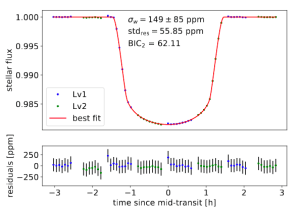
Transit of WASP-121b observed by HST with a model fit by Hellard et al.

A new paper by Hugo Hellard et al discusses whether h2 for a hot-Jupiter exoplanet can be measured from the shape of the transit lightcurve, given good-enough photometry such as that from the Hubble Space Telescope.

The main problem is that the transit profile is heavily affected by variations in the brightness of the stellar disc, in particular the limb darkening (a star’s limbs appear a bit dimmer, because a tangential line-of-sight into a gas cloud skims only the cooler, upper layers). Thus the Hellard et al paper discusses at length different ways to model the limb darkening.

A star’s disk is dimmer at the edges, so a transiting exoplanet removes less light (here Venus, top right, is transiting the Sun).

The end-result, however, is a claim to have measured h2 for WASP-121b, with a value of h2 = 1.4 ± 0.8. This is not (yet) a strong constraint, but points to the potential in the future, and also flags up the need to understand and properly parametrise limb darkening.
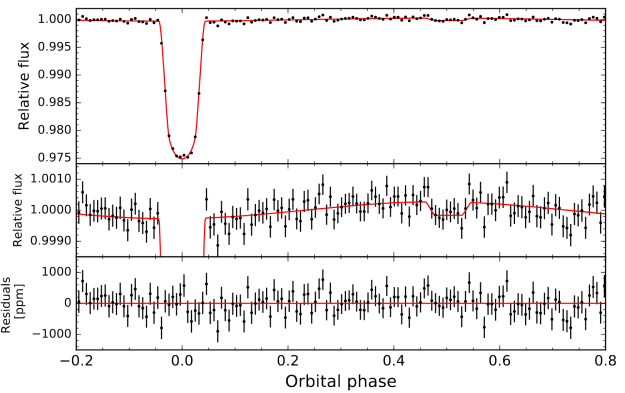
TESS phase curve of WASP-19b

The space-based photometry from the TESS satellite is producing high-quality light curves of many of the WASP exoplanets. Here is the lightcurve of WASP-19b, from a new paper by Ian Wong et al:

In addition to the transit (phase zero), the lightcurve shows a shallower eclipse of the planet (phase 0.5) and a broad variation caused by the changing aspect of the heated face of the planet. Unlike in some planets, the hottest part of the planet directly faces the star, so there is no offset in the phase of the broad modulation.

Wong et al deduce that the dayside face of the planet is heated to 2240 ± 40 K, that there is no flux detected from the colder night side, and that the planet reflects 16 ± 4 percent of the light that falls on it. The last value is relatively high compared to other planets.

Water in exoplanet atmospheres

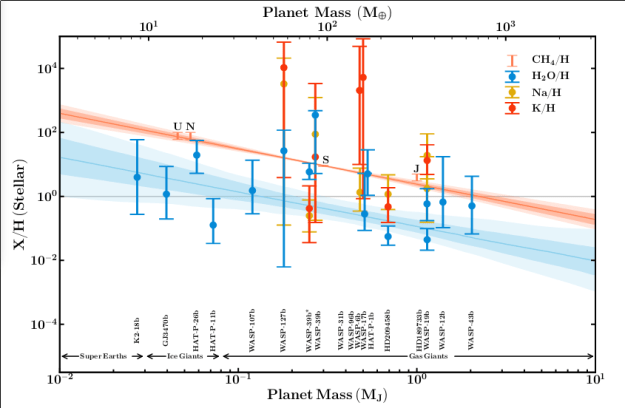
The Cambridge Institute of Astronomy have put out a press release based on a new paper analysing the water abundance in the atmospheres of 19 exoplanets, 11 of them being WASP planets.

The plot shows the measured water abundance versus the planet’s mass. Welbanks et al state that: “We find a mass–metallicity trend of increasing H2O abundances with decreasing mass”, and also that: “The H2O abundances in hot gas giants are likely due to low oxygen abundances relative to other elements rather than low overall metallicities, and provide new constraints on their formation mechanisms”.

The press release explains that: “The researchers found that while water vapour is common in the atmospheres of many exoplanets, the amounts were surprisingly lower than expected, while the amounts of other elements found in some planets were consistent with expectations”.

The press release has led to coverage in the Daily Express, Astronomy Now, and Science News, among other sites, accompanied by this graphic:

The atmosphere of the inflated hot Jupiter WASP-6b

Atmospheric characterisation of hot Jupiters continues apace, using both ground-based telescopes such as ESO’s Very Large Telescope and satellites such as Hubble.

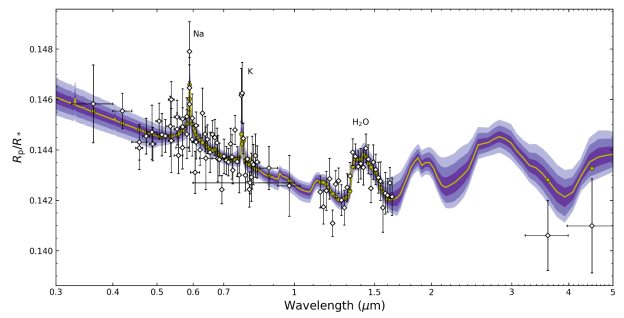
Aarynn Carter et al have just produced a new analysis of WASP-6b:

The spectrum shows absorption due to sodium (Na), potassium (K) and water vapour, while the modelling implies that the atmosphere is partially hazy. Carter et al state that: “despite this presence of haze, WASP-6b remains a favourable object for future atmospheric characterisation with upcoming missions such as the James Webb Space Telescope.