Monthly Archives: November 2019

The spectrum of the bloated, sub-Saturn-mass planet WASP-127b

Here is the latest analysis of the spectrum of WASP-127b, led by Jessica Spake and newly announced on arXiv.

The different datasets come from the Hubble Space Telescope and the Spitzer Space Telescope. Spake et al see obvious features from sodium, potassium, water and carbon dioxide. They conclude that the planet has a super-solar metallicity and that its skies are relatively cloud-free.

WASP-127b is a highly observable target since, despite being less than Saturn’s mass, it is bloated to larger than Jupiter. The puffy atmosphere projected against the host star gives results in a strong signal observable during transit. Spake et al look forward to observing the planet with the James Webb Space Telescope, and say: “the hint of a large absorption feature around 4.5 microns is strong evidence that future observations of WASP-127b with JWST will be able to measure the abundances of carbon-bearing species in its atmosphere”.

The orbit of WASP-12b is decaying

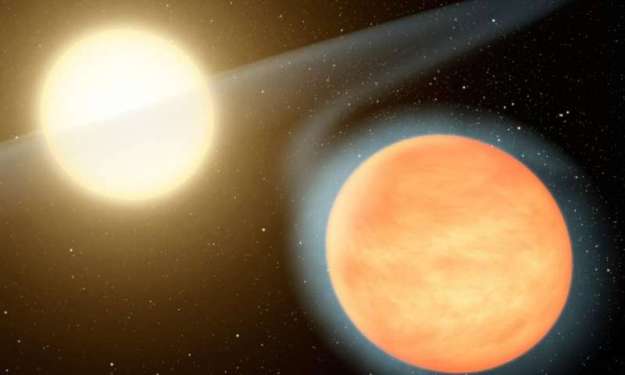
Here’s the latest update on the changes in the orbital period of WASP-12b, from a new paper by Samuel Yee et al.

The times of transit are getting earlier, which means that the period is decreasing slightly. By also considering the times of occultation (when the planet passes behind the star), and also the radial-velocity measurements of the system, the authors deduce that the changes are not the effect of some other planet, but are a real decay in the orbit of WASP-12b. This is expected to occur as a result of tidal interactions between the planet and its host star.

One notable conclusion is that the rate of period decay in WASP-12b is much faster than that in WASP-19b, which shows no detectable period change yet, despite it being an even shorter-period hot Jupiter, which should increase tidal interactions. Yee et al suggest that the difference could arise if the host star WASP-12 is a sub-giant star, whereas WASP-19 is not.

Update: Following an article on WASP-12b’s orbital decay, supplied by Liz Fuller-Wright of Princeton University, and appearing in phys.org and Science Daily, the work has gained media attention from CNN, Science Times, Universe Today, and the UK’s Metro.

Gravity darkening of planet-host MASCARA-4

MASCARA is one of WASP’s competitor transit-search projects, so let’s celebrate a neat result from TESS data of transits of MASCARA-4b. The host star, MASCARA-4, is a hot, fast-rotating A-type star. As a result of its fast rotation, the equatorial regions are being flung outwards by centrifugal forces, such that the star has a flattened, oblate shape. As a result, the force of gravity will be less at the equator than at the poles of the star, and that means that the equatorial regions will be slightly cooler and so a bit dimmer (in outline, that’s because gravity inward pull is balanced by gas pressure, and so lower gravity means lower pressure, and the temperature of a gas is related to its temperature through the perfect gas law). This effect is called “gravity darkening”.

The star spins around its axis (thick line) while the planet orbits at an oblique angle.

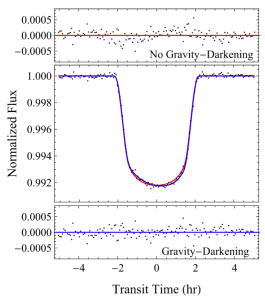
In a new paper, John Ahlers et al have detected the effect of gravity darkening on a transit lightcurve of the hot Jupiter MASCARA-4b. The planet has a misaligned orbit, first coming onto the stellar face near the equator, and then moving towards a pole. That means it moves from slightly cooler regions to slightly hotter regions, and that changes the amount of light occulted by the planet.

If gravity darkening is not taken into account then the model fit is a bit too deep at the start and a bit too shallow at the end of the transit. One of the benefits of detecting this effect of gravity darkening is that it then tells us the true angle between the star’s spin axis and the planet’s orbit (whereas other methods, such as Doppler tomography, only tell us the projection of that angle onto the sky).

Looking forward to WASP-79b with JWST

The bloated hot-Jupiter WASP-79b has been selected as an Early Release Science target for the James Webb Space Telescope, so is being studied with current facilities such as HST and Spitzer.

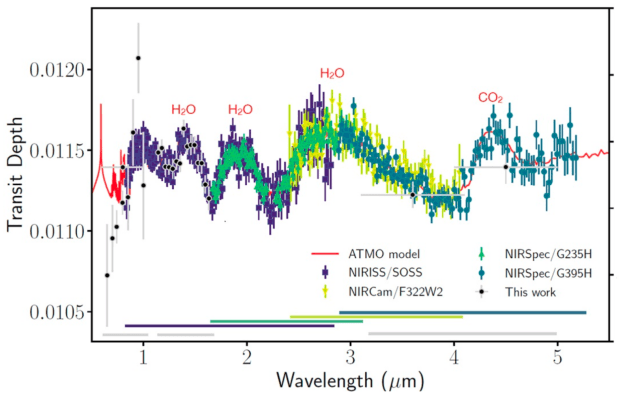
Here is a simulation of what the spectrum of WASP-79b might look like when observed with JWST, taken from a new paper by Kristin Sotzen et al.

Sotzen et al have collected together data from HST, Spitzer and the Magellan telescope in order to model the atmosphere of the planet and use that to predict the results of the JWST observations. The different coloured symbols are for different instruments of JWST, namely NIRSpec, NIRCam and NIRISS. The main spectral features are caused by water and carbon dioxide molecules. With a partially cloudy atmosphere and detectable water features, Sotzen et al confirm that WASP-79b is a prime target for JWST.