Monthly Archives: November 2017

Wide-coverage spectrum of exoplanet WASP-39b

WASP-39b is turning out to be one of the more important WASP discoveries, being observed with the Hubble Space Telescope, the Spitzer Space Telescope and large ground-based telescopes such as the VLT. This is because, as a Saturn-mass planet with a bloated radius, it has a low surface gravity and so is ideal for atmospheric characterisation. Further, it has relatively clear skies showing spectral features.

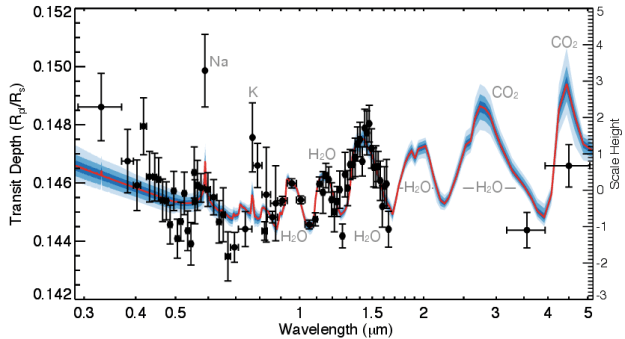
Now a team led by Hannah Wakeford from Exeter University have put the different data-sets together to produce the widest-coverage spectrum of the planet so far:

The dominant spectral features are due to water vapour, while there are narrower lines due to sodium (Na) and potassium (K) and a Rayleigh-scattering slope at the blue end.

The main finding from fitting the water features is that the atmospheric metallicity must be at least 100 times that of the sun. This high value shows the diversity of exoplanets. The authors conclude that “WASP-39b is an ideal target for follow-up studies with the James Webb Space Telescope”.

A first planet for the Next Generation Transit Survey

The latest transit survey to announce their first planet is the Next Generation Transit Survey. While the planet NGTS-1b has a fairly normal mass and radius for a hot Jupiter, it is unusual in being found transiting an M0-type dwarf, a star of only 0.6 solar radii. Thus the planet is nearly a quarter as big as the star, in terms of radius, the highest planet-to-star ratio yet found.

NGTS is an array of twelve 20-cm telescopes sited at Cerro Paranal in Chile, and has been accumulating survey data since 2016.

Next-Generation Transit Survey

It is important to realise that the newer survey NGTS does not supersede WASP, but instead complements it, being designed to do a different task. WASP, and similar surveys such as HATnet and KELT, use camera lenses (typically 200-mm f/1.8 or 85-mm f/1.2) to survey large swathes of sky. The data is good enough to detect transits of Jupiter- and Saturn-sized planets, but not smaller ones.

NGTS was designed to find smaller planets, down to Neptune and possibly super-Earth size. To do that it uses bigger optics, being telescopes rather than camera lenses, with a much better plate scale (more CCD pixels per chunk of sky). This gives much better photometry, but at the price of a much smaller field of view. A smaller field of view means covering many fewer bright stars.

Indeed, NGTS has a field of view comparable to the Kepler field (1% of the sky), though since it will raster several fields it will add up to sky coverage comparable to that of the Kepler K2 mission phase.

Thus WASP, running with 200-mm lenses surveying much of the sky, finds Jupiters and Saturns transiting stars of typically V = 9 to 13. NGTS can find smaller planets, and is aimed at finding Neptunes, but will likely find them transiting fainter stars of typically V = 13 to 14 (and perhaps, as with K2, an occasional brighter one).

Meanwhile, WASP-South has recently been running with wider, 85-mm lenses, which cover the whole Southern sky and target stars of V = 6.5 to 11.5. Hence the two surveys are entirely complementary: WASP aiming for large, Jupiter-sized planets around very bright stars, while NGTS aims for Neptune-sized planets around much fainter stars.

The main competition for WASP is now KELT and MASCARA, whereas the main competition for NGTS is the ongoing K2 mission. Of course NASA’s forthcoming TESS mission, set for launch in 2018, should out-compete all of the ground-based surveys.

WASP planets selected for James Webb Space Telescope ERS and GTO

Studying the atmospheres of exoplanets is one of the main goals of the James Webb Space Telescope, now scheduled for launch in mid 2019. The mission recently asked for proposals for “Early Release Science”, observations to test out the instruments, show what JWST can so, and supply the community with data to start analysing.

Of 13 ERS proposals accepted, the “The Transiting Exoplanet Community ERS Program”, led by Kepler lead-scientist Natalie Batalha, got all the time it asked for.

WASP planets feature heavily in the ERS program, since many transit relatively bright stars. Large, puffy gaseous planets will also give the strongest and clearest signals of atmospheric features, and so are optimum early targets. While JWST will want to look also at atmospheres of smaller, rocky planets, “Astronomers initially will train their gaze onto gaseous Jupiter-sized worlds like WASP-39b and WASP-43b because they are easier targets on which to [look for the chemical fingerprints of the atmosphere’s gases]”.

The target list for the ERS proposal is currently being finalised in the light of the recent delay in JWST launch from 2018 to 2019, though an earlier draft of the proposal featured 7 WASP planets out of 12 targets.

Further, the four GTO teams have also selected WASP planets for early JWST observations. GTO time (“Guaranteed Time Observations”) is time allocated to the teams who built the JWST instruments as a reward and incentive. All four instrument teams have picked WASP planets, including WASP-17b, WASP-52b, WASP-43b, WASP-69b, WASP-77Ab, WASP-80b, WASP-107b and WASP-121b.

Meanwhile, Kevin Heng, of the University of Bern, has written a popular-level account for American Scientist of how JWST is expected to revolutionise the study of exoplanet atmospheres.