Monthly Archives: December 2016

Long-period brown dwarfs for WASP-53 and WASP-81

The WASP project has just released the discovery paper for the systems WASP-53 and WASP-81, led by Amaury Triaud. We’ve known about close-in hot-Jupiter planets around these two stars for several years, but the paper had been delayed owing to an interesting development: the radial-velocity monitoring showed that the planets both had longer-period brown-dwarf companions. Several years of data have been needed to prove the reality of these brown dwarfs, now dubbed WASP-53c and WASP-81c.

Radial velocity monitoring of WASP-53 and WASP-81

The plot shows the “radial velocities” — how much the star is tugged about by the gravity of orbiting bodies — as a function of time (in BJD, a count of days). WASP-53 is on the left and WASP-81 on the right. The red line is a fit to the data. The close-in hot Jupiters (WASP-53b and WASP-81b, with orbits of 3.3 and 2.7 days respectively) cause short-period variations, so fast that they appear as a solid red swathe.

In addition, though, WASP-53 shows a variation owing to a more-massive brown dwarf with an orbital period of about ten years and a mass of at least 16 Jupiters. Similarly, WASP-81 shows a variation caused by a 57-MJup brown dwarf in a 3.5-yr orbit. Both outer orbits are highly eccentric.

The presence of the brown dwarfs has interesting consequences for ideas about how planets form. It is generally accepted that hot Jupiters form further out, where it is colder, where ices can stick together and form a planetesimal. But the presence of eccentric brown dwarfs, disrupting the proto-planetary disc in that region, would have made that hard. So maybe the planets formed further in? Or maybe the brown dwarfs were originally elsewhere, and moved to their current orbits later on?
Magnetic activity on planet-host stars

One interesting question is whether close-in hot-Jupiter planets have an effect on the magnetic activity of the host star. There have been suggestions that star–planet interactions might increase magnetic activity on the star, or that tidal interactions might decrease it. Further, if mass lost from planets forms an absorbing cloud around the star, then it might reduce observable signs of magnetic activity, even if it doesn’t affect the magnetic activity itself.

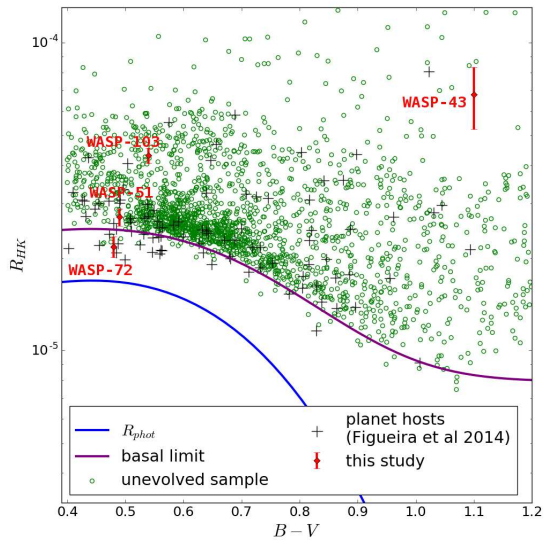
A new paper by Daniel Staab et al, led by the Open University, investigates the issue by looking for markers of magnetic activity in spectra of host stars WASP-43, WASP-51, WASP-72 and WASP-103. In the following plot, RHK is a marker of magnetic activity, plotted against the temperature (B–V) of the star. The green dots are a large sample of field stars, while the four WASP host stars are labelled in red.

Chromospheric activity on planet-host stars.

The result is that at least one planet-host, WASP-43, has an abnormally high degree of magnetic activity, while another one, WASP-72, has abnormally low magnetic activity. Staab et al conclude that there is no single factor explaining the differences, and that more than one effect might be in play. As often, a much larger sample of data is needed to investigate the issue.

The atmospheres of WASP planets with JWST

The James Webb Space Telescope is expected to revolutionise the study of exoplanet atmospheres following its launch in 2018, and WASP planets will be among the prime targets. Paul Mollière et al have been simulating the data expected, and have produced this illustration of the atmospheric emission spectrum of WASP-18b.

Spectrum of exoplanet WASP-18b as observed with JWST

The different coloured curves result from different assumptions about WASP-18b’s atmosphere. The lines along the bottom illustrate the spectral coverage of the different JWST instruments. In contrast to existing data (Spitzer results are shown as black squares), the JWST data will have both the spectral resolution and signal-to-noise to differentiate clearly between different models.

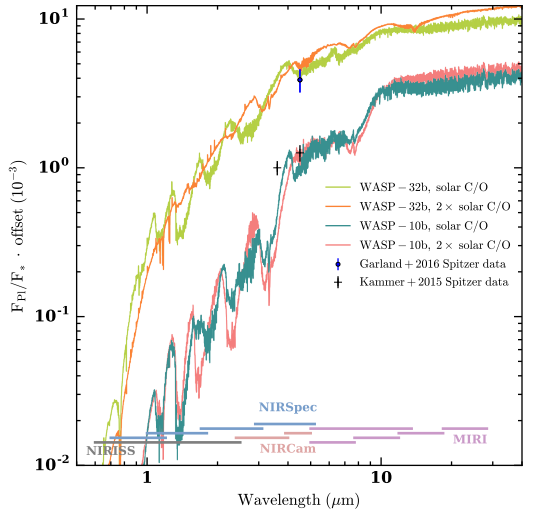
Mollière et al have also simulated spectra for cooler planets, such as WASP-10b and WASP-32b.

WASP-10b and WASP-32b simulated atmospheres observed with James Webb Space Telescope.

The different models are for different abundances of carbon relative to oxygen (C/O), showing that JWST should be able to settle the issue of which exoplanets have enhanced abundances of carbon relative to the Solar System.

Such simulations show that the results from JWST should be spectacular, opening up whole new areas of enquiry.