
Monthly Archives: November 2016

WASP-20 is a binary star

The host star of the hot Jupiter WASP-20b has been found to be a binary star. A new paper by Daniel Evans et al finds WASP-20 to be a binary separated by 0.26 arcsecs, sufficiently close that the second star had not previously been noticed. Evans et al used the SPHERE instrument on ESO’s Very Large Telescope to find the slightly dimmer companion:
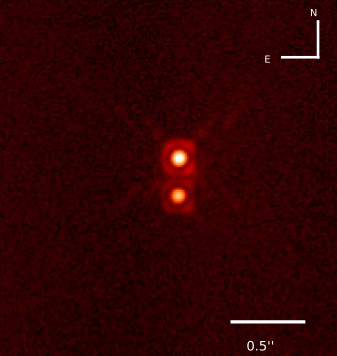
WASP-20 is a binary star

The two stars, WASP-20 A and WASP-20 B seem to be gravitationally bound, and the planet appears to orbit the brighter star. The companion star is 61 astronomical units from the planet-hosting star, close enough that it might have had a gravitational effect on the orbit of the planet.

This is relevant since hot Jupiters are thought to have been created much further from their star than their current close-in orbits, and gravitational perturbations from a third body is one suggested mechanism for causing them to migrate inwards.

WASP’s “Super Saturn” feature for kids

The possible discovery of an exoplanet ring system, a “Super Saturn”, has featured in a Frontiers for Young Minds article aimed at scientists aged 8 to 15 years.

The suggestion of an exoplanetary ring system was an interpretation of the multiple dips in the lightcurve of a star, catalogued as 1SWASP J140747.93–394542.6, as observed in WASP-South data in 2007. The article gives a good introduction to the WASP project at an accessible level, complete with this image of the “Super Saturn”:

Illustration of the "Super Saturn" found in WASP data.

The clear atmosphere of WASP-39b, seen from the ground

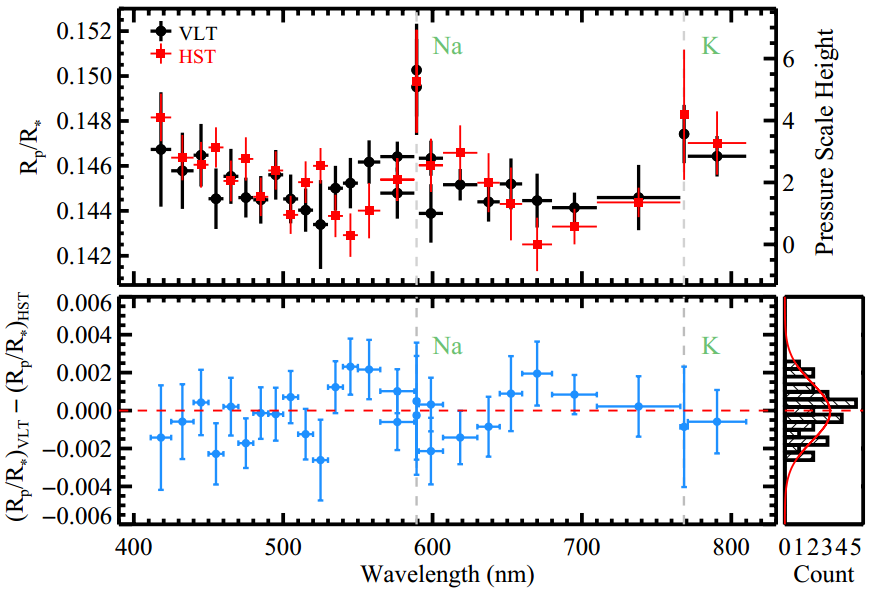
Most of the best detections of features in the atmospheres of transiting exoplanets have come from the Hubble Space Telescope, but time on hugely expensive satellites is in high demand and limited. Thus a recent paper led by Nikolay Nikolov from Exeter University is a welcome development. Nikolov and his team observed WASP-39b and detected a strong Sodium line from the planet, which indicates a clear atmosphere. The result came from the newly upgraded FORS2 spectrograph on ESO’s Very Large Telescope.

Sodium in the atmosphere of exoplanet WASP-39b

The important feature of the plot is that the VLT data (black) are every bit as good as those from a previous detection of the same line using the Hubble. While Hubble has the advantage of being in space, the VLT has a much larger mirror and can observe whole transits without the gaps seen in Hubble data owing to its low-Earth orbit.

The similar result from a very different facility also gives confidence in the correctness of such detections of features in exoplanet atmospheres, which are, after all, pushing current technology to its limits.