Monthly Archives: August 2015

The orbit of WASP-33b is precessing

Hot Jupiter planets are in tight orbits around their host star, and since that star will not be perfectly spherical, small gravitational perturbations should cause the orbit to precess. A team led by Marshall Johnson has now shown that this is indeed happening in WASP-33.

WASP-33 is a very hot, rapidly rotating A-type star. This means the planet is only detected by the “shadow” that it causes in the profiles of the spectral lines of the star during transit.

Since the star is rotating the spectral lines will be broadened by the Doppler effect, with photons from the approaching limb being blue-shifted and photons from the receding limb being red-shifted. As the planet transits the star, it blocks the light from one small region of the star’s surface. This removes the photons that are Doppler shifted with the velocity of that part of the star’s surface.

The trace of the planet across the star’s surface during transit can therefore be seen as a stripe moving in velocity across the profile of the star’s spectral lines. This is seen in these false-colour images of the spectral line of WASP-33, taking during two transits, six years apart:
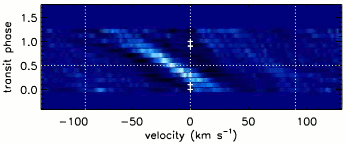
WASP-33 line profiles

WASP-33 line profiles

The white diagonal stripe is the path of the planet, blocking out the photons below it. The stripe is clearly in a different place in the two observations. This means that the path of the orbit has changed. Johnson et al give the following schematic of how they think the orbit of the planet has changed between the two observations.
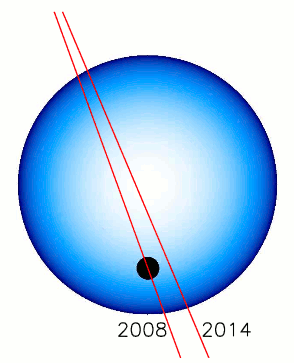
WASP-33 precession

This observation validates the theory that the orbit should be precessing, and is only the second detection of nodal precession in an exoplanet orbiting a single star, after the example of Kepler-13 Ab.

Four planets around WASP-47!

As NASA’s Kepler mission covers fields in the ecliptic previously surveyed by WASP, it is obtaining photometry of unprecedented quality on some WASP planets. The big news this week is the discovery of two more transiting planets in the WASP-47 system.

WASP-47 had seemed to be a relatively routine hot-Jupiter system with the discovery of a Jupiter-sized planet in a 4-day orbit, reported in a batch of transiting planets from WASP-South by Hellier et al 2012.

But WASP-47 is anything but routine. Now Becker et al have announced that the Kepler K2 lightcurves show two more transiting planets: a super-Earth planet in an orbit of only 0.79 days, and a Neptune-sized planet in an orbit of 9.0 days. Being much smaller, these planets cause transits that are too shallow to have been seen in the original WASP data.

WASP-47 transits with Kepler K2

The super-Earth, labelled WASP-47c, has a radius of 1.8 Earths while the Neptune, labelled WASP-47d, has a radius of 3.6 Earths. The triple-planet system is dynamically stable, but the gravitational interaction causes perturbations in the orbits, leading to variations in the times of the transits.

Such “transit-timing variations” or TTVs lead to estimates of the planetary masses. Becker et al find that the hot Jupiter has a mass of 340 Earths (consistent with the mass of 360 Earths originally reported by Hellier et al from radial-velocity measurements), while the Neptune has a mass of 9 Earths. The super-Earth must be less massive than that, but current timing measurements are not sensitive enough to say more.

WASP-47 TTVs Transit timing variations

As if three planets were not enough, there is a probable fourth planet orbiting WASP-47. The Geneva Observatory group routinely monitor known WASP systems, taking radial-velocity measurements over years, to look for longer-period planets. Marion Neveu-VanMalle and colleagues have recently reported the detection of another Jupiter-mass planet orbiting WASP-47, this time in a much wider orbit of 571 days.

The WASP-47 system has now become hugely interesting for understanding exoplanets, and will trigger many additional observations of the system. For example, being bright enough to allow good radial-velocity data, it will provide a much-needed check that the mass estimates from TTVs match those from the more traditional radial-velocity technique.

The system will also be of strong interest to theorists, who will want to understand the formation and origin of a planetary system with this architecture. One immediate consequence is that it shows that a hot Jupiter can arise by inward migration through the proto-planetary disk, without destroying all other planets in its path.

Spitzer observations of cool WASP planets

A new paper by Joshua Kammer et al reports observations of 5 transiting hot-Jupiter planets with the Spitzer Space Telescope. The Spitzer infra-red observations looked for the occultation of the planet, when it passes behind its host star. By comparing the observed emission in and out of the occultation one can deduce the temperature of the planet’s atmosphere.

Kammer and colleagues chose to look at 5 relatively cool hot-Jupiter planets (ones around cooler stars, or orbiting further from the star), with expected temperatures in the range 900 to 1200 K. Of the 5, four were WASP planets (WASP-6b, WASP-10b, WASP-39b and WASP-67b).

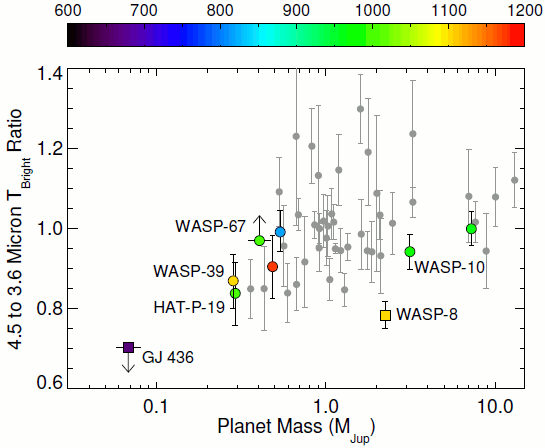
The point of looking at cooler planets is that the ratio of the light in two Spitzer pass-bands, 3.6 and 4.5 microns, is expected to depend on the metallicity (the abundance of elements heavier than hydrogen and helium) of the planet’s atmosphere.

The authors found a tentative but possible relation between that ratio and the mass of the planet.

kammer

The plot shows the brightness ratio in the two pass-bands against planet mass. The named planets are also colour-coded by the planet’s temperature (where the top bar shows the scale in Kelvin). There is a possible trend to a higher ratio at higher masses (WASP-8b is a clear outlier to the trend, and the authors suggest that this might be because it is in a highly eccentric orbit).

Kammer et al say that “If this trend can be confirmed, it would suggest that the shape of these planets’ emission spectra depends primarily on their masses, consistent with the hypothesis that lower-mass planets are more likely to have metal-rich atmospheres.”