
Monthly Archives: June 2015

NASA’s Hubble Telescope Detects ‘Sunscreen’ Layer on WASP-33b

NASA have put out a press release about Hubble Space Telescope observations of WASP-33b.

WASP-33b is the hottest of the WASP planets, being the only one so far found orbiting a very hot A-type star. A team led by Korey Haynes from NASA’s Goddard Space Flight Center, have used Hubble to show that WASP-33b has a “stratosphere”. The spectrum in the infra-red is best explained by a temperature inversion caused by the presence of Titanium Oxide in the atmosphere.

Titanium Oxide is noted for its ability to absorb light, which is why it is often used in sunscreen lotion. NASA’s graphic shows how an absorbing layer in the atmosphere produces a “temperature inversion” with a hotter layer higher up:

WASP-33b stratosphere

WASP-33b’s stratosphere was detected by measuring the drop in light as the planet passed behind its star (top). Temperatures in the low stratosphere rise because of molecules absorbing radiation from the star (right). Without a stratosphere, temperatures would cool down at higher altitudes (left). [Image: NASA/GSFC]

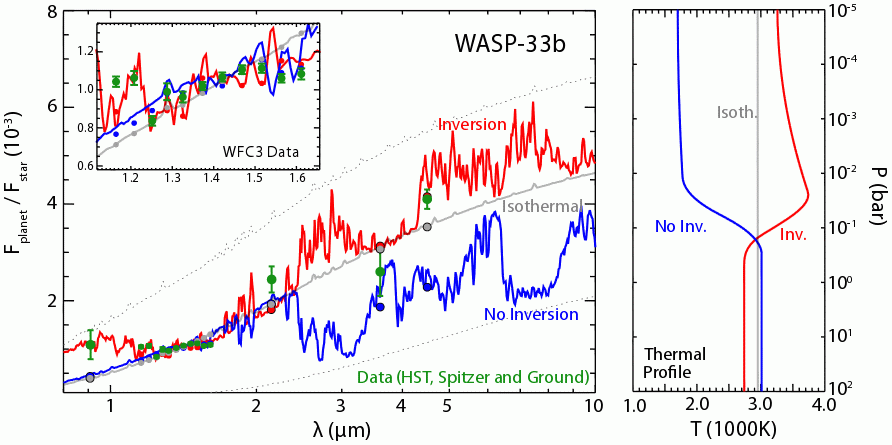
By comparing models with and without a temperature inversion to the spectrum of WASP-33b, as observed with Hubble’s WFC3 instrument, Haynes et al “make a very convincing case that we have detected a stratosphere on an exoplanet”.
Spectrum of stratosphere in WASP-33b

The figure shows the spectrum of WASP-33b (left) and the temperature profile of the atmosphere (right), both for models with a temperature inversion (red) and without an inversion (blue). (From Haynes et al 2015)

The work has been reported widely, in over 100 news and science websites, such as by SciTechDaily, Pioneer News, The Daily Mail, and NY City Today.

15-yr-old work-experience schoolboy discovers a new planet

Press release:

A 15-yr-old schoolboy has discovered a new planet orbiting a star 1000 light years away in our galaxy. Tom Wagg was doing work-experience at Keele University when he spotted the planet by finding a tiny dip in the light of a star as a planet passed in front of it.

“I’m hugely excited to have found a new planet, and I’m very impressed that we can find them so far away”, says Tom, now aged 17. It has taken two years of further observations to prove that Tom’s discovery really is a planet.

Tom found the planet by looking at data collected by the WASP project, which surveys the night skies monitoring millions of stars to look for the tell-tale tiny dips (transits) caused by planets passing in front of their host star.

Tom’s planet has been given the catalogue number WASP-142b, being the 142nd discovery by the WASP collaboration. It is in the Southern constellation of Hydra. While astronomers worldwide have now found over 1000 extra-solar planets, Tom is possibly the youngest ever to have done so.

“The WASP software was impressive, enabling me to search through hundreds of different stars, looking for ones that have a planet”, says Tom. The planet is the same size as Jupiter, but orbits its star in only 2 days. With such a short orbital period the transits occur frequently, making such planets much easier to find.

While the planet is much too far away to see directly, an artist’s impression shows how it might look. The hemisphere facing the star is hot, blasted by the irradiation from the star, while the other hemisphere is much cooler.

Tom Wagg at Keele Observatory 3.

Tom Wagg at Keele Observatory    (Click for high-res version; 3MB)

Tom, a pupil at Newcastle-under-Lyme School who has always been keen on science, asked for the work-experience week after learning that Keele University had a research group studying extra-solar planets.

“Tom is keen to learn about science, so it was easy to train him to look for planets”, says Professor Coel Hellier, who leads the WASP project at Keele. Tom has since achieved 12 GCSEs, all at A*, and wants to study physics at university.

The planet is one of a class of “hot Jupiter” planets, which — unlike the planets in our own Solar System — have very tight orbits close to their stars. They are thought to have migrated inwards through interactions with another planet. Thus it is likely that Tom’s planet is not the only planet orbiting that star.

Artist's impression of Tom's planet, WASP-142b, orbiting its star, WASP-142. The  planet is depicted as seen from a hypothetical moon. A second, dimmer star is seen in the background. Being 1000 light years away, the planet is too distant to  obtain a direct image.

An artist’s impression of the planet WASP-142b, depicted as seen from a hypothetical moon.
(Credit: David A. Hardy. http://www.astroart.org/)    Click for high-res version (1.5MB)

For more information email waspplanets@gmail.com

Updates: Coverage on about 300 news websites worldwide, including: BBC News, ITV News, CNN, TIME, Salon, Yahoo News, The Huffington Post, The Washington Post, Toronto Star, The Telegraph, The Guardian, The Independent, Der Spiegel, News Deutschland, India Today, IOL South Africa, France, Chile, Australia, Mexico, China, and Russia.

[Err, Wow!, successful press release! Now on about 650 news websites worldwide, about 205 in English, 59 in German, 48 in Spanish, 106 in Russian, 30 in Chinese, 23 in French, 20 in Italian, 40 in Turkish, 26 in Portuguese, 23 in Indonesian, 14 in Greek, 12 in Bulgarian, 11 in Hungarian, 8 in Polish, 4 in Slovakian, and others including Tamil, Vietnamese, Thai and Malayalam!]

WASP-121b: another planet close to tidal destruction

WASP is particularly good at finding hot-Jupiter planets in ultra-short orbits of order 1 day, since such planets produce lots and lots of transits. WASP-121b is the latest WASP-South discovery, with an orbital period of only 1.2 days and a bloated radius of 1.9 Jupiter-radii.

Being so large and so near to its host star, the planet is close to being destroyed by tidal forces. Indeed, tides will be causing the planet’s orbit to decay, and the planet will be spiralling inwards to destruction on a time-scale of maybe only a few million years, short by astrophysical standards.

The planet is also orbiting a hot F-type star, with a surface temperature of 6500 K. This means that the side of the planet facing the star will be among the most irradiated known. This raises the possibility to detecting the heat of the planet, by watching for the occultation when it passes behind its star, half an orbit away from the transit.

Delr01

Laetitia Delrez, of the University of Liège, who leads the WASP-121b discovery paper, has used the TRAPPIST robotic telescope to look for the occultation. On seven occasions the TRAPPIST team observed the star over the expected phases, using a far-red z’-band filter to increase sensitivity to thermal radiation. They then added the lightcurves together:

WASP-121b occultation

And there it is, a dip of only 6 parts in 10,000, an impressive detection for a small 0.60-m telescope, but revealing the heat of the planet and showing that it is heated to 2400 K by the stellar irradiation.

The ready detectibility of the planet’s occultation, coupled with the fact that the host star is relatively bright star at V = 10.4, mean that WASP-121b will be a prime target for studying the make-up of its atmosphere.