
Monthly Archives: July 2014

WASP planets will get names in a public vote

Written by Tom Wagg

WASP planets, like all exoplanets, get catalogue numbers but, so far, have not been actually named. The International Astronomical Union policy is now about to change, with the announcement of a contest in which astronomy clubs and non-profit organisations can submit names for exoplanets.

The worldwide public will then be able to vote on their favourite name for an exoplanet and the winning names will be officially sanctioned by the IAU.

IAU

Among the 305 exoplanets which have been selected for the first round of naming are 10 of the earliest discovered WASP exoplanets. These include WASP-12b, which has recently been found to contain water, and WASP-10b, which is thought to have a massive outer companion.

The host stars of WASP-7b and WASP-14b are both bright enough to be visible in a pair of binoculars, one in the Northern Hemisphere and the other in the Southern Hemisphere, which means that it will be possible to name a WASP planetary system that you can readily point to at a star party.

Members of the public can propose names for just one exoplanet, or for a whole planetary system such as 55 Cancri which includes five exoplanets.

Once the naming process is over we will post the new names of our WASP planets and the creators of these names on this blog. To get involved simply follow this link and submit your proposed exoplanet names for your chance to be credited with naming your own exoplanet!

The grazing transit of WASP-67b

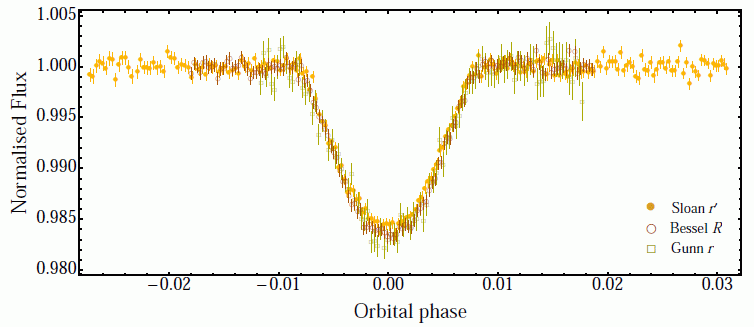
The hot-Jupiter exoplanet WASP-67b is a curiosity, being the only known exoplanet with a grazing transit, such that not all of the planet transits the host-star’s disc. This means that the characteristic “second contact” and “third contact” points are missing from the transit lightcurves. These are the points where, usually, the whole planet is now in front of the star, and the transit is then flat-bottomed, apart from the relatively small effects of stellar “limb darkening”.

The four "contact" points of a planetary transit, illustrated for Mercury transiting our Sun.

The four “contact” points of a planetary transit, illustrated for Mercury transiting our Sun.

In WASP-67b’s grazing transit the planet is never completely in transit and thus the transit lightcurve has a continuously varying V shape. The grazing nature of WASP-67b was confirmed by a detailed study of new transit lightcurves by Mancini et al (2014), who used the GROND instrument on ESO’s 2.2-m telescope at the La Silla observatory.

The transit of WASP-67b from Mancini et al. (2014)

The transit of WASP-67b from Mancini et al. (2014)

The lack of second and third contact makes the system parameters hard to tie down, and thus obtaining a secure estimate of the planet’s radius and density requires Mancini et al’s high-quality lightcurves. WASP-67 is also notable for being in one of the target fields of the revamped Kepler spacecraft’s K2 mission, and thus we can expect ongoing detailed study of this system.