Monthly Archives: October 2017

Hot Jupiter irradiation and the efficiency of heat recirculation

Here’s an interesting plot from a new paper by Michael Zhang et al.

The x-axis is the irradiation temperature for a sample of hot-Jupiter exoplanets; that is, how blasted the day-side of their atmosphere is by irradiation from the host star. This depends on the temperature of the star, its size, and the closeness of the orbit.

The heat of the day side of the planet is then transported to the night side by winds (the planets are phase-locked, so the same side always faces the star). The efficiency of this re-circulation of heat then determines whether the hottest regions of the planet are directly facing the star, or whether they are offset by some angle. This angle can by measured by looking at the “phase curve” radiation in the infra-red.

The y-axis then shows the observed offset angle as a function of the irradiation. The plot shows that the offset angle appears to be highest for cooler planets, and then decreases as irradiation increases, but then perhaps increases again for the very hottest planets such as WASP-33b.

There is, however, also a lot of scatter in the plot. The authors speculate that this might result from differing metallicities of the planets, which affects how well they form clouds, which can then determine the albedo of the planet, and thus how much irradiation is simply reflected.
Outer-orbiting companions of hot-Jupiter planets appear to be co-planar

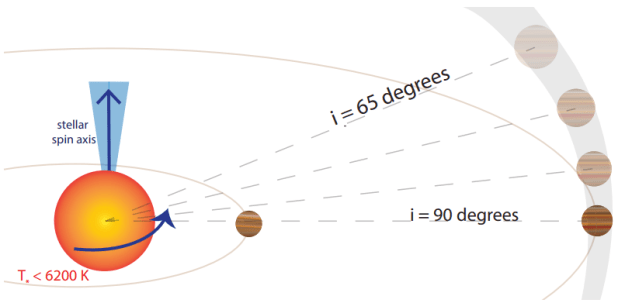
On-going radial-velocity monitoring of WASP hot Jupiters has shown that some of them have companions, additional Jupiter-mass planets in much wider orbits.

This might be part of the answer as to why there are hot Jupiters at all. Standard planet-formation theory suggests that they must form much further out, where it is colder and where ice can form, enabling bits of pre-planetary debris to clump together. Thus one solution is that gravitational perturbations by third bodies (wide-orbit massive planets or companion stars) push the inner planets into highly eccentric orbits, where tidal capture then circularises them into hot-Jupiter orbits.

But, if this “Kozai effect” is to work, the outer planets need to be in orbits tilted with respect to the orbits of the hot Jupiters. This requires i < 65 degrees, rather than the co-planar i = 90 degrees.

A new paper by Juliette Becker et al reports an analysis of six hot-Jupiter systems orbiting cool stars that have an outer planetary companion. These are WASP-22, WASP-41, WASP-47, WASP-53, HAT-P-4 and HAT-P-13. Though a statistical analysis they show that the outer planets are most likely co-planar, with orbits tilted by no more than 20 degrees. They thus argue that Kozai-driven high-eccentricity migration is not the dominant way of forming hot Jupiters.

Precise masses for the WASP-47 exoplanetary system

In the discovery paper the exoplanet WASP-47b was introduced to the world with the description: “With an orbital period of 4.16 d, a mass of 1.14 MJup and a radius of 1.15 RJup, WASP-47b is an entirely typical hot Jupiter”.

And it did appear to be entirely typical until Juliette Becker et al looked at K2 lightcurves and found two more planets, a super-Earth orbiting inside the hot Jupiter (WASP-47e in a 0.79-d orbit) and a Neptune orbiting just outside it (WASP-47d in a 9-d orbit). Around the same time Neveu-VanMalle et al announced long-term monitoring showing another Jupiter-mass planet (WASP-47c), this one in a much wider orbit of 580 days. Thus WASP-47 was shown to host a whole exoplanetary system, one that is so-far unique.

Since then WASP-47 has been observed intensively in order to measure the planet masses and investigate the dynamics of the exoplanetary system. The state of play is now reported by Andrew Vanderburg et al. The planets’ host star is tugged around by the gravitational pull of the orbiting planets, leading to the following cyclical variations in the observed radial velocities:

Combining all the information, Vanderburg et al deduce that the innermost “super-Earth”, WASP-47e, is not dense enough to be made only of rock. Instead it likely has a liquid or gaseous envelope (possibly water or steam) surrounding an Earth-like core. That is unlike other ultra-short-period super-Earths which appear to be fully rocky.

From modelling the dynamical history of the system Vanderburg et al also deduce that the outermost planet, WASP-47c, is likely in an orbit that is in the same plane as those of the inner planets. If this were not the case then the system would not be stable. Thus they conclude that the likelihood that WASP-47c also transits its star, as seen from Earth, is relatively high, which should motivate a campaign to look for those transits.